

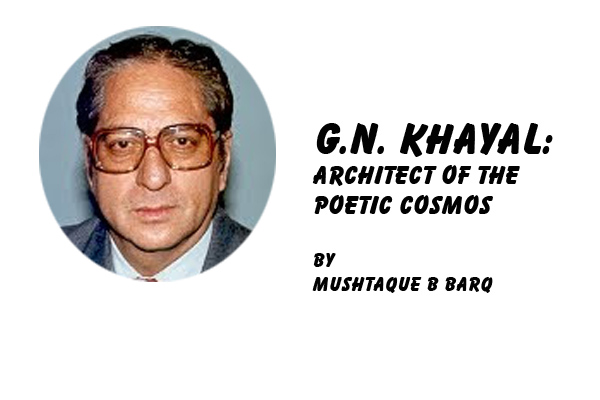
Mushtaque B Barq
Introducing a poet is like pushing open the wide gate of literature. One of the genuine abilities that every poet possesses is the mastery of language; their alchemy assists in shaping words and expressions. This capability engages a poet in exploring human agony, suffering, romance, pleasure, and unaddressed human desires, finding a place for these sentiments within their verses that, in reciprocation, makes them eternal. They live when rest is silent. Their influence lasts for generations to come because their verses carry a golden thread that connects them with generations they may have hardly thought of addressing. Thus, they not only create a pulsating history but also provide stimulation for others to carry the torch of verse ahead. The landscape that their widespread expressions draw mesmerizes the reader, and in this way, a poet secures a timeless place, living on through the ages. G N Khayal was one of the few writers whose pen consistently transcended the boundaries of various writing genres. His translations, poems, essays, reports, and various other forms bear testimony to his artistic excellence and the merit of his expressions. It might appear as merely a sentence to align these diverse literary creations, but the truth is, translation and poetry, as well as the crafting of essays and journalistic pieces, stand at different poles along the same river. When such a wide array of forms is designed and composed on the same desk, one can genuinely sketch the cosmos of G N Khayal’s literary cosmos.
G N Khayal’s poetic growth is gradual, akin to that of poets worldwide. His verses are abundant with rainbow colours and crimson romance, reflective of his youthful days. His canvas is replete with human desires that he adorns by seeking refuge in poetry. One cannot forget the first section of ‘Shabnum Ka Aatish Kadah,’ which is passionately filled with romance, coinciding with the heart-throbbing beauty of Kashmir. The scenic beauty and youthful grandeur of his inner valley find a match in his verses. The other section sketches human agony, unending worries, and social and inner unrest. A poet is defined by what he lives for, where he resides, and how he lives; thus, he carries the entire globe along with him on his journey, forming a link between the past and the future by seamlessly connecting it with the present. In this way, he portrays his cosmos based on his observations.
Let us analyse the poem ‘Chandni’ (Moonlight)
A cry rang out from a house in the street of Mohalla
News has it: a daughter from the house has been taken away
She was young, bore the name ‘Chandni’, her visage was akin to moonlight
And for his brother, ‘the sun’ the heaven fractured
He was an apple of her eye and resided deep in his soul
Quietly, without disclosing his intensions, he set to seek her
When in following night ‘Chandni’ reappeared in the vicinity
Locked were her lips, her eyes shrank and dishevelled hair
With her body battered and her steps faltering
The entire area was in a strange state, a pain and pleasure
Someone rejoiced at her return, rest were unwilling to welcome her
Oh Lord! Forgive the turpitudes of agitators
Oh Lord! Mend the torn hems all
As the ‘Chandni’ graced the vicinity again, the entire night gleamed
But alas! ‘The sun’ never bestowed upon us again.
The subtle use of symbols elevates this poem to a unique dimension. ‘Chandni,’ the sufferer, becomes a casualty of aggression; subjected to torment that erodes her identity and individuality. In regions where conflict emerges like a dawn and dissipates like a capricious cloud film, ‘Chandni’ embodies the pinnacle of physical, mental, and psychological trauma—a weight she carries throughout her life, akin to unsightly blemishes tarnishing the once pristine surface of the moon. Poet Khayal ingeniously disrupts the natural order, bringing the moon down to Earth and compelling it to bear the weight of human suffering. This topsy-turvy portrayal of a celestial phenomenon serves as a poignant metaphor for the anguish endured by the victims of power. Khayal, with audacious perspective, opens the gates of his perceptions, presenting the world with the moon on Earth and the lamentations that replace it, stretching to touch the horizons. The meticulously crafted scene of agony not only unveils the suffering of ‘Chandni’ but also reflects the poet’s own anguish, intimately intertwined with the nearby area he calls home.
The suffering portrayed in the poem is multi-dimensional: for ‘Chandni,’ it is deeply personal, while for the brother, ‘the sun,’ it takes on a universal significance. GN Khayal, as a poet, successfully conveys the agony of the brother, forming the tragic essence of the poem. Comparable to a serious short story, the poem follows a linear form, unfolding like a well-crafted plot. The unbearable pain experienced by ‘the sun’ is mentioned briefly, recognizing the inadequacy of words to convey such intense suffering. In such moments, poets like Khayal, akin to other great literary figures, invite readers to feel the experience rather than merely describing it through the veil of imagery. Khayal’s voice is sharp and piercing; his images in the poem delicately shift from the visual to the organic. The unrest of ‘the sun’ carries universal appeal, impacting the broader world. The eclipse of agony faced by ‘the sun’ not only consigns the regular and punctual sun to oblivion somewhere in the abyss of the underworld but also silently imparts a message that earthly troubles can cast shadows even on the blazing sun above the azure sky. The ugly spots on the moon and the blazing torment of the sun are wonderfully used as contrasts to balance the beam of the poem. To maintain such equilibrium, Khayal must be given a due share.
The relation between two heavenly objects has been descried in human emotions is yet another striking feature of the poem. Although the two celestial objects that we have been watching moving and shining over our heads in the poem are personified as human beings.
He was an apple of her eye and resided deep in his soul
Quietly, without disclosing his intensions, he set to seek her.
The relationship between the two is akin to that of a brother and a sister. The moon, always in tow of her brother ‘the sun,’ and the brother, who unfailingly guides his sister when she ventures to the other side of the world, greets her every morning and cradles her in comfort until dusk. This unbreakable cycle is abruptly shattered when, unfortunately, a hand reveals the sanctity of it all. The brother’s heart, once a terrific hearth now reduced to ashes, compels him to conceal his burn marks. The sensitivity and gravity of this relationship can only be truly felt, and Khayal has brought this unbearable pain to Earth, challenging the celestial world to translate human suffering beyond the realms of illusions, mirages, and ambiguities.
The entire area was in a strange state, a pain and pleasure
Someone rejoiced at her return, rest were unwilling to welcome her.
This unforgettable episode has other implications, which G. N. Khayal has highlighted while keeping the social stigma into consideration. The mixed response of the people is a diamond cut in the mirror, displaying our hypocrisies. The return of ‘Chandni’ has exposed the very core of our social fiber as the choices are divided like our faiths and formalities. The lack of ‘inclusiveness’ has disturbed the poet to the extent that he has himself being drowned in the current of it as ‘mixed approach’ is what all he has experienced, and as a poet, he has dared to register that ‘rest were unwilling to welcome her’ which surely exposes the pigeonhole philosophy of ‘exclusive’ school of thought.
The architecture of the poem is admirable. Additionally, it has lifted the texture of the tragic event to a satirical note, so this poem is a complete scan of society. The theme of the poem has further intensified the event to let the human agony be felt above the skyline, and G. N. Khayal has wonderfully justified the relationship, the unaddressed cries of a conflict zone, and above all, he has kept his verses cascading like tears to drench every hem.
As the ‘Chandni’ graced the vicinity again, the entire night gleamed
But alas! ‘The sun’ never bestowed upon us again.
Mushtaq B.Barq is a Columnist, Poet and Fiction Writer. He is the author of “Feeble prisoner, “ Wings of Love” and many translation works are credited to the author like “ Verses Of Wahab