

Kashmir Pen News Desk
Srinagar, January 6:
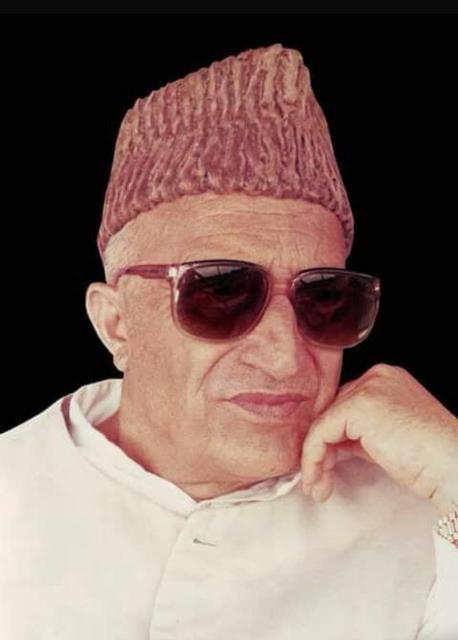
The 17th death anniversary of former Chief Minister of Jammu and Kashmir and Founder President of the Jammu and Kashmir Awami National Conference (ANC), Late Khawaja Ghulam Mohammad Shah, is being observed today with reverence and remembrance across the Valley. A congregational Fateh Khawani will be held at the Mazar of the late leader at Chattabal, Srinagar, followed by a commemorative function at the party headquarters .

Born on July 20, 1920, at Chattabal, Srinagar, Khawaja Ghulam Mohammad Shah—popularly known as G.M. Shah (Buchh)—was a towering political figure who played a decisive role in shaping Jammu and Kashmir’s political and administrative landscape for over five decades. A close associate and trusted lieutenant of Sher-e-Kashmir Sheikh Mohammad Abdullah, Shah Sahib was both a witness to and participant in Kashmir’s most turbulent political phases .

He entered politics at young age, joining the Muslim Conference in 1935 as Captain of Young Volunteers at just 13. A law graduate from Aligarh Muslim University, he later earned a fellowship under a United Nations programme from the London School of Economics. In 1948, he married Begum Khalida Abdullah, the eldest daughter of Sheikh Mohammad Abdullah .

Shah Sahib proved his administrative competence early, serving as Controller of Supplies (1947–1953) during Sheikh Abdullah’s emergency administration. He was arrested alongside his leader during the August 9, 1953 coup, a watershed moment when democratic institutions in Kashmir were dismantled .

A practising Muslim with a firm belief in secularism, democracy and equality, G.M. Shah spent nearly 15 years in prison and detention during his lifelong struggle for the dignity and rights of the people. He later served as General Secretary of the Jammu and Kashmir Plebiscite Front, demonstrating exceptional organisational strength under severe political repression .

Between 1975 and 1982, Shah Sahib held several crucial portfolios in Sheikh Abdullah’s government, including Food and Supplies, Transport, Works and Power, earning a reputation as one of the most efficient cabinet ministers of his time. His tenure was marked by landmark developmental works across the State .

Serving as Chief Minister from 1984 to 1986, G.M. Shah’s tenure is widely regarded as one of the golden phases in J&K’s administrative history. A firm believer in Kashmiriyat, he ensured that no blood was shed on the streets of Kashmir during his rule. He chose to relinquish power rather than compromise the constitutional rights of the State or govern at the dictates of New Delhi—an act remembered as a defining moment of political integrity .

Among his lasting contributions were the completion of major projects envisioned by Sheikh Abdullah, including SKIMS Soura, LD Hospital Srinagar, Sher-e-Kashmir Convention Complex, High Court and Assembly Complex Srinagar, Srinagar–Jammu Highway bypasses, New Tawi Bridge, Foreshore Road, sports complexes, irrigation projects, residential colonies, and the conceptualisation of micro and mini hydel projects .

As Chief Minister, he regularised the services of 42,000 daily wagers, provided employment to 20,000 educated youth, initiated the 700 MW Uri Hydel Project, modernised road infrastructure, expanded educational institutions, strengthened irrigation facilities, and took several pro-people welfare measures benefiting artisans, farmers, students and workers .

To reinforce the secular ethos of governance, Shah Sahib facilitated the establishment of both a Masjid and a Mandir in the Civil Secretariats of Jammu and Srinagar and at the Bagh-i-Bahu Fort in Jammu .

He also proposed the concept of an Intra–Jammu and Kashmir Conference for peaceful resolution of the Kashmir issue, presenting it to former Indian Prime Minister Atal Bihari Vajpayee and former Pakistan President Pervez Musharraf, advocating a five-region dialogue involving Jammu, Srinagar, Ladakh, Muzaffarabad and Gilgit-Baltistan .
On the occasion, the Awami National Conference, under the leadership of Begum Khalida Shah, reiterated its commitment to uphold the legacy of Late G.M. Shah by continuing the struggle for restoration of constitutional rights, dignity and peace in Jammu and Kashmir. The party called for unity beyond regional, religious and political divisions to safeguard the cultural and constitutional fabric of the region .
Remembered as a statesman of integrity, courage and moral conviction, Late Khawaja Ghulam Mohammad Shah continues to inspire generations through his life of sacrifice, service and steadfast commitment to democratic values.
“Zindagi Mein Tu Raha Bandha Nawaz,
Gamgusar, Mehrban wa Charasaaz.”
This remembrance stands as a lasting tribute to one of Jammu and Kashmir’s most principled and visionary leaders .
