
HOW does one describe a year of a pandemic? Will it be remembered for the virus that swept the globe? It most certainly will be as it will for the phrases and words we were introduced to, from ‘lockdown’ to ‘self-isolation’ to ‘quarantine’. This was the year a face mask transformed from a skin treatment to a sort of covering that became as mandatory as a handkerchief once was. The mask, this year, reflected, our awareness and civility. The better part of the year was spent dealing with the COVID outbreak that affected over 1.19 lakh people and claimed nearly 1900 lives.
REVISED MEDIA POLICY
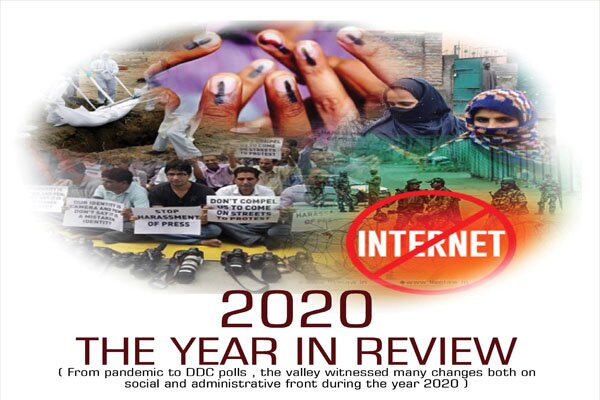
Complaints of “harassment” and “intimidation” by journalists followed during the course of the year as reporting from the region has been increasingly becoming difficult since India’s Hindu nationalist government introduced the Revised Media Policy following scrapping of the Article 370 of India’s constitution that granted the disputed region a measure of autonomy.
The new media policy authorises government officers to decide on what is “fake news” and “anti-nationalism” – a step that media personnel say could be misused by authorities in the disputed region, where anti-India sentiments run high.
LONGEST INTERNET CLAMPDOWN
Since last August, the Himalayan region of 12 million was put under months-long strict internet shutdown – longest by a democracy – and security crackdown that created hardships for the journalists, who were forced to use a government-sponsored media centre with extremely limited resources. In many cases, journalists had to smuggle out content in pen drives by air to their offices in the capital, New Delhi. ‘Punished for speaking the truth’
Since late last year, several local journalists have been summoned by police or investigating agencies for doing their professional duty.
High-speed internet on mobile devices remained suspended in most parts of Jammu and Kashmir even after the passage of 16 months since the abrogation of Article 370 as the administration still feels that allowing the service poses a threat to the sovereignty and integrity of India.
MAJOR CHANGES IN ADMINISTRATION
On the administration front, BJP leader Manoj Sinha replaced Girish Chander Murmu as the Lieutenant Governor of Jammu and Kashmir amid rumours of a rift between the latter and Chief Secretary of the Union Territory B V R Subrahmanyam.
DDC POLLS
But the successful conduct of the DDC elections was the highlight of 2020.
Maiden District Development Council (DDC) elections in the far end of 2020 marked a resumption of political activity in Jammu and Kashmir after abrogation of special status and reorganisation of the erstwhile state last year.
The year 2020 began amid uncertainty as most of the mainstream political leaders continued to be under various forms of detention following the landmark constitutional amendments of 2019.
While some leaders were released in the first two months of the year — purportedly after signing a bond not to speak against the abrogation of Article 370 — the outbreak of the coronavirus pandemic hastened the release of many others, including Farooq Abdullah and Omar Abdullah, in March.
However, PDP president Mehbooba Mufti remained in incarceration for the longest period — 14 months — and was released only in October, just ahead of the DDC polls. However, within hours of the final results being declared, opposition parties charged the Union Territory administration of luring independents to support the BJP or its proxies.
Seven mainstream political parties — NC, PDP, People’s Conference, Awami National Conference, People’s Movement, CPM and CPI — cobbled an alliance under the name of People’s Alliance for Gupkar Declaration (PAGD) with Farooq Abdullah as its head.
The main purpose of forming the alliance was to strive for the restoration of the special status of Jammu and Kashmir.
Even before the alliance could take baby steps, the DDC elections were announced and the PAGD was expected to boycott.
But the alliance took the electoral plunge as a grouping.
The results were along the expected lines with minor surprises here and there.
The PAGD bagged 110 seats.
Kashmir predominantly voted for the PAGD candidates with BJP bagging three of the 140 seats, while the Apni Party of Altaf Bukhari winning a few others.
However, the three wins for the BJP were a massive shot in the arm for the saffron party as it marked its first victory in any election where the National Conference and the PDP were also taking part.
On the other hand, Hindu-dominated districts in the Jammu region and Doda district gave a resounding mandate to the BJP.
In fact, 63 of the 75 seats won by the BJP came from the six districts of Jammu, Kathua, Samba, Udhampur, Reasi and Doda.
However, the BJP faced a blank in Poonch and managed just three seats each in Rajouri, Kishtwar and Ramban districts — a performance below par compared to the 2014 assembly elections.
“The administration has now taken on the responsibility of trying to collect independent candidates for the BJP and its recently-formed subsidiary,” NC leader Omar Abdullah said.
“It seems that the government does not have enough to do and has branched out into this line of work as well,” he said about the “wooing” of Independent DDC members.
Independents emerged as the third-largest entity in the DDC polls, bagging 50 seats.
The BJP with 75 seats and the NC with 67 were the top two parties.
“There are some disturbing reports about interference in democracy, in people’s verdict, wherein the government of the day is acting in a partisan manner. Facilitating moves by some people to attract independents towards them,” PAGD spokesman and People’s Conference chairman Sajad Lone said.
He said the government should desist from humiliating the “great verdict” of the people of Jammu and Kashmir.
“History is replete with examples that those who tried to humiliate the verdict of the people ended up with a disaster,” he added.
While DDC elections in the rest of the country have become a norm for a long time now, the residents of Jammu and Kashmir had their first experience of directly electing district-level councils.
However, the process of the election — mainly campaigning — was marred by allegations of favouritism towards the BJP and its allies while the opposition parties’ leaders were prevented from campaigning.
The sudden announcement of the DDC elections in the newly-carved Union Territory caught most of the regional parties off-guard.
The NC and the People’s Democratic Party (PDP) did not take part in the panchayat elections in 2018 due to apprehensions that the BJP-led government at the Centre was planning to tinker with the special status of Jammu and Kashmir.
The result of the boycott was that the BJP, for the first time, won any kind of election in the valley.
Anti-corruption agencies intensified probes against mainstream political leaders as Farooq Abdullah had properties worth Rs 11.86 crore attached by the Enforcement Directorate in connection with the JK Cricket Association scam, while youth PDP leader Waheed Para went behind bars for alleged links with militants.
It will also be remembered as the year when the shift in the balance of power became a little more obvious as the United States struggled (and failed) to control the virus compared to Southeast Asia, especially China. Indeed, the debate over the shifting sands of power will only become louder in the coming months and years. Or will it be remembered as the year of science in which a vaccine was developed and rolled out within months to provide hope as the year came to an end?
ADVERTISEMENT
2020
THE YEAR IN REVIEW
ADVERTISEMENT


Leave Comment

ADVERTISEMENT