

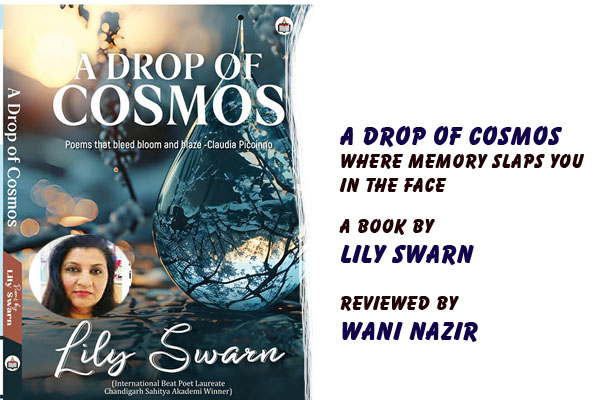
Lily Swarn is not writing poetry; she is, more or less, exhaling it. The poems don’t merely lie there, gazing beautiful; they rush, throb, and at times smack you in the gut. Each stanza is almost like there’s a big, messy orchestra behind it — you’re slogging through grief over here, then all of the sudden you’re lifted by hope and then, whoa, you’re back in the slush of loss yet again. Swarn’s gift for infusing life into every line, squeezing out every ounce of feeling until you’re blinking and a little out of breath is worth learning. Her language is soiled with ache and beauty, sewing a wild patchwork of what it means to be human.
But she drags you right into the tangled morass of memory and loss right out the gate — no warning, no sideways intro. Even in her own words, she appears bruised by the sense of what she’s lost:
Words formed into repulsive shapes
Lopsided squiggles with throttled viruses
Of startling deaths of dear friends
No showing off — each poem is more like a bloodletting. She refers to her lines as “condensed drops of blood sometimes,” and, really, yeah. This is not poetry for pleasure or decoration; it’s survival. She’s burning how she feels on the page with a hot iron — and you can smell the singe.
It’s already wild, the scope of Swarn — one minute she’s in mourning with the entire world, the next she’s hatching down into one tight knot of her own private pain. It’s half ancient mythological, half protective mom, her tone. She’s had too much of it — of the burning pyres, the don’t-give-a-damn world — and she’s not cutting any slack for any of it:
For my eyes saw the pyres of the dead blazing ire
Ire on an unfeeling world
Where those who provide food to the world
Perish on the frozen streets
Broken hearted and struck with woe
But she doesn’t leave you to drown. And suddenly you’re curled up in her childhood home, surrounded by the warmth of old love and flooding nostalgia:
Ancestral homes are like warm hugs
Visiting them was like a dip in an ocean of love…
Relationships were cozy and tight knitted
Her nostalgia isn’t even just a faded photograph — it’s a stack of old newspapers, it’s talking to painted camels on the wall. There’s magic in her remembering:
The air is heavy with nostalgia
It’s the weight of memories piled in the heap of old newspapers
The painting on the wall still knows my secrets
I had shared them often with those camels on canvas
Time is the villain and the hero of her universe. It will ruin you, but it will also put you back together — sort of. Swarn understands this paradox; she more or less resides inside it:
Time that ruins, devastates and scars
Time that caresses, fondles and heals
Time that lets you bounce back again and again!
Her roots? Deep. She reels in the Ganga — death isn’t the end, it’s a cosmic embrace:
The perfect place for embracing death
Is in your benign waters O Ganga
Floating clay dishes with oil lit wicks on your surface
Cupping hands full of your water
Offering prayers And then there’s her fascination with flesh — yes, the one the other stuff is made of. She regards it like some ancient, storybook, full of secrets and scars:
Flesh has a brilliant memory
Elephantine and accurate
It never lies.
Flesh knows
Instinctively Arjunesque!
Chilling so-worst-it-has-to-be-verite moments? One woman carrying her life — her actual life — in a beat-up old swag. It’s uncooked, it’s humanity, it’s heartbreak in one image:
Laboriously she gathered
Her possessions in a
Tattered cloth bundle
Spilling at the seams.
Knitted brow mangled with
Boulders of life hammering
Her aching knees
But you know what’s at the heart of all this? Loving. Not the fluffy, Instagram-filtered kind. The type that has risen from ashes raked through hell, and still blooms:
Why is love synonymous with spring ?
Bahaar ka mausam, the time when lovers unite
After a long winter of discontent
A Drop of Cosmos isn’t a book — it’s an alive, breathing, messy bundle of feelings. Swarn’s writing doesn’t merely invite you to empathize; it has you dragged over the coals of your own memories. Her lines contain pain as if it were a family heirloom, yet there’s light as well —winking through those cracks. She is fragile, ferocious and not at all afraid to reveal her scars. They insist on an amplifier to our feelings, in a world accustomed to flat reduction of all things to sensation.” In the end, Swarn’s poems are a call to: if you’re truly living, you’re feeling — big time. And poetry like this? It’s more than art; it’s sanctuary, rebellion and resurrection writ large.
ABOUT THE REVIEWER
A Kashmir University Gold medalist in English Literature, Wani Nazir from Pulwama J&K India, writes poetry and prose in Urdu, Kashmiri and English. His poetry and prose has been published in a slew of National and International journals of repute. He has been receiving laurels for his beautiful writings. He was awarded with The Nissim Excellence in Writing Award 2018 for Poetry and Criticism, The Kashur Qalam Best Poet Award 2017. He is the author of a collection of poetry, “… And the Silence Whispered”, the collection of poems that has been received well in the literary circles.

