

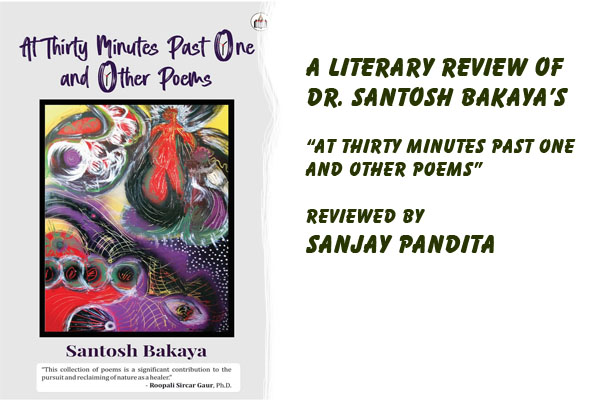
Some poetry books offer you solace, some offer insight, and some hold a mirror to the quiet disquiet we live with. Dr. Santosh Bakaya’s At Thirty Minutes Past One and Other Poems transcends all three. It is a poetic map of the modern soul—a cartography of insomnia, memory, nature, and emotional resurrection. Divided into three thematic sections—“Night Falls,” “Nature Shows the Way,” and finally culminating in “Liberation”—this collection of 62 poems gently but firmly escorts the reader through the creaking corridors of sleepless nights into the vibrant thresholds of morning light. It is not merely a volume of verse; it is an introspective pilgrimage through darkness into dawn.
The title itself—At Thirty Minutes Past One—is no arbitrary timestamp. It is that unsettling hour when sleep has betrayed the body, when silence is so loud it rings in one’s ears, and when shadows begin to move with lives of their own. It is the hour of ghosts—not just those with bedsheet heads and rattling chains, but the quieter, more persistent ones that reside in memory, in longing, in guilt, in suppressed grief. And yet, it is also an hour that precedes the earliest sliver of dawn. It is the hour of suspended time, when thought is unmoored from daily obligation, and imagination is liberated from chronology. Dr. Bakaya reclaims this hour—inhabiting it with surreal metaphors, paradoxical musings, and a tapestry of emotion that refuses to settle into despair.
From the opening poems of the first section, “Night Falls,” the poet is in conversation with insomnia—not as an adversary to be conquered, but as a sentient force to be understood. The night in these poems is not mute; it speaks, sings, groans, and sometimes mocks. It is not a flat backdrop but an active agent, throbbing with phantoms, absurdities, and hyperreal detail. In the poem “Inscrutable,” for instance, the poet sits amid shifting shadows, recalling the invisible wounds inflicted by life. “I watched the play of shadows, recalling the blows life had dealt me,” she writes, and it is in this quiet recollection that the poem draws its power. Memory becomes a sword, and memory also becomes a flickering digital code—ephemeral, but piercing. The scene is both intensely personal and eerily universal. The reader, too, is compelled to look at the wall and recall their own shadows.
One of Dr. Bakaya’s unique poetic abilities is her conjuring of the inanimate as vividly animate. Cupboards become trapdoors to otherworlds; paintings come alive; cats and sheep refuse to play their comforting symbolic roles. The traditional motifs of night—darkness, silence, sleep—are all subverted. Silence is not peaceful; it is “palpable” and even clamorous. Sleep, that once-welcome guest, now evades with perverse consistency. The poet toys with the familiar ritual of counting sheep, yet even these are rendered ineffective. “Counting them doesn’t work. Sleep still evades the night.” This wry observation echoes deeply in a world increasingly afflicted by restlessness—not just physical, but existential.
And yet, this is not poetry of despair. On the contrary, it is poetry of engagement. The poet is not a passive victim of her insomniac affliction; she is a participant, a chronicler, and often, a magician transmuting dread into wonder. Her verbal palette, as aptly described in the foreword by Dr. Roopali Sircar Gaur, is black—but a “shining, reflecting black.” The kind of black that absorbs, refracts, and ultimately, illuminates.
Even the ghosts in this collection are not merely terrifying. They are nuanced—some “friendly,” some “devilish,” all craving attention. There is a psychological realism underpinning their appearance. These ghosts do not wear tattered shrouds; they wear the garments of unresolved questions, childhood fears, and adult regrets. They clamber onto pillows and perch atop memories, lingering not for fright but for understanding. Dr. Bakaya allows them space. She does not exorcise them. She listens to them. And through her, so do we.
But just when the night threatens to engulf, the collection shifts gear. The second section, “Nature Shows the Way,” is an awakening—not just of the outer world, but of the inner eye. Here, nature is not just background—it is balm, philosopher, guide. Trees, clouds, peacocks, and rain are not ornamental—they are characters, participants in the poet’s transformation. This section could well be titled “Poems of Resurrection,” for that is what they enact.
In Wilted Greens, the poet looks through her window and observes clouds “playing hide and seek.” The greens outside—once wilted—now “smile.” But it is not a naive pastoral fantasy. There is tension, a thunderous cloud that “makes me tremble at the brink of despair.” Hope does not arrive easily. It tiptoes in, as two boys fighting in the street suddenly dissolve their conflict into laughter, their guffaws drowning out the thunder. The transformation is subtle yet seismic. “Spellbound, I see hope dancing on the rain-drenched ground.” The poet’s bruised spirit, like the leaves and children outside, is not merely healed; it is renewed.
Nature, in Dr. Bakaya’s poetic landscape, is not static. It is dynamic, capricious, and instructive. It teaches not through maxims but through motion. Clouds don’t preach—they move. Children don’t advise—they play. Trees don’t sermonize—they sway. And yet, through these movements, truths are distilled. In the hands of a lesser poet, such symbolism might collapse into sentimentality. But Dr. Bakaya treads carefully. Her metaphors are fresh, her tone understated, her revelations hard-earned.
The final section of the book, culminating in the poem Liberation, completes the poetic arc. If the first section is a descent into the underworld of sleeplessness, and the second a journey through the healing terrain of nature, then this final part is an ascent—a soaring back into light, clarity, and selfhood. Liberation is a sublime declaration of emancipation—not from others, but from the self’s own imprisonments. “The soothing wind touched her cheeks, like the playful fingers of a first-time lover—shy, bashful, and diffident.” The imagery is sensual but not indulgent. The wind becomes an intimate presence, nature a long-lost confidante. The incarcerated soul is set “Free—Free—Free!” and the poet becomes “one with nature. Nature was she!”
This final merging is not merely poetic; it is metaphysical. It suggests a state of being where boundaries dissolve—between the poet and the peacock, between memory and wind, between the darkness within and the light outside. This moment of transcendence does not come as a grand crescendo. It comes softly, like dawn itself. But once arrived, it lingers—leaving the reader lighter, calmer, and more awake than before.
What also distinguishes At Thirty Minutes Past One is Dr. Bakaya’s consistent lyrical voice. Her diction is both musical and conversational. She weaves in idioms, allusions, and the occasional wink of humour that keeps the tone from becoming overwrought. She “laughs with, not at” the world, as the foreword notes. Even her darkest lines carry the grain of hope, the shimmer of moonlight on a troubled lake. There is an unmistakable compassion in her gaze—toward people, toward animals, and even toward shadows.
Humour flickers throughout the volume—not loud, but wry and affectionate. In her portraits of ghosts, or when describing the pretentiousness of language in daylight (“banal clichés which looked pompous and dignified just a few hours back deflate, and lie helplessly”), she pokes fun with the gentleness of someone who has made peace with absurdity. She knows that the human condition is as laughable as it is tragic—and she allows both truths to exist side by side.
Stylistically, the collection is held together by recurring motifs: the wind, the moon, shadows, children, cats, ghosts, and songs. Especially notable is her subtle use of music—songs once sung, mostly Western, that now haunt the mind like fragments of forgotten lives. These sonic ghosts are cultural relics, half-remembered, half-invented—yet powerfully evocative. They thread the personal to the universal, suggesting that insomnia is not only an individual affliction but a shared cultural condition.
Dr. Bakaya’s work is profoundly relevant in our times, when sleep has become elusive, nature distant, and silence commodified. Mental health crises are rampant, and digital distractions often drown the soft voices within. In such a world, At Thirty Minutes Past One does not merely offer poetry—it offers companionship. It assures us that the night has meaning, that insomnia can yield art, that silence can speak, and that nature still holds the power to restore what urban life has eroded.
In conclusion, At Thirty Minutes Past One and Other Poems is not just a collection—it is a journey. A spiraling inward and an expansion outward. It begins in the belly of the night, where ghosts whisper and shadows mock, and it ends in a sun-drenched clearing, where the soul walks free amid birdsong and breeze. This is poetry that dares to dwell in darkness without succumbing to it. It is not afraid of the night, because it trusts in the dawn.
Dr. Santosh Bakaya, with her erudition, empathy, and unmatched lyrical grace, has gifted us a book that lingers long after the final line. It is a work to be read slowly, revisited often, and carried within—as torchlight, as lullaby, as gentle guide. And if one happens to find themselves awake at thirty minutes past one, restless and searching, these poems will not only keep them company—they may even help them find their way to morning.
ABOUT THE REVIEWER
Sanjay Pandita is a Poet , Literary Critic & Columnist , can be reached at sanjaypanditasp@gmail.com

