

Mushtaq Ul Haq Ahmad
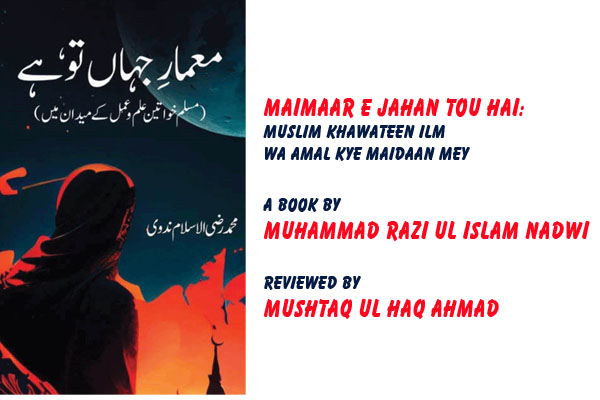
MaiMaar e Jahan Tou Hai: Muslim Khawateen ilm wa amal Kye Maidaan Mey
Author: Muhammad Razi Ul Islam Nadwi
Publisher: Hidayat Publishers & Distributors, New Delhi, India & Al Qalam Publications, Kashmir
Year of Publication: 2023
Pages: 288
Price: Rs 300
ISBN: 9788195276721
This book is a carefully curated collection of the author’s writings, originally composed and shared over time on social media platforms and through the ubiquitous messaging app WhatsApp. What could easily have remained scattered digital fragments is here gathered into a coherent, reflective volume that speaks directly to contemporary Muslim women’s lived realities in South Asia, especially in contexts such as India where religious discourse, gender norms, and state policy intersect in complex ways. The author does not claim to write a systematic treatise; instead, he offers a series of reflections, re‑readings of texts, and pastoral observations that, when read together, form a powerful counter‑narrative to popular misogynist interpretations of Islam.
Nature and structure of the work
The book’s genesis in social‑media and WhatsApp exchanges gives it an intimate, conversational tone, yet the author succeeds in elevating these pieces into a sustained theological and social commentary. Many of the essays read like “halaqas in print”: short, accessible, and rich in references to Qur’an, Hadith, and classical scholarship, but always oriented toward the everyday concerns of Muslim women—marriage, education, work, dress, and religious participation. The lack of a rigid academic structure is in fact one of the book’s strengths: it mirrors the organic way in which questions about women and Islam arise in real life—during family disputes, in school corridors, in WhatsApp forwards, and in mosque corridors.
Re‑reading “deficient in religion and intellect”
One of the issues the book engages with is the reinterpretation of the famous Hadith in which the Prophet ﷺ is reported to have said that women are “deficient in religion and intellect” (naqisātun fī al‑dīn wa al‑‘aql). The author devotes a significant portion of the text to dismantling the misogynist reading that has turned this narration into a blanket condemnation of women’s minds and piety. He argues that the “deficiency” is not intrinsic but functional and legal: it relates to certain juristic rulings (for example, the requirement of two female witnesses in specific financial matters and the suspension of prayer and fasting during menstruation), not to women’s essential worth or cognitive capacity.
Drawing on classical and contemporary scholars, the author shows that the same women who are described as “deficient” in this Hadith are elsewhere celebrated for their deep knowledge, sharp reasoning, and bold questioning of the Prophet ﷺ himself. He cites the example of the “woman of high intelligence” (al‑jazlah) who stood up to debate the Prophet ﷺ, illustrating that “deficient in intellect” cannot mean intellectually inferior in an absolute sense. This nuanced reading allows the author to reclaim the Hadith from patriarchal misuse and to situate it within a broader framework of gender‑sensitive fiqh that distinguishes between legal concessions and ontological judgments.
Hadiths wrongly interpreted as misogynist
The book also takes on a number of other Hadiths that are frequently cited to portray Islam as inherently hostile to women. The author carefully traces how certain phrases have been decontextualized, mistranslated, or selectively emphasized to construct a narrative of female inferiority. For instance, he unpacks the language of “leading men astray” and shows that it is not a condemnation of women’s nature but a warning about the emotional and psychological dynamics that can affect any human being, male or female, when desire overrides reason.
In doing so, the author implicitly challenges the culture of “Hadith‑bashing” that reduces complex narrations to one‑line slogans. Instead, he invites readers to approach Hadith with the same rigor that classical scholars applied: attention to chains of transmission, linguistic nuances, historical context, and the overall Qur’anic worldview. This methodological self‑awareness makes the book not only a corrective to misogyny but also a quiet pedagogical exercise in how to read Hadith responsibly.
Women as narrators, scholars, and teachers
A particularly striking section of the book is devoted to the role of women in the transmission and teaching of religious knowledge. The author emphasizes that there is not a single known case of a woman fabricating or concocting a Hadith, a point that underscores the reliability and trustworthiness of female narrators in the Islamic tradition. He highlights the fact that major male scholars—Imams and jurists—regularly learned from women, including from the Prophet’s own wives, especially ‘Aisha (may Allah be pleased with her), whose vast knowledge of Hadith, fiqh, and Qur’anic exegesis shaped early Islamic scholarship.
The author then contrasts this rich history with the contemporary reality in many Muslim communities, where women are often excluded from formal teaching roles and even from physical access to mosques. He laments the disappearance of the women’s halaqas—circles of learning in which women once taught each other Qur’an, Hadith, and fiqh—and notes that in many places women are now not even allowed to enter the mosque, let alone lead or teach. This historical‑theological argument is not merely academic; it is a pointed critique of the institutionalization of gender segregation that has gone far beyond what the early sources actually prescribe.
Women, mosques, and the voice of women
The book dedicates substantial space to the question of women praying in mosques and the objections raised against it. The author cites the well‑known Hadith in which the Prophet ﷺ says, “Do not prevent the female slaves of Allah from going to the mosques,” and contrasts this with later narrations attributed to ‘Umar ibn al‑Khattab (may Allah be pleased with him) that are sometimes interpreted as banning women from mosques altogether. He argues that the attribution of such a blanket ban to ‘Umar is historically and textually problematic, and that what exists are context‑specific cautionary measures rather than a universal prohibition.
On the issue of women’s voices, the author engages with the debate over whether a woman’s voice is “awrah” (something to be concealed). He rejects the extreme view that women must lower their voices or avoid public speech altogether, pointing out that the Qur’an and Hadith repeatedly depict women speaking openly, asking questions, and even debating with the Prophet ﷺ. Instead of treating the female voice as inherently shameful, he frames it as a medium of knowledge, counsel, and social responsibility, provided it is used with modesty and dignity.
Marriage, family, and counselling
Another major strand of the book deals with marital and family life, especially the problems that arise between husbands and wives. The author stresses that many of these conflicts stem not from inherent incompatibility but from misreading of religious texts, rigid gender roles, and the absence of proper counselling. He advocates for pre‑marital and post‑marital counselling grounded in both Islamic ethics and modern psychology, arguing that marriage is not merely a legal contract but a spiritual and emotional partnership that requires continuous effort and communication.
The author also critiques the popular analogy that compares the husband to the “manager” of the family, as if the household were a corporate enterprise with a clear hierarchy of command. While he acknowledges that Islam assigns the husband a role of responsibility (qiwāmah), he insists that this is a demanding, servant‑leadership role, not a license for domination. He rightly points out that reducing marriage to a managerial model flattens the relational, emotional, and spiritual dimensions of the bond and can easily be abused to justify authoritarian control.
Women’s work, hijab, and education
The book also addresses the social marginalization of Muslim women who are left without meaningful public roles, often told that their only proper sphere is the “four walls of the home.” The author notes the irony that, even as some girls and women pursue higher education and employment, they are still ideologically confined to domesticity, as if their work outside the home were somehow secondary or suspect. He calls for a rethinking of women’s social tasks, arguing that motherhood, housework, and caregiving must be recognized as legitimate forms of labour, while women’s participation in education, scholarship, and the public sphere should be encouraged rather than feared.
On the issue of hijab and the Indian school‑system debates, the author situates the hijab controversy within the broader politics of secularism, nationalism, and religious identity. He distinguishes between hijab (head‑covering) and niqab (face‑covering), acknowledging that there is a legitimate difference of opinion among scholars regarding the latter, while affirming that modesty in dress is a shared Islamic value. Rather than reducing the hijab to a mere symbol of oppression or resistance, he invites readers to see it as part of a larger ethical framework that includes justice, dignity, and the right to education.
Joint versus nuclear family: a balanced view
In a more sociological chapter, the author examines the advantages and disadvantages of joint and nuclear family systems, especially as they affect women. He acknowledges that joint families can provide emotional and financial support, but they can also become sites of surveillance, control, and inter‑generational conflict. Nuclear families, on the other hand, offer greater privacy and autonomy, but may leave women isolated and without extended kinship networks. The author does not prescribe one model over the other; instead, he urges families to reflect on their specific circumstances and to prioritize mutual respect, communication, and shared responsibility.
Absence of discussion on female imamah
One notable limitation of the book is that the author does not engage with the question of female imamah—whether women can lead mixed‑gender congregational prayers. Given the depth of his discussion on women’s roles in mosques, teaching, and public life, this silence is striking. One might have expected at least a brief treatment of the classical positions and contemporary debates on whether women can lead men in prayer, especially in light of the broader argument that women’s religious participation should not be unduly restricted. This omission does not invalidate the book’s overall project, but it leaves a gap in what could have been a more comprehensive exploration of women’s leadership in ritual space.
Style, tone, and audience
The author’s style is accessible yet intellectually serious, combining short, punchy reflections with longer, more analytical pieces. He writes for a lay Muslim audience—especially women and young people—who encounter confusing or oppressive interpretations of Islam in their daily lives. At the same time, his frequent references to Hadith, classical scholars, and contemporary debates make the book useful for students of Islamic studies and for educators who want to equip themselves with gender‑sensitive arguments.
Overall assessment
Taken together, this collection represents a timely and much‑needed intervention in contemporary Muslim discourse on women. By re‑reading Hadiths that have been weaponized against women, by highlighting women’s historical role as narrators and scholars, and by addressing practical issues such as marriage, hijab, and family structure, the author constructs a vision of Islam that is both faithful to the tradition and responsive to modern realities. The book is not without its limitations—its structure is episodic, and it leaves some important questions (such as female imamah) unaddressed—but as a whole it succeeds in challenging misogyny, reclaiming women’s religious agency, and offering a compassionate, balanced perspective on the relationship between Islam and women.
M. H. A. Sikander is Writer-Activist based in Srinagar, Kashmir.
First published in www.newageislam.com
