

AVTAR MOTA
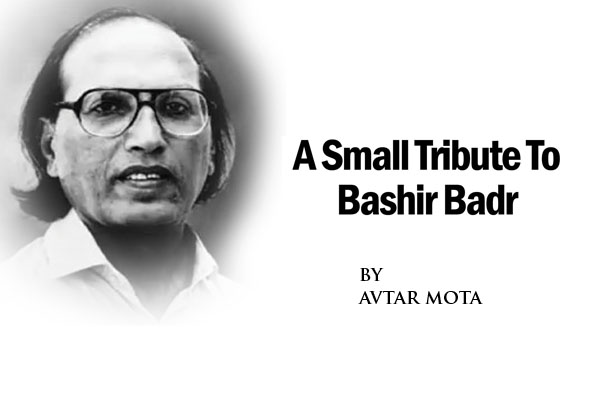
Bashir Badr is no more. He was a poet who did not write poetry from the minarets of abstraction. He wrote it from the dust of courtyards, the ache of bus journeys, the quiet grief of waiting rooms, and the stubborn hope that survives unrequited love. The passing of Bashir Badr marks not merely the departure of a celebrated Urdu poet, but the quiet extinguishing of one of the gentlest lights in the literary consciousness of the Indian subcontinent. Some poets astonish through grandeur, through intellectual complexity, or through the sheer architecture of language. Bashir Badr achieved something far rarer. He entered the emotional bloodstream of ordinary people. His verses travelled without passports through drawing rooms, tea stalls, railway platforms, university corridors, and lonely midnight conversations. He was not a poet confined to anthologies or academic seminars; he was a living presence in memory and speech. His couplets became part of the emotional vocabulary of everyday life.
To speak of Bashir Badr is to speak of intimacy. His poetry never announced itself with the authority of doctrine. It arrived softly, like remembered rain upon an old courtyard, or like the scent of jasmine crossing a summer evening. Indeed, perhaps the most fitting metaphor for his literary presence is fragrance itself. Bashir Badr was a fragrance that wafted freely in the air for all to benefit from. One did not need specialised learning to appreciate him. His poetry belonged equally to the labourer returning home after dusk and to the scholar immersed in literary criticism. Like fragrance, his verse moved invisibly yet unmistakably, entering hearts without ceremony and remaining there long after the moment had passed.

What distinguished him from many contemporaries was his refusal to treat poetry as an exercise in obscurity. Urdu Ghazal tradition, shaped profoundly by Persian aesthetics, has often delighted in elaborate metaphor, ornate diction, and philosophical abstraction. Bashir Badr inherited that tradition yet consciously simplified its language without diminishing its emotional depth. In his hands, the Ghazal shed unnecessary embellishment and returned to human experience. Consider his celebrated line:
“koyi haath bhi na milayega jo gale milogay tapaak se
Ye Naye Mizaj ka shahar hai zara faaslon se mila karo ”
The diction is startlingly plain. There is no rhetorical flourish, no lexical extravagance. Yet within this simplicity lies an entire sociology of modern alienation. The couplet warns against excessive openness in a world increasingly governed by suspicion and emotional distance. Bashir Badr understood that the deepest truths often arrive unclothed. Like the English Romantic poet William Wordsworth, who sought poetry in “the real language of men”, Badr trusted simplicity as an instrument of profundity. Both poets recognised that emotional authenticity possesses greater permanence than decorative sophistication.

Poetry Rooted in Lived Experience
Bashir Badr’s greatness lies not merely in style but in witnessing. His poetry emerges from lived experience rather than literary performance. One senses throughout his work the presence of actual streets, actual separations, and actual evenings endured in silence. He transformed personal memory into collective recognition. When he wrote:
“Ujale apni yaadon ke hamaare saath rehne do,
na jaane kis gali mein zindagi ki shaam ho jaaye”
He articulated not theatrical melancholy but existential vulnerability. The couplet carries the weariness of a man acquainted with uncertainty. Memories become a source of illumination against the approaching dusk of life. There is tenderness here, but also resignation. Bashir Badr never sentimentalised suffering; he dignified it. This quality invites comparison with Philip Larkin, another poet of urban solitude and quiet emotional fracture. Like Larkin, Bashir Badr possessed an extraordinary sensitivity to loneliness embedded within modern life. Yet where Larkin often descended into scepticism and emotional austerity, Badr preserved warmth. Even in disappointment, his poetry retained faith in tenderness. His verse recognised pain without surrendering to bitterness. One of his most haunting couplets captures the paradox of urban proximity and emotional estrangement:
“issi shahr mein kayi saal se meray kuchh kareebi azeez hain,
unhe meri koyi khabar nahi mujhe unka koyi pata nahin”
In these lines, Bashir Badr distilled the metropolitan condition with astonishing economy. Human beings inhabit the same city, perhaps even the same neighbourhoods, yet remain existentially absent from one another’s lives. The tragedy of modern civilisation lies not in physical distance but in emotional disconnection. The couplet recalls the emotional landscapes of T. S. Eliot’s urban poetry, particularly the spiritual isolation depicted in The Love Song of J. Alfred Prufrock. Yet where Eliot’s fragmentation is intellectually dense and symbolically layered, Bashir Badr achieves similar emotional resonance through conversational clarity.
His poetry carried the atmosphere of post-Partition India as well. Though rarely overtly political, his work bears the shadow of displacement, communal fracture, and civilisational anxiety. Bashir Badr belonged to that generation for whom memory itself became a homeland. Yet he refused polemic. Instead, he allowed human feeling to reveal historical wounds indirectly. In this restraint lay his moral strength.
The Democratisation of the Ghazal
One of Bashir Badr’s most enduring contributions was the democratisation of the Urdu Ghazal. He brought the form closer to everyday speech without vulgarising it. He proved that refinement need not depend upon obscurity. His poetry restored accessibility to a literary tradition that sometimes risked becoming insulated within elite cultural circles. This is why his couplets are remembered orally rather than merely textually. People quote Bashir Badr not because they studied him, but because they lived through him. His verses accompany heartbreaks, departures, reconciliations, and solitary evenings. They survive because they are usable truths.
“Dushmani jam kar karo lekin ye gunjaish rahe,
Jab kabhi hum dost ho jayein to sharminda na hon”.
In this remarkable couplet, Bashir Badr transforms a simple reflection on enmity into a profound meditation upon the ethical limits of human conduct. The verse suggests that conflict is an unavoidable condition of existence, yet true wisdom lies not in the intensity of opposition but in preserving the moral possibility of reconciliation. Beneath its conversational simplicity resides a deeply philosophical insight: human relationships are transient, mutable, and never wholly fixed within the categories of friend or foe. By urging restraint even in moments of bitterness, the poet affirms a civilisational ideal in which dignity, memory, and compassion outlast anger itself. The couplet, therefore, becomes not merely advice about social behaviour, but a subtle statement on the impermanence of human divisions and the enduring necessity of grace.
Similarly, moving is the couplet:
“Musafir hain hum bhi musafir ho tum bhi,
Kisi mod par phir mulaqat hogi”
There is remarkable grace in these lines. Life becomes a journey marked by temporary separations and unforeseen reunions. The philosophy is simple yet humane. Bashir Badr’s poetry repeatedly returns to impermanence, but never with despair. Rather, he suggests that transience itself lends beauty to human encounters. In this regard, one might compare him with Thomas Hardy, whose poetry often meditates upon time, separation, and fragile human continuity. Yet Bashir Badr differs in temperament. Hardy’s universe is frequently governed by cosmic indifference, whereas Badr’s retains emotional reciprocity. His poetry whispers consolation even while acknowledging loss.

The Illusion of Proximity: Bashir Badr on Surface-Level Intimacy
The couplet,“Aankhon mein raha dil mein utar kar nahin dekha, Kashti ke musafir ne samandar nahin dekha”, “He remained in the eyes but never descended into the heart; the boat’s traveller never truly saw the ocean” functions as a philosophical indictment of superficial engagement in human relationships. Bashir Badr deploys the maritime metaphor with intellectual precision: the ‘Kashti ka musafir’, though physically situated upon the’ Samandar’, mistakes mere contact for comprehension, content with the visible surface while remaining estranged from the oceanic depths. Psychologically, this mirrors the condition of modern intimacy, wherein individuals may inhabit each other’s immediate perceptual field, the “Aankhon”, or eyes, yet refuse the existential vulnerability required to ‘Dil mein utarna’, to descend into the heart’s uncharted interiors. The couplet thus exposes a central paradox of closeness: proximity without penetration, presence without perception. It suggests that true knowledge of another demands not spatial nearness but ontological immersion, a willingness to abandon the safety of the boat’s deck for the unfathomable abyss beneath. In this sense, Badr critiques the complacency of relational spectatorship, arguing that to love or understand without plumbing the other’s depth is to remain, philosophically and emotionally, a stranger to the very ocean one claims to traverse.
The Smile as Masquerade: Bashir Badr on the Ethics of Concealment
The couplet, “Ye hansi bhi koyi naqaab hai jahaan chaaha hum ne gira liya / Kabhi unka dard chhupa gaye kabhi apna dard chhupa liya” “This smile too is a kind of mask we wore wherever we pleased / Sometimes we hid their pain, sometimes we hid our own” articulates a profound philosophical anthropology of emotional performance. Bashir Badr recasts the Hansi, or smile, not as a spontaneous expression of joy but as a deliberate Naqaab, a mask donned with agency and intentionality, thereby destabilising the assumed transparency of human affect. Intellectually, the couplet interrogates the social contract of appearances: the smile becomes an ethical instrument, deployed alternately in altruism and self-preservation. To ‘Unka dard chhupa gaye’ reveals a compassionate deception, a Levinasian responsibility for the Other’s vulnerability wherein one’s countenance absorbs another’s sorrow to spare them exposure; conversely, ‘Apna dard chhupa liya’ exposes the existential burden of the self, where joy is performed to maintain social equilibrium or to evade the ontological weight of one’s own suffering. Thus, Badr situates the human subject within a theatre of affect, where the face is both stage and curtain. The philosophical implication is unsettling: authenticity itself becomes negotiable, and intersubjective life is mediated by calibrated concealments. In this economy of masks, the smile emerges as neither lie nor truth, but as a liminal gesture, a civilising veil that sustains community while quietly archiving the unspoken sorrows of both self and world.
When Worship Becomes a Moral Contradiction
Bashir Badr’s haunting couplet, “Yahaan ek bachche ke huun se jo likha hua hai usse pahein, tera keertan abhipaap hai abhi mera sajda haraam hai”, is not merely a lament over communal riots; it is a profound philosophical interrogation of religion itself. Badr asks us
to read what has been written in the blood of a child, for there are moments in history when human suffering becomes a more authentic revelation than any sacred text. The image is deeply unsettling because it inverts the hierarchy upon which organised religion often rests. Instead of scripture judging humanity, humanity’s violated innocence judges scripture and its adherents. The murdered child becomes the ultimate moral philosopher, exposing the abyss between religious profession and ethical conduct.
Badr’s insight resonates with a timeless philosophical truth: no act of worship can compensate for the destruction of human life. Ritual belongs to the realm of symbols; a child’s life belongs to the realm of reality. When symbols are preserved at the cost of reality, religion descends into idolatry of its own forms. In declaring kirtan to be paap and sajda to be haram, the poet is not attacking Hinduism or Islam; rather, he is defending the very essence of both. He reminds us that God cannot be approached through ceremonies stained by indifference to suffering. The ethical claim of the innocent precedes every theological claim. Before one becomes a Hindu or a Muslim, one is confronted by the face of another human being whose vulnerability imposes a moral obligation. The couplet also exposes the tragic paradox of communal violence. Men kill in the name of God and then seek absolution from the very God in whose name they have killed. Such worship is self-contradictory. It assumes that the Divine can be honoured through devotion, even as His creation is desecrated. Yet if God is the source of all life, then every drop of innocent blood constitutes a metaphysical rebellion against Him. The poet, therefore, shifts the locus of the sacred from temple and mosque to the violated body of a child. The true blasphemy is not the neglect of ritual but the abandonment of compassion.
At its deepest level, the couplet articulates a philosophy of moral primacy. Ethics is not a branch of religion; it is the condition that makes religion meaningful. Whenever worship ceases to deepen our humanity, it loses its spiritual legitimacy. The blood of a child becomes the final court of appeal before which all doctrines, identities and rituals must stand trial. In that tribunal, no community can claim innocence, no creed can seek refuge in dogma, and no prayer can escape judgement. The poet’s message is stark and universal: when innocence is sacrificed, religion loses its voice, and silence becomes holier than prayer.
The Permanence of Simplicity
What ultimately makes Bashir Badr unforgettable is his understanding that poetry need not shout to endure. He recognised that whispers often outlive thunder. In an age increasingly attracted to spectacle and linguistic exhibitionism, he chose quietness. His art rested upon emotional precision rather than intellectual display. He trusted the reader’s heart. This trust explains his extraordinary popularity across generations. Young lovers discovered themselves in him. Elderly readers found companionship in his melancholy. Even those unfamiliar with the technicalities of Urdu prosody recognised the humanity within his lines. Badr restored dignity to ordinary feelings. He taught that poetry’s highest task is not to impress but to illuminate.
Like Wordsworth, he found profundity in common speech. Like Larkin, he chronicled modern loneliness. Like Hardy, he understood the ache of transience. Yet despite these comparisons, Bashir Badr remains uniquely himself. His poetry carries the fragrance of Indian evenings, of fading letters, of conversations interrupted by silence, of resilience quietly maintained against despair.
He leaves behind no elaborate philosophical system, no difficult intellectual manifesto. Instead, he leaves mirrors. In those mirrors we encounter ourselves: bruised yet hopeful, wounded yet capable of tenderness, lonely yet still searching for connection. Few poets achieve such intimacy with their readers. Fewer still sustain it across decades.
Bashir Badr gave language back to the streets and gave the streets a claim to eternity. He reminded us that literature is not merely an academic enterprise but an emotional inheritance shared by humanity. His couplets will continue to drift through gatherings, classrooms, radio programmes, and solitary recollections long after literary fashions have altered. They will endure because they arise from truths that do not age. The finest poets do not merely write about life; they enlarge our capacity to feel it. Bashir Badr did precisely that. He was a fragrance in the cultural air, gentle, pervasive, restorative, asking for nothing, belonging to everyone. And like all true fragrances, his presence will linger even after the flower itself has disappeared from sight.
Bashir Badr, born in Ayodhya, Uttar Pradesh, on 15 February 1935, was celebrated for his unparalleled command of Urdu literature, especially the Ghazal, through which he captured the delicacy of love, separation, memory, and the quiet sorrows of human existence with remarkable grace. Equally at ease in Hindi and English, he stood as a luminous representative of the subcontinent’s shared literary and cultural heritage. His poetry possessed the rare ability to transform ordinary emotions into timeless philosophical reflections, touching hearts across generations and boundaries. Though the poet has departed from this world, his verses continue to breathe in the silence of lonely evenings, in the tenderness of remembrance, and in the unspoken emotions of countless.
Avtar Mota is a bloger and writes for local and national papers and magazines
