

By Mushtaq Bala
As days turn into weeks, the prolonged outage of the Jammu and Kashmir Single Window Clearance Portal has snowballed into a full-blown crisis, sounding a clarion call for immediate government intervention. What began as a technical glitch has now exposed deeper vulnerabilities in the region’s digital governance infrastructure — a system that was meant to empower, but is instead paralyzing Kashmir’s entrepreneurial spirit.
Startups, youth entrepreneurs, and members of the business community across the Union Territory are raising the alarm. Their appeal is not political, but existential: “Fix it — before you lose a generation of job creators.”
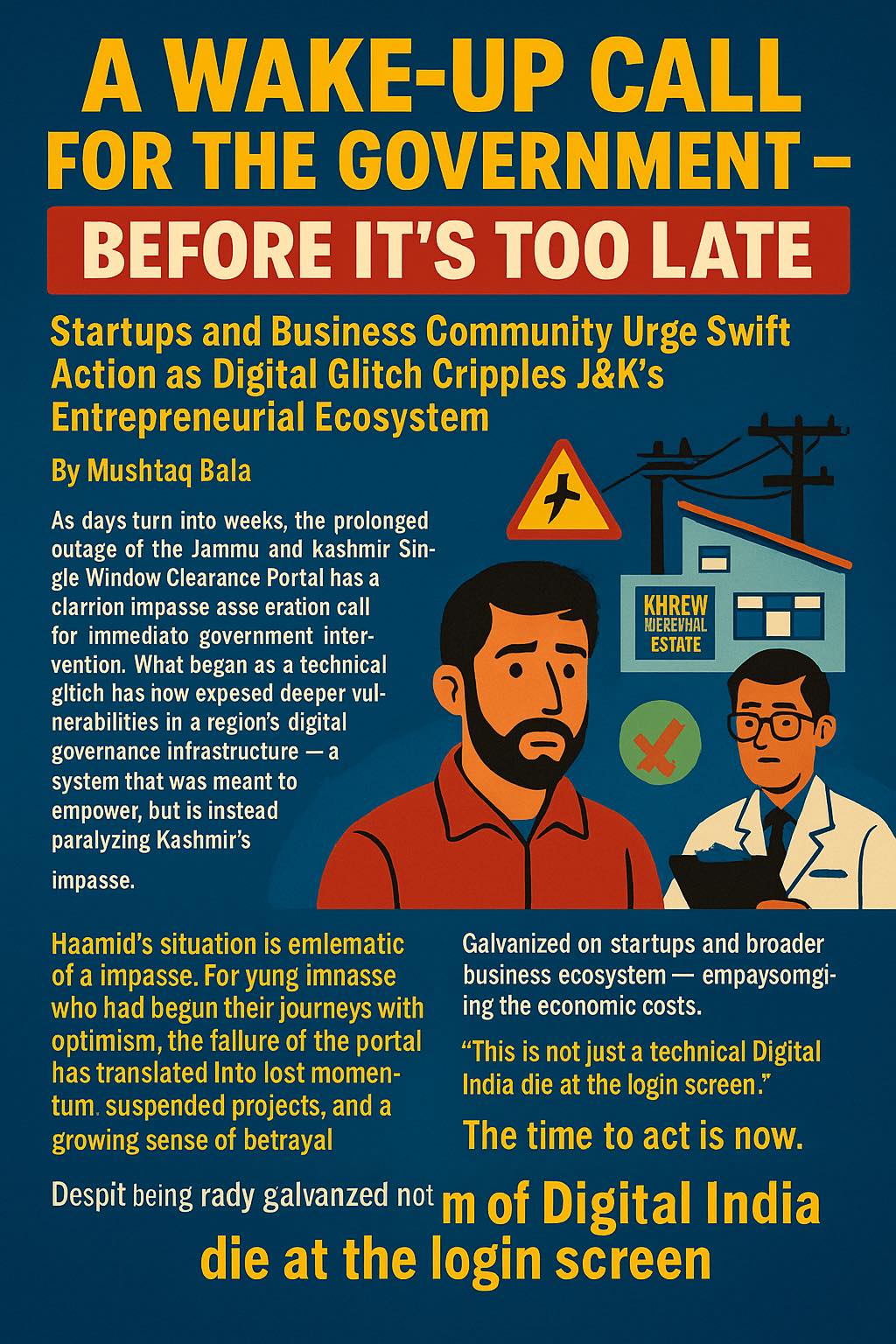
Among the many affected is an enterprise led by Haamid Mushtaq Bala, who has been persistently knocking on the doors of the concerned electric sub-division to get a power connection sanctioned for his unit at Khrew Industrial Estate, which is provisionally registered with the District Industries Centre (DIC) Pulwama. However, the concerned officer has refused to proceed without a “Consent to Establish” certificate from the Pollution Control Office Pulwama — a document that remains inaccessible because the Single Window System is non-functional. The impasse has effectively stalled Haamid’s entire project despite fulfilling prior formalities.
Haamid’s situation is emblematic of a larger crisis. For young innovators who had begun their journeys with optimism, the failure of the portal has translated into lost momentum, suspended projects, and a growing sense of betrayal. Despite being ready to establish industrial units, many are now stuck in limbo, unable to upload documentation, track applications, or proceed with licensing.
“This is not just a technical issue. It’s a rupture in trust,” said one affected entrepreneur. “We bought into the promise of ease of doing business, digital transparency, and self-reliance. But now, we’re being punished for believing.”
The situation has galvanized not just startups but broader voices in the business ecosystem — from industrialists to investors — all echoing the same sentiment: a working portal is not a privilege, it’s a necessity. They emphasize that delays in restoring digital infrastructure are resulting in real economic costs — stalled employment opportunities, dried-up investments, and disillusioned youth.
Stakeholders are now demanding a two-fold approach. First, an immediate technical resolution to bring the portal back online. Second, a practical contingency plan: allow for manual processing of applications and files so that pending approvals and projects don’t gather dust during the outage.
“This is a wake-up call,” warned a prominent industry voice. “In the race for digital governance, we’ve ignored the basic principle — systems must serve the people, not stall them. If the portal fails, the government must not. Manual options must be revived temporarily.”
In a region where youth unemployment is among the highest in the country, and entrepreneurship is often the only viable alternative, this digital breakdown is more than a technical snag — it’s an avoidable blockade in the path of progress.
The message from Kashmir’s aspiring entrepreneurs is loud, clear, and urgent:
Don’t let the dream of Digital India die at the login screen.
The time to act is now.

