
Gulab’ by any name is Gulab, so odoriferous, so influential and so dainty to touch. But when the same is shrouded in mystery, the aroma, the grace and the dearness find a space in the recesses of the mind. As a matter of fact the Bard of Kishtiwar district of Chenab Valley Mr. Gulab Saify Kraipak got his title ‘Gulab’ before his birth by a saint popularly known as Kani Baba of Shopian Kashmir. The saint, as Saify was told by his parents took him in his lap and sang:
Kar Phalihamo Lo Gulabo Lo
(When shall Oh ! Rose Ye bloom)
Later on Jinab Janbaz Dolwal sahib mentioned in one of his songs in praise of Saify in a Sufi congregation Tchete Ma Janbazini Tari Wolukh, Kem Wari Pholukh Gulabo lo. The story doesn’t end here, a famous poet of Chenab Valley Jinab Rehmat Ali Rehmat insisted the then a science student Saify to write something on the given copy in Kashmiri which he did with Roman English and just then after an incubation period, Gulab Saify gave vent to his feelings in the form of poetry. Son of a civil engineer Mr. late Saif-ud-din Kraipak, a close friend of famous duo Mr. Janbaaz Kishtawari and Rassa Javedani. After completing his schooling from Kistawar, he graduated from Jammu University. His mother Naseema Akhtar , a house maker has been an inspiration for the reason she has always encouraged the poet to write. As a poet, his canvas of poetry came to limelight when for the first time he wrote his Ghazal:
Zuv Jaan Wandeyo Pott Tchaie Lo Lo
Dil Ha Nuotham Keme Maie Lo Lo
(Let me offer to thy silhouette my entire me
My heart you seized out of what adoration!)
Taking off from the rough ground, Gulab Saify proved his grits, both as a songwriter and undoubtedly as Ghazal writer. His famous songs have not only lured young singers to perform , but also the subtlety of his verses has moved many hearts. His songs like Nigar wallo, Hawaawo heut karun gun gun, Swandar kya maleun meon, Mouj, Dubrai ,Hayatek silsillan pakwun chhu Rouzun, Shroni gome kanan waani goum kanan, Amarat Mohabbatich, Sabar Rowoum, Saruk Shamm Baguk, Takdeeras Tadbeer banan, Shabe aki Gamatch, Karnai Safar karnai saffar Mokleo kithken and his nazam Koor ti Moul and Akh Basti aes yath basti manz have raised his poetic excellence to new heights hither to unexplored.
For last two months there has been a ripple in the river of art. The source of the ripple is Saify Sahab for the reason that the poet has introduced Treyout for the first time in Kashmiri poetry. In English there are forms like tercet, which is a poetic triplet in which three lines follow the same rhyme scheme AAA. The other forms of tercet are Haiku which is an example of an unrhymed tercet poem. Enclosed tercet where the ABA pattern is followed. William Carol Williams created Triadic- line poetry or stepped line which is a long line divided into three parts. He used this long-line poetry as a “variable foot”, a metrical device to resolve the conflict between form and freedom in verse. Each of the three staggered lines of the stanza should be thought as one foot, the whole stanza becoming a trimeter line. A trimeter, which is meter of three metrical feet per line, is another form of the same genre.
But in Kashmiri poetry the ripple is felt. There has been a mixed reaction. To many this form is just another scale to restrict free flow of ideas and for many this innovative form is acceptable for brevity and wit. Treyout is different from Hiaku and tercet in terms of number of lines. Treyout is not restricted to three lines. It provides a platform to go with the flow and as such one can add binaries to expand its canvas.
As for Treyout is concerned, Saify sahib has employed both forms in his newly introduced genre in Kashmiri Poetry i.e, Tyraout can be written as minimum three line poem each carrying three words or a three syllables per verse. What is more interesting in Saif’s Treyout is that a stanza either carrying three words or three syllables must have three intricate interlocking words/ syllables to convey a story.
Q. What are the basic Principles of Treyout?
A. There are a few principles that can guide any poet to compose a Treyout.
A) 1) Each line of Treyout comprises of three words or three syllables. There is no provision for the fourth word or a letter.
BEI CHHUS WAERIS
BEI CHHUS QABEELLE
MEI CHHUNNE WASEELLE.
Example in English (Tri syllabic form)
Death is life
life is short
let us live
hope shapes love
love is but
oblation.
Example in Urdu
Haal Kya kahein
Kitne ghubar hain
Jumle hazar hain
Note:- compound or integrated /murakab/tarkeeb (kashmiri, urdu, persian, hindi, Arabic etc) can be taken as one word. Like in Urdu (Be-dard, sitam-ghaar, gham-khwaar, rahat e jaan,Dil e nadan etc.) In English/ other foreign languages (teddy bear, rainy day, Housewife etc)
2) Every line is desired to be completed in its meaning with the only exception of an interrogative line. A line that asks a question can be dependent on a different line for the completion of meaning. The Treyout at least must tell us about three persons, three relative things, three objects or three places, three feelings, three periods of time or nay other three entities.
3) Treyout is comprised of minimum three lines and can go up to any number of lines on the basis of multiples of three like 6, 9, 12, 15 ……. 30, 102, 111, 300 etc. lines.
4) In Treyout however, rhyme is not mandatory, but the last two lines/ misras are desired to be in rhymed form( Ham kafia). It can be adopted according to the requirement of the verse as long as it does not hamper the intricacy of the verse.
Q. What has been the reaction of the poets and critics?
A. As you know that any new form in the art needs analysis. People who have analysed this form have appreciated me. I have received overwhelming response from the young and eminent poets of the valley. They have found this form as the easiest way to give vent to their emotions. And of course, there are people who are still working on and I am eagerly waiting to read their responses and reactions. Those who have tried this form have written impressive verses and I have a firm faith that this form will soon gain popularity.
Q. What is your message to budding poets of the Valley?
A. I believe that hard work has no substitute . Budding poets must keep reading the eminent poets and learn how to handle the intricacies of the verse. As a creative artist I want them to think out of the box and bring out the best out of hard work. I personally follow the golden rule, i.e. before writing a line I read and analyse ten and I suggest the budding poets to follow the same rule.
ADVERTISEMENT
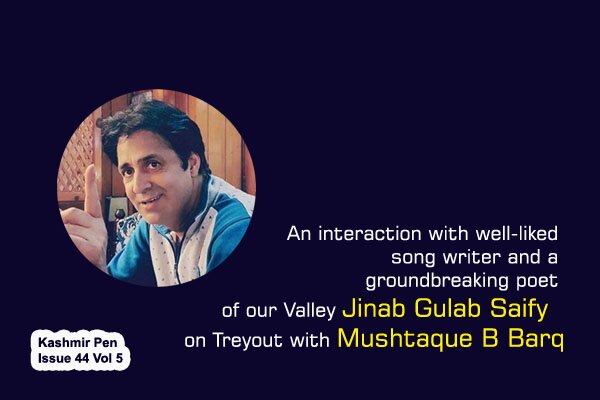
An interaction with well-liked song writer and a groundbreaking poet of our Valley Jinab Gulab Saify on Treyout with Mushtaque B Barq
ADVERTISEMENT


Leave Comment
ADVERTISEMENT