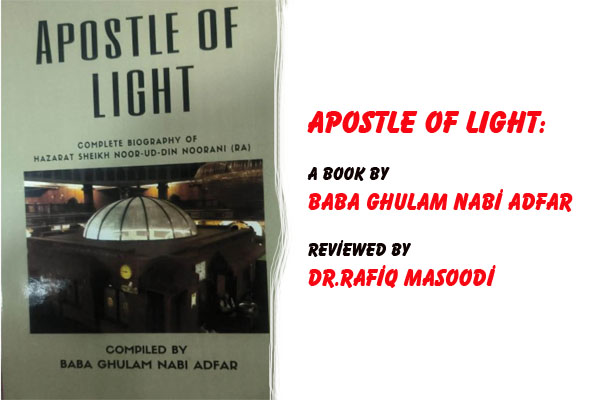
Prologue: Some Books Inform, Some Transform.
Some books are read for information. Some for examinations. And some to be transformed. Baba Ghulam Nabi Adfar’s Apostle of Light_ belongs to the fourth category, the books that do not let you sleep.
After more than 10 years of research into Persian, Arabic, Sanskrit and Kashmiri sources, Adfar, a Chrarin, an exile, a lover, has not just written a biography. He has restored a memory. He has reclaimed a heritage. And he has relit the lamp that has guided Kashmir since 1377, when a child was born in Kaimoh, whom Salar Sanz named Noor-ud-Din.
This is the “lost chapter of history” Adfar mentions in his preface. The first authentic, scholarly, and spiritually complete biography of Hazrat Sheikh Noor-ud-Din Noorani RA — lovingly called Nund Rishi and reverently called Alamdar-e-Kashmir, the Flag-Bearer of Kashmir. 359 pages, 23 chapters + appendices. And on every page, the same question Jahangir asked when he saw a Chinar on fire — Chi Aatash? Chi Naar?
Who is Adfar? Why This Book Could Only Be Written by a Chrarin
You cannot understand the book without understanding the author. Adfar is not a professor who lectures in a seminar. He is a Chrarin who saw Chrar-e-Sharif burn in 1995. Who saw people rebuild it brick by brick with their own hands. For him, Sheikh-ul-Alam’s biography is not a history project, it is a debt.
Written in Jalandhar, Ranjeet Enclave, at 7:38 pm, but rooted in Roza Bal Chrar-e-Sharif, every sentence trembles with that exile’s longing. That is why the book is both research and prayer. Adfar ends his preface with a dua: ”May this book become a minaret of knowledge and keep the true essence of Hazrat Noor-ud-Din Noorani alive for generations.” After reading 359 pages, I can say …the dua has been accepted.
The Architecture of the Book: A Spiritual Pilgrimage from the Birth of Kashmir to the Birth of Noor
Adfar does not take us straight to the saint. He takes us to the soil. That is his greatest wisdom.
PART I: THE SOIL, Chapters 1-3 , Tuloo-e-Kashmir
Chapter 1: Dawn of Kashmir, Chapter 2: Geographical Structure Chapter 3: Mystical Tradition._ Adfar does not begin with the Wali, he begins with the earth. Because Sheikh Noorani cannot be understood without the Chinar trees, the Wular Lake, and the snowy rivers he called “Signs of God.”
His first correction: The Wali did not come from outside. He was born from Kashmir’s soil. Kashmir was always the land of Rishis — from Hindu Rishis to Muslim Rishis. The chain did not break, it transformed. And that transformation is named Nund Rishi.
Adfar reviews all Persian histories from Kalhana to Jonaraja and proves that the Rishi tradition was Kashmir’s indigenous spiritual democracy long before institutional Islam arrived.
PART II: THE INNER WORLD Chapters 4-14,The Kashmir Inside Man
Chapter 4: Spiritual Reality ,Chapter 5: Power of Meditation, Chapter 6: Yogi Culture, Chapter 7: The Rishi’s Platonic Thought , Chapter 8: The Best Character — Chapter 9: Ideal Behavior…
Here Adfar does what fake scholars never did. He presents Sheikh Noorani not just as a cave-dwelling ascetic, but as a thinker, a yogi, a philosopher.
Chapter 6…Yogi Culture, is the most dangerous and most beautiful chapter. Adfar proves that Sheikh’s dialogue with Lalleshwari of Padmanpora,Lal Ded was not a Hindu-Muslim dialogue. It was a dialogue between two Rishis. Two barefoot philosophers who met beyond religion.
In Chapter 7,Platonic Thought,Adfar quotes Mir Muhammad Hamadani RA: “He was an ascetic, a mystic, a wonder of the age, a man of deep contemplation.”Noorani spoke in Kashmiri, but thought universally. His shruk”Ann poshe teli,yeli vann poshe” Food will last only if forests last, is a deeper political philosophy than Plato’s Republic.
PART III: THE MOVEMENT, Chapters 15-22,The Rishi Movement, The Heart of the Book, 65 Pages (154-219)
If you have to read only one part, read this. This is the heart.
Adfar proves that Sheikh Noorani was not a recluse. He was a statesman, a reformer, a nation-builder.
His four keywords, appearing from page 18 and dominating the whole book: Cultural Harmony, Integration, Political Consciousness, Institution Building.
The Rishi Order: According to Adfar, the Rishi order was Kashmir’s first welfare, ecological, and interfaith harmony model — 600 years before modern NGOs. Rishi khanqahs were not just for zikr. Langar was cooked, forests were saved, Hindus and Muslims sat together. It was a parallel economy of compassion.
Linguistic Heritage:* He wrote for farmers in Kashmiri, but defended faith with scholarly depth. That is why his kalam is still for Kashmiris “the status of the Quran’s sacred vocabulary.”
Guardian of Faith:* Adfar shows how Sheikh spread Islam not with sword, but with shruk. His Islam was the Kashmiri translation of Hamadani’s Islam.
PART IV: LEGACY — Chapter 23 + Epilogue — A Chorus of Voices*
Chapter 23: Spiritual Confluence with Mir Muhammad Hamadani RA…. Wisaal ….Shum Bi’s Elegy ….Baba Dawood Khaki’s Marsiya…. Poetry of Patriotism …Epilogue: Reflections on Rasool-e-Noor._
Adfar does not end with death. He ends with voices. Women’s voices. Disciples’ voices. Later Rishis’ voices.
“Shum Bi ka Nauha” pages 341-348 seven pages. Most Sufi biographies ignore women. Adfar brings them to the centre. Because Sheikh Noorani’s message was for all, not just for ulama. As Shum Bi said: ”With prophetic attributes, you emerged as the perfect leader of your people.”
Baba Dawood Khaki’s marsiya makes your eyes wet. And finally, poetry of patriotism & those same shruks that still echo on Radio Kashmir in Shahnaz Sopori’s voice.
Adfar’s Revolutionary Thesis: Recovery of the Dynamic Leader*
What is Adfar’s central argument?
The Misconception Spread for 600 Years: For centuries, fake scholars and power structures systematically suppressed Sheikh Noorani’s legacy. They presented him only as a cave ascetic. Teachings of “inner awakening, moral character, service to humanity” were hidden under the blanket of mysticism. Generations thought he had renounced the world.
Adfar’s Recovered Truth Through His Own Verses Shruk:
Adfar relies only on his own verses. No exaggeration. When Baba Kamal says ”Noor-ud-Din is the great gift of the Merciful for God’s creation,” Adfar lets contemporaries speak.
Revolutionary Spirit:* “Revolutionary action to refine human nature” Page 19.
Social Reformer:* He “struggled continuously for the prosperity, betterment and enlightenment of his people.”
Father of the Nation:* “Father of the Nation” Preface. Quranic verse “Wa li kulli qawmin Haad”_ “For every nation there is a guide” embodied in him.
Architect of Kashmiriyat:* Because of him, the world knows Kashmiriyat , Love, Sincerity, Hospitality, Unity. Mir Syed Ali Hamadani RA testified: ”This boy can turn an autumn-stricken field into a green garden.”
That is why Adfar’s book is an “academic and historical correction.” Not to reduce Sufism, but to complete it. Sheikh Noorani was both: the ocean of gnosis, and the boatman who ferries souls through the stormy waves of existence.
Literary & Spiritual Merits — Why This Book Will Remain.
Honesty of Authenticity:* Adfar depends only on his own shruks. When he has doubt, he says he has doubt.
Language as Heritage:* Kashmiri Shruk + Translation + Commentary. A couplet like ”Posh ti phool gashith, Bagwani yaad koruth” becomes a full chapter on renunciation.
Women’s Voices:* Shum Bi’s Nauha. No Sufi biography before has given women such central space.
Depth of Title:* “Rasool-e-Noor” from Greek Apostolos “one who is sent.” Combined with Baba Kamal’s testimony. Sheikh Noorani was not self-made. He was sent. With a mission.
Timeliness:* Written in exile in Jalandhar at 7:38 pm, but rooted in Chrar. That longing makes every page overflow with love.
Notes for Readers & Final Verdict*
Density:* 359 pages, 23 chapters + appendices. Not casual reading. It demands slow, contemplative reading — like zikr.
Scholarly Style:* Adfar uses terms like “Cultural Harmony, Institution Building.” Best for researchers, but general readers need patience.
Only for Seekers: This book will not satisfy those who want miracles and tales. Adfar deliberately removes the veil of fantasy to show the practical reformer. Some will call it “too historical.” But that is Adfar’s purpose.
Who Should Read It?
Students of Kashmir: To know Kashmir beyond conflict — to touch its spiritual roots.
Researchers of Sufism: To see how Sufism merged with Shaivism, Yoga and local ethos.
Every Kashmiri Youth: Adfar writes: “Understanding the practical aspects of Alamdar’s character will inspire generations in pursuit of knowledge, justice, and light.” In today’s divisive times, Sheikh Noorani’s call, “Look at all equally” is medicine.
Final Word — With the Book’s Own Sincerity.
Apostle of Light is not the story of a man who died in 1438. It is the story of a light that did not go out. When Chrar-e-Sharif burned in 1995, people rebuilt it brick by brick. That is the true biography of Sheikh Noorani — written by a nation’s love.
Baba Ghulam Nabi Adfar, as a “Chrarin,” has fulfilled his duty. He has returned to Kashmir its conscience. From “Tuloo-e-Kashmir” Chapter 1 to “Minaret of Knowledge” Page 20, he takes us from the birth of the earth to the birth of its soul.
Final Verdict:If you want to know in one book why Kashmiris still cry at a saint’s shrine after 600 years — read this. Sheikh-ul-Alam is waiting. The lamp is lit. Adfar has just turned it towards us.
As Sheikh Noorani said: ”Yim saari kari vuchh, su chhu Rishi” — He who sees all as equal, is the true Rishi. Adfar saw Sheikh Noorani equally — Wali and reformer, ascetic and politician. That is why this book will remain.
ABOUT THE REVIEWER
Dr. Rafiq Masoodi, the author and former Secretary, Poet, Broadcaster & Literary Scholar