

SANJAY PANDITA
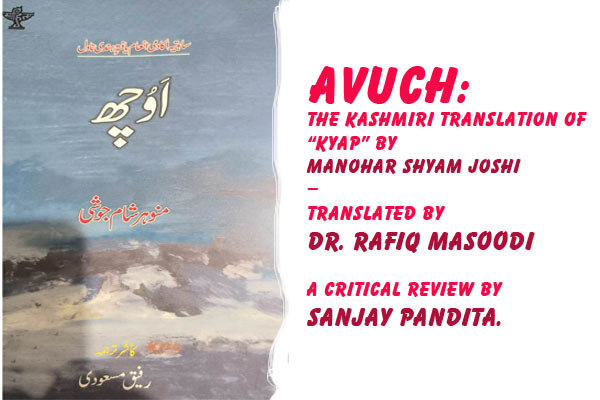
The act of translation, when it rises beyond the mechanical transfer of words and meanings, becomes an act of profound literary resurrection. It is not merely about carrying a text from one language into another; it is about transporting an entire sensibility, a rhythm of thought, a cultural memory, and an emotional landscape. In this sense, the Kashmiri translation of Kyap, originally written by the celebrated Hindi novelist Manohar Shyam Joshi and translated by Rafeeq Masoodi, emerges as a significant literary achievement. It stands as a testament to the rare possibility that a work deeply rooted in one linguistic and cultural milieu can find an equally compelling life in another without losing its essence, its feel, or its soul.
Kyap itself is not an ordinary novel that lends itself easily to translation. It is a work that thrives on ambiguity, fragmentation, irony, and a deliberate resistance to conventional narrative structures. Joshi’s prose is not linear; it moves in spirals, digressions, interruptions, and philosophical reflections. It challenges the reader not only to follow a story but to participate in its unfolding, to question its assumptions, and to inhabit its uncertainties. Translating such a work is not simply a matter of linguistic competence—it demands a deep engagement with the author’s intellectual temperament and creative vision.
Rafeeq Masoodi approaches this challenge with a sensitivity that is both artistic and disciplined. From the very outset, it becomes evident that his objective is not to domesticate the text or make it conform to the expectations of Kashmiri readership. Instead, he allows the original’s complexity to remain intact, trusting the Kashmiri language to carry its weight. This trust in the expressive capacity of Kashmiri is, in itself, a bold and commendable choice. It affirms that Kashmiri, often celebrated for its poetic richness, is equally capable of sustaining the demands of a complex, postmodern narrative.
One of the most striking features of this translation is Masoodi’s handling of tone. In Kyap, Joshi frequently oscillates between satire and seriousness, between playful irony and existential reflection. A passage that begins with a humorous observation about the absurdities of social life may gradually evolve into a meditation on the futility of human endeavors. Capturing such tonal shifts in translation is an intricate task, as it requires not only linguistic precision but an intuitive understanding of emotional nuance.
Masoodi succeeds in this regard with remarkable finesse. Consider, for instance, a situation in the novel where a character reflects on the meaningless pursuit of status within a corrupt bureaucratic system. In the original Hindi, this reflection may be expressed through a blend of colloquial humor and underlying despair. A literal translation would risk either exaggerating the humor or flattening the philosophical depth. Masoodi, however, recreates the passage in Kashmiri by employing idiomatic expressions that carry a similar dual resonance. The humor remains understated, almost ironic, while the sense of quiet resignation is preserved. The reader does not merely understand the passage; they experience its emotional complexity.
Another area where the translation demonstrates exceptional skill is in the rendering of dialogue. Kyap is rich in conversational exchanges that reveal character psychology, social hierarchies, and cultural tensions. These dialogues are often rooted in specific linguistic rhythms and regional inflections. Translating them into Kashmiri requires more than a direct conversion of words; it requires a reimagining of speech patterns so that they feel natural within the Kashmiri linguistic context.
Masoodi accomplishes this with a subtlety that is both effective and unobtrusive. The characters, when they speak in Kashmiri, do not sound like translated figures; they appear as if they belong organically to the language. For example, a sarcastic remark delivered in Hindi with a certain cadence is rearticulated in Kashmiri with an equivalent rhythm and tone, ensuring that the underlying irony is not lost. This ability to recreate conversational authenticity is crucial, as it allows the reader to engage with the characters on an immediate and emotional level.
Equally significant is Masoodi’s treatment of the novel’s postmodern structure. Kyap does not adhere to a linear narrative; it unfolds in fragments, shifting between perspectives, timelines, and states of consciousness. There are abrupt transitions, unresolved threads, and deliberate ambiguities. Such a structure poses a considerable challenge in translation, where there is often a temptation to impose clarity or coherence for the sake of readability.
Masoodi resists this temptation with commendable restraint. He preserves the fragmentation, the discontinuities, and the open-endedness that define the original text. For instance, in passages where the narrative shifts suddenly from an external description to an internal monologue, he maintains the transition without inserting explanatory markers. The reader is left to navigate the shift, just as in the original. This fidelity to structure ensures that the philosophical intent of the novel remains intact. Kyap is not meant to offer easy answers; it is meant to provoke thought, to challenge perception, and to embrace uncertainty. Masoodi’s translation honors this intent.
The preservation of narrative voice is perhaps the most subtle and yet the most crucial aspect of this translation. Joshi’s voice is distinctive—ironic yet compassionate, detached yet deeply observant, playful yet philosophical. It carries a certain rhythm that is not easily replicated. Masoodi captures this voice with remarkable consistency, allowing it to resonate within the Kashmiri language without distortion.
In reflective passages where Joshi engages in philosophical musings—on identity, on the nature of reality, on the absurdities of modern existence—Masoodi adopts a tone that is conversational yet layered with meaning. The language remains accessible, but it carries an undercurrent of depth that invites contemplation. The reader is drawn into the narrative not through overt intellectualization but through a gradual immersion in its thought processes.
The translation also excels in its handling of cultural nuances. While Kyap is rooted in a broader Indian context, many of its references are specific to certain social and institutional frameworks. Masoodi navigates these references with a careful balance of fidelity and adaptation. Where possible, he retains the original context, allowing the reader to encounter it in its authentic form. Where necessary, he subtly adjusts the expression to ensure comprehension without compromising meaning.
For example, a reference to a bureaucratic procedure or a social custom may not have a direct equivalent in Kashmiri culture. Instead of forcing a literal translation, Masoodi conveys the underlying idea—the experience of navigating authority, the emotional response of the character—through language that resonates with Kashmiri readers. This approach ensures that the translation remains both authentic and accessible.
The linguistic texture of the translation deserves special mention. Kashmiri, with its rich tradition of poetry and oral expression, offers a unique range of tonal and rhythmic possibilities. Masoodi harnesses this potential with great skill, crafting prose that is fluid, evocative, and at times lyrical. Yet, this lyrical quality never overwhelms the narrative; it serves to enhance the emotional and intellectual depth of the text.
This is particularly evident in the translation of metaphors and imagery. Joshi’s writing often employs subtle images that carry both literal and symbolic significance. Translating these requires not only an understanding of their semantic meaning but an ability to recreate their emotional impact. Masoodi succeeds in this by finding Kashmiri equivalents that evoke a similar resonance. A metaphor that suggests fragmentation or alienation in Hindi finds an equally powerful expression in Kashmiri, ensuring that the reader experiences the same depth of meaning.
Another noteworthy aspect of this translation is the translator’s restraint. In many translations, the translator’s voice tends to intrude, either through excessive interpretation or stylistic embellishment. Masoodi, however, maintains a disciplined invisibility. His presence is felt not as an authorial intervention but as a guiding force that facilitates the reader’s journey. This restraint is indicative of a deep respect for the original text and a clear understanding of the translator’s role.
In the broader context of Kashmiri literature, this translation holds immense significance. It introduces readers to a major work of modern Hindi fiction while simultaneously expanding the expressive possibilities of the Kashmiri language. It demonstrates that Kashmiri is not confined to lyrical or traditional forms but is fully capable of engaging with complex, experimental narratives. In doing so, it enriches the literary landscape and opens new avenues for creative exploration.
Moreover, the translation fosters a dialogue between linguistic and cultural traditions. In a multilingual society like India, such dialogues are essential for the growth of literature. By bringing Kyap into Kashmiri, Masoodi not only makes the novel accessible to a new audience but also contributes to a broader exchange of ideas and sensibilities. It is an act of cultural mediation that bridges divides and creates connections.
Ultimately, the success of a translation lies in its ability to evoke the same emotional and intellectual response as the original. By this measure, Rafeeq Masoodi’s Kashmiri translation of Kyap can be regarded as exemplary. It preserves the essence, feel, and soul of the original work by Manohar Shyam Joshi with remarkable integrity. It does not merely replicate the text; it recreates its spirit, allowing it to live and breathe in a new linguistic environment.
In conclusion, this translation stands as a powerful reminder that literature, at its finest, transcends the boundaries of language. It affirms that the true essence of a work lies not in its words alone but in the emotions, ideas, and experiences it conveys. Through his sensitive and skillful translation, Rafeeq Masoodi ensures that the world of Kyap continues to resonate, inviting Kashmiri readers into its intricate, thought-provoking, and deeply human narrative. It is, in every sense, a work that honors the original while creating something new—an echo that carries the same depth, the same music, and the same enduring soul.
ABOUT THE REVIEWER
Sanjay Pandita is a poet, columnist & critical analyst , can be reached at sanjaypanditasp@gmail.com

