

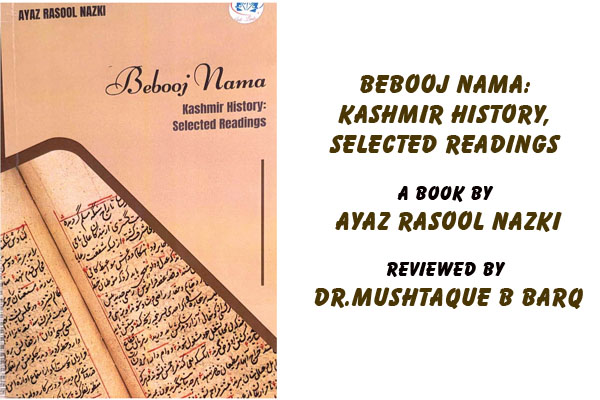
Beboojnama is a Persian-language historical and literary work attributed to Mulla Hamidullah Shahabadi, a 19th-century Kashmiri poet and scholar. The title “Beboojnama” or “The Book of Lawlessness” or “The Book of Disorder,” reflects on the tumultuous periods in Kashmiri history. The manuscript is sometimes referred to as Napursan Nama, with “Napursan” meaning “unaccountable” or “beyond accountability,” emphasizing the themes of lawlessness and moral decay during the periods it covers. This literary work is a blend of prose and poetry with visible elements of theatre and storytelling. It offers a critical analysis of the Mughal, Afghan, and Sikh rule in Kashmir, reflecting lawlessness, deceit, and unaccountability.
The work encompasses the unbearable agony, oppression, tyranny, corruption, and disregard faced by the Kashmiri people living under these eras. It also offers a glimpse into the social, political, and cultural dynamics of Kashmir during the 19th century, showing how oral tradition, folklore, and folk poetry served as a means to voice the shared experiences and oppressions of the time.

Ayaz Rasool Nazki has translated and analysed Beboojnama in his book titled Bebooj Nama: Kashmir History, Selected Readings. This work attempts to delve into the profound realms of Kashmiri history as collective memory and identity. Dr. Maroof Shah, in the introduction section of the book, sums up the main themes and creates a pathway for readers to explore Nazki’s experience as a translator and analyst. He writes: “Ayaz has pioneered a new approach to Kashmir reading its history in literary archives.” The Beboojnama of Ayaz Nazki offers a kaleidoscopic view of the political conditions of Kashmir, bringing to the surface the agonies and unvoiced plight of the people who lived under constant tyranny starting from the Mughal, Afghan, and Sikh periods.
Chapter Summaries
Chapter 1: Shinai Mugul – Highlights of Akbar’s High-Handedness
The first chapter, Shinai Mugul, highlights the high-handedness of Emperor Akbar, who dispatched his forces on 20th December, 1685 AD, under the command of Raja Bhagwan Das, Shah Quli Khan, and Shahrukh Mirza. Akbar refuted the treaty formulated by Raja Bhagwan Das and detained Yousuf Shah as a prisoner. According to protocol, Yousuf Shah had to meet Akbar, but Akbar’s actions displayed a blatant disregard for the agreement.
The book provides us with an excerpt that reads:
“Ever since Akbar added Kashmir to his dominions, the valley cast its spell upon him and his descendants. Kashmir formed the inspiration for the greatest Mughal emperors during the years it was an appendage of the Delhi throne.”
The author, Ayaz Nazki, satirically sums up the Mughals, associating them with words that have crept deep into our vernacular, such as Ratte e Mogul, Pog e Mogul, and Shina i Mogul. His painstaking research has ignited a profound ripple, captivating modern readers of history who view this much-anticipated work as a pivotal exploration of the poem, serving as a powerful testament to our collective agony. By interpreting a literary work as a political document of the past, the author transcends the complexities of literature and poetic form, focusing instead on constructing an argument that analyzes the subject matter and its treatment through the lens of political analysis.
Chapter 2: Jabbar Jande
Jabbar Jande is a tale of the last Afghan governor whose regime lasted only a few months. Jabbar Khan (1819) earned the epithet Jabbar Jande — “the rag.” A saying that goes with it reads:
“Jabbar jande hardas ti korun wande” (meaning “even the summer he turned into winter”).
There is a story connected to this: Jabbar Khan ordered that the Hindu festival Shivratri be shifted to the festival of Asarh, thus spoiling the grace and sanctity of the festival. The chapter also mentions the rule of Nadir Shah, a Turk who ruled for 11 years, until his assassination in 1747. By 1752 AD, Ahmad Shah Abdali finally succeeded in separating Kashmir from Mughal rule. This led to the Afghan takeover of Kashmir, where they ruled for the next 67 years.
Khwaja Karim Dad Khan, an Afghan governor, not only destroyed the economy but also created deep religious and sectarian divisions within society. Heavy taxes were imposed on everyone during his rule. His son, Azad Khan, even surpassed him in cruelty and harsh punishments.
The chapter sheds light on how Kashmiri Pandits were involved in administration during the time of Sukh Jiwan Mal, a policy of administrative inclusion that continued under subsequent governors. Pandit Sahaj Ram held two key positions: Sahibkar and Peshkar. By the end of Afghan rule, Kashmiri Pandits had emerged as the sole politically elite group administering state functions during the Sikh and Dogra periods.
The chapter also features a translated version of The Tale of the Farmer’s Wife and the Honeybee, depicting the symbolic oppression of the subjects. It serves as a curtain-raiser for the transition of rulers, which Ayaz Nazki has briefly curated to keep it simple yet effective. His scholarly skill is evident as he keeps events well-connected without adding unnecessary passages — a hallmark of meticulous research.
Chapter 3: Raz Paether – Bhand Paether
This chapter provides a detailed account of Bhand Paether, traditionally considered the theatre of the people, purely folk in nature and democratic in spirit. Ayaz informs us that this tradition skilfully employs the art of camouflage and satire to evoke laughter while often delivering serious social or political commentary.
A key feature of the chapter is the inclusion of the full text of the play The King’s Play (Raaze Paether). This play vividly depicts the political drama of the era, where a king grants bounties to anyone who asks — illustrating a ruler disconnected from reality, surrounded by opportunists. Shah Gassi, embodying hypocrisy and veiled intentions, is brilliantly presented. His ever-present role flatters the king and derives personal benefits, creating an atmosphere where sycophancy overshadows truth.
Raaze Paether exemplifies how Bhand Paether blends humor, mimicry, and sharp social critique. Traditionally performed by Bhand troupes (folk performers), this form of street theatre uses exaggerated gestures, masks, and improvisation to entertain and critique the powerful — a true expression of the people’s voice.
Through this play, Ayaz captures the spirit of Kashmiri folk theatre, showing how performers’ centuries ago used wit and satire as tools of subtle resistance and mirrors to society’s flaws.
Chapters 4, 5, and 6: Gulab Singh, Ranjit Singh, and Kashmir under Sikh Rule
Chapters 4, 5, and 6 offer a detailed charter of Gulab Singh, Ranjit Singh, and the political scenario of Kashmir under Ranjit Singh. Ayaz explains how the final outcome of the Sikh-Dogra confrontation saw Jammu State fall under the control of Maharaja Ranjit Singh. Gulab Singh shifted his loyalties, enlisted in the Sikh army, and rose to become the commander of the Dogra cavalry.
An added attraction of these chapters is a letter from Ranjit Singh to his Kashmir governor, Milan Singh, providing valuable historical insight. Furthermore, William Dalrymple’s Return of a King is referenced, mentioning a British officer’s account of meeting Maharaja Ranjit Singh and offering a vivid external perspective on his rule.
This book stands as a remarkable attempt at reconstructing historical evidence on a personal front, requiring not only brilliance but also unwavering dedication — hallmark qualities of Ayaz Nazki. A noted poet, scholar, and cultural historian from Kashmir, Nazki’s work bridges traditional and contemporary perspectives, offering fresh insights while staying deeply rooted in the spirit of the land. His contribution to preserving and enriching regional literature ensures that Beboojnama remains an everlasting gift for generations to come.
ABOUT THE REVIEWER
Dr.Mushtaque B.Barq is a Columnist, Poet and Fiction Writer. He is the author of “Feeble prisoner, “ Wings of Love” and many translation works are credited to the author like “ Verses Of Wahab
