

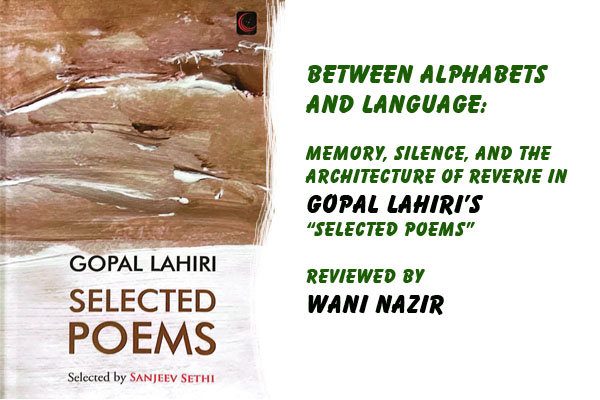
Alright, let us talk about Gopal Lahiri’s “Selected Poems”. The first line throws you right into this weird, dreamlike state: “…unknown alphabets draw humpbacked sand dunes/aligned in endless rows on the shore /of my sleep.” It feels familiar, like a language you almost understand when you are drifting off to sleep. Those dunes? They are like the hidden rules of dreaming, shaped from forgotten memories and desires. It is got a real Emily Dickinson vibe – this feeling that everything is changing, nothing is set in stone, just your inner thoughts and feelings with no clear direction.
Then, in this strange mental space, you might think of Leibniz and his monads, but in a fresh, poetic way: “Limbs, lungs or even wings are now/ stitching garments on the canvas.” Your body is just existing – breathing, moving, creating who you are from bits and pieces. It is like a Rilke idea of “Live your questions now”—you are not trying to fix your life, just putting together something that works. Suddenly – “The floral landscape hides the topography/ of the table, pot and plates.” Imagine Vermeer’s tidy rooms turning into a jungle. Life, the messy stuff, is being taken over by dreams. Wislawa Szymborska knew this trick – change how you remember something, and your coffee cup becomes strange.
But when things go wrong, the whining starts: “Words vanish like Houdini when I need them.” You are reaching for the perfect word, and it disappears! Kafka is probably laughing somewhere, and Dickinson’s advice to “Tell all the truth but tell it slant” rings in your ears. But “the new grass opens its eyes.” Things always start again, even when you lose track. “Now nothing escapes, nothing enters”—to sharpen the scene until the question is put to faith— but the last cloud is one with the light at anchor in the heart of the sky. That is intense. Here, faith does not need words; it just exists in silence, like Rumi said – a calmness that doesn’t care about language.
Then comes these lines: “Each night I lose to another alphabet/ another syllable/ the slapping of stars on mirror/ building the quiet raga amidst this chaos.” Who wouldn’t understand – everyday things, but odd? Stars hitting a mirror, making their own music in the mess. The poem is a private soundtrack, maybe never played out loud.
“We reach the edge write seven syllables/ under the/ eyelids/ street lights shed their skin.” These lines are crazy good. There is a hint of Rilke, but this time it is happening behind your eyelids, not on a page. Street lights are changing, shedding their old selves for new ones.
“The evening sky repeats a smile that burns/ and comes through unknown stars.” It is both soft and harsh. Again, Dickinson shows up —something formal after the pain. That smile is not human; it is cosmic, riding odd stars in the dark.
“A line still exists between us/An absence of clutter under/half-concealed light—/I am inventing a life I can live with.” That is honest. Setting limits, keeping things messy enough to manage. Close to the world, but always slightly removed, living a life of what ifs. “There is a sense of trespass as you/ intrude on my reverie./ Near, not touching, conversing,/and you reach me between the lines.” Lahiri understands the delicate balance: love and art exist in the spaces between things, not in the things themselves.
And then: “The mist comes in. The breeze somewhat grey,/ I only pray for early morning and then/ I’ll talk about the rise of diastole and systole.” Back to the body. A foggy mind, waiting for the morning, and then – a lesson on biology. Lahiri brings us back from the clouds to heartbeats and skin.
Gopal Lahiri tears apart the rules of language, showing how love can die on a blank page: “Sentences losing grammar now/ words small letters/ love dies slowly on the blank page.” Language breaks down, love fades, and the pages stare back at each other. Dickinson says, “Because I could not stop for Death — / He kindly stopped for me.” But here, it is grammar and feelings slipping away as you try to write them down.
Really, it is all a mess – dream threads, memory threads, language threads, all those things we can’t quite say – woven together. That is life, I guess. Clichés ruin everything you thought was unique. Any painter would get how language fails to capture the individual – the vivid becomes ordinary. “The wooden door records soul stories,/ minutes fly out in a jiffy./ We hope for a quiet morning together.” Doors as witnesses? It is simple, but now they are memory banks for our souls. Time goes by, desire appears, and hope is as fragile as a tissue.
“Window sills scribble poetry behind the flower pots,/ small shops sell marbles and lollipops.” These small details – marbles, lollipops – have an impact. It is like a small world blooming in a garden. The ordinary becomes full of memories.
“I run my fingers over your hair and access/ your illusions, your freedom of magic.” The line between me and you disappears. We might not understand it all, or get the radical message that made so much 20th-century art explicit, but it is real and exciting, like secret letters, or Rilke’s you must change your life moment, all in a touch. “Haiku climbs through the clouds of philosophy/ picks up the pieces of your thought.” Meta-poetry time. Haiku tries to hold big ideas in just a few lines. It is small but huge – a tiny world of strong poems. And these great lines, “The resolutions fade in the rising sun,/splitting me like the flakes of mica schist,/ I carve them in my own image.” The sun ruins your best plans. You fall apart into a bunch of tiny selves, each a rough and shiny piece.
Lahiri plays with words and language, trying to make them fit: “I live in my lips and sound is a diversion,/a line is often left hanging to suspend in desire.” Talking is just teasing. Words stop, and meaning hides. Desire is left hanging, unspoken. Classic – using subtle rhymes and leaving things out to keep you guessing. The poet fills in the blanks and silent spaces while trying to figure out the hidden messages. “These will be only dots, syllables, and smears./ Speaking to me only in semaphore.” Simple language – just blips, scraps, and dashes. You have to guess and fill in the missing pieces.
Again the poet caches us unawares and jolts the ground beneath our feet: “Your shadow closes around my throat/your eyes are now raw amethyst/ bloom in silent whispers,/ the cloud diffuses into hope/ from frail memories,/ I watch you leave me. That is beautiful and heart-breaking. Love strangles, eyes turn into gems. Hope drips from a cloud, squeezed from old memories. It is a certain kind of pain – love as a wound and a change. In one poem, Lahiri, like the Pre-Raphaelites, shows the small details so carefully. “There is a deep silence—/a chain of red squirrels hides those/ wild nuts,/ narrow creeks bending rhythms inside/ the escarpment.” Nature is hiding memories – red squirrels storing secrets, creeks humming hidden songs. It has that secluded garden feeling, mixed with A hidden hum. Lahiri then walks into the whispering corners of life, “I hope the whisper draws out its deeper flavour/ the common humanity/ sometimes even rupture in one dream,/ finding a quiet place at the corner.” Whispers become a meeting point – breaks and connections all mixed together. That corner is both a hiding place and a gathering spot.
The reader is about to go to a painting exhibit of memory and feeling as Lahiri makes that “there is a memory of sky in this dark chamber,/ of the sun going down, how the earth smells/ paint, brush, hands and everything.” Memory is not just a thought – it is paint on your fingers, the smell of dirt, the coming of night. The mind is a dark room, but the sky is there too. A smart reader would totally understand this kind of sensory confusion. These lines make us to the place of repressed heart: “Everything rinses/ of voices in the room,/ a set of drawing,/ like an inheritance, slowly withdraw/ the heartbeat of repression.” Silence is not empty; it is a hidden art. The repressed things start to beat again as the secret poems do, and all those lines no one has figured out yet.
The poet feels nostalgic when he talks about childhood: “Childhood, that word—it has a smell to it/ like fresh flowers in a cut-glass vase. It rustles/ as if a silk curtain across the glass door/ and the window,/ exploring the blurriness of borders.” Childhood is all perfume and soft sounds, floating in the air, hardly here or there. Boundaries blur – just like an old house, full of history and ghosts. The following lines from a poem in the collection pierce our skin and dig deep: “When words chase me from/ your body, I want to escape,/ the swing door returns.” Words become unwanted. You want to run from them, but the swing door keeps pushing you back. Desire comes back to you.
“Scrubbed its walls, deconstructed,/ people can slip through the cracks;/ escape with only sadness.” Peel it back and you can leave – but you are dragging sadness with you. Freedom is never free. “We laugh, we cry, we break laws,/ we are not punished.” Living openly does not fit into a neat poem, but a hidden poem just disappears. Sometimes, being close to someone takes away your freedom to speak. It is like Lahiri’s drawer is full of orphans, full of poems that never found their place.
Lahiri’s poems? They are different. You read them and there is this background hum, this old-fashioned feeling. One moment you are lost in a dreamy state, the next you are back in the dirt and mess of the real world. Put him next to Dickinson, Rilke, Szymborska – and you start to get it: He is all about those unclear edges, those mostly forgotten feelings, the things you almost remember but can’t quite name. His words are scattered – a sparkle here, a whisper there – but somehow they say everything.
And when you really give yourself to these poems – the silent sadness, the uncertain trust, the raw, touchable memories – Lahiri is almost whispering to you: “Hey, stop searching for what is right there. Notice what is not there, what floats nearby but is hard to reach.” It is not about what is obvious. It is about the things that creep and hide and peek around corners of your mind, slow and strange, words coughed up half-formed, the alphabet a mystery, but still, somehow, like he is whispering right in your ear.
ABOUT THE REVIEWER
A Kashmir University Gold medalist in English Literature, Wani Nazir from Pulwama J&K India, writes poetry and prose in Urdu, Kashmiri and English. His poetry and prose has been published in a slew of National and International journals of repute. He has been receiving laurels for his beautiful writings. He was awarded with The Nissim Excellence in Writing Award 2018 for Poetry and Criticism, The Kashur Qalam Best Poet Award 2017. He is the author of a collection of poetry, “… And the Silence Whispered”, the collection of poems that has been received well in the literary circles.
