

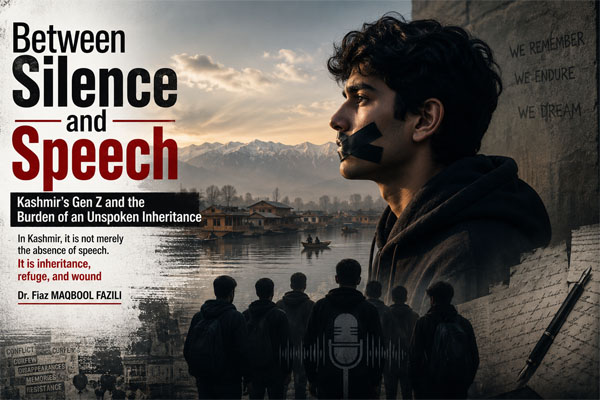
In Kashmir, it is not merely the absence of speech. It is inheritance, refuge, and wound, Dr.Fiaz MAQBOOL FAZILI
Dr.Fiaz MAQBOOL FAZILI
In Srinagar, evening descends with the hush of water darkening on the Dal. In quiet rooms, rice steams, haakh waits in its bowl, and three generations gather at the dinner table. Yet often the most important news remains outside language: a rejected job application, a failed interview, another door closed without ceremony. Everyone knows; no one speaks. Between love and shame, between disappointment and protection, silence takes its place at the table. In Kashmir, it is not merely the absence of speech. It is inheritance, refuge, and wound.
Recalling lyrics of The Sound of Silence,”Hello darkness, my old friend;I’ve come to talk with you again;Because a vision softly creeping;Left its seeds while I was sleepingAnd the vision that was planted in my brain;Still remains;Within the sound of silence
In restless dreams, I walked aloneNarrow streets of cobblestone’Neath the halo of a street lamp;I turned my collar to the cold and damp;When my eyes were stabbed by the flash of a neon light;That split the night-/ I took my pen oh no, fingers on key board…key strokes saying.”For generations, Kashmiri silence has carried the weight of endurance, restraint, hospitality, and dignity. It has been a way to survive without spectacle, to grieve without display, to respect without excess. But the children of this old quiet now stand before a world that rewards declaration. They are asked to explain themselves, sell their skills, defend their ideas, and turn inner worth into a language that classrooms, interview panels, and digital platforms can recognise.
Kashmir is not poor in talent. Its classrooms hold quick minds; its homes carry memory, wit, and imagination; its culture has long been fed by argument, poetry, and patient thought. Yet ability, left unspoken, can pass for absence. English may open doors, but it cannot be allowed to become the only proof of merit. As Sahil argues, the crisis begins early, in classrooms where children are seldom invited to think aloud, name what they feel, or stand behind an idea with confidence.
“The roots of this hesitation lie in prolonged uncertainty,” said Dr. Umar, a mental-science expert whose name has been changed. In a landscape of delayed recruitment, postponed examinations, paper-leak controversies, and shifting age limits, the future does not arrive as a road but as fog. Young aspirants prepare, wait, recalibrate, and wait again. When effort repeatedly meets delay, confidence does not collapse loudly; it thins, retreats, and learns to call withdrawal patience.
Counselling professionals describe a rising tide of stress, anxiety, depression, and exhaustion among young adults who prepare for opportunities that arrive late, change shape, or vanish altogether. Delayed recruitment weakens faith in effort; postponed exams drain momentum; shifting policies make planning feel fragile; and private disappointment slowly hardens into habit. This is the quieter crisis beneath the visible one: a generation taught by uncertainty to wait rather than move, to endure rather than speak.
Such endurance is often praised as resilience, but praise can become another form of neglect. Dr. Towseef Bhat writes that Kashmiri youth have inherited lives shaped by interruption until resilience itself begins to feel “like destiny.” Silence, then, is not merely temperament or culture. It is a shelter built under pressure. The danger is that shelter becomes a permanent address, and young people are celebrated for surviving conditions they should never have been asked to normalise.
The wound is also linguistic. For many young Kashmiris, English glitters with promise: ambition, mobility, escape. Kashmiri, meanwhile, is made to carry both pride and apology. A young person may speak Kashmiri with a grandmother, Urdu with parents, and English with teachers, employers, friends, and the wider digital world. Such fluency should be abundance. Instead, it sometimes becomes a partition inside the self, separating the tongue of opportunity from the tongue of memory, humour, grief, affection, and belonging. “I will always find it haunting,” said 22-year-old Huzaifa, “to have a heart that beats in Kashmiri but a tongue that navigates the world in English.”
Language, once the house of intimacy, has also become a ladder of class. M Mahir says children learn early that speaking Kashmiri in school can make them seem “village” or less sophisticated. Thus, a culture rich in poetry, humour, tenderness, and moral memory is pushed to the margins in the name of refinement. What is lost is not vocabulary alone, but ease: the right to sound like oneself without shame.
The digital world sharpens this fracture. Mushtaq Bala, chief editor of Kashmir Pen, calls social media a “comparison machine,” a bright court where success is staged and struggle hidden from view. For young people already measuring themselves against uncertain systems, silence can become a necessary veil: protection from the arithmetic of likes, followers, visibility, and approval.
And yet Kashmiri silence cannot be dismissed as weakness. It has graveyards inside it, migrations inside it, mothers with trembling hands, elders whose days pass like slow shadows across a floor. Long grief does not always announce itself with collapse. It settles into routines, the body, the lowered voice, the room where everything important has already been understood. For mothers, elders, and displaced families, silence can be survival, waiting, and longing—the last language left when history has spoken too much.
The task before Kashmiri youth is therefore delicate: to honour inherited silence without becoming its prisoner. They must learn to name their skills, cross the tunnels of the Valley, and still carry the Valley within them. As Rakshan writes, “Culture survives best when culture earns a livelihood.” Identity, too, survives by movement: by speaking Kashmiri without apology, mastering English without surrender, respecting the silences of elders, and yet claiming a voice of one’s own.
Prof. Dr. Gazanfer Ali warns that “a generation on pause cannot be expected to drive progress.” A generation cannot remain forever at the threshold, carrying certificates in one hand and uncertainty in the other. Movement requires more than ambition. It requires voice, family spaces where failure can be spoken without shame, and institutions that offer direction, mentorship, and credible pathways into work.
The Srinagar dinner table remains, then, an image of both tenderness and danger: family gathered Dal kinarey, love present, pain understood, truth left unnamed. Silence has taught Kashmir endurance, tenderness, restraint, and survival. But endurance alone cannot carry a generation into the future. Kashmir’s Gen Z must inherit the dignity of silence without submitting to its prison. They must learn when silence protects, when it must be translated, and when, at last, it must be broken, and Resilience — the forgotten art and trait of traditionalism: being respectful even in dissent, knowing that the work still continues the next day.
The author Is a lifelong observer of Kashmir’s social change, civic life, and intergenerational challenges.
—

