

The alarm rang at 6 AM. Zara silenced it with a practiced slap, her mind already scrolling through the day’s tasks.The client meeting, the new recruitments…. In her neat Gurugram apartment, with its view of other identical glass towers, she was an expert programmer, her emotions neatly compartmentalized like lines of a well-written script.
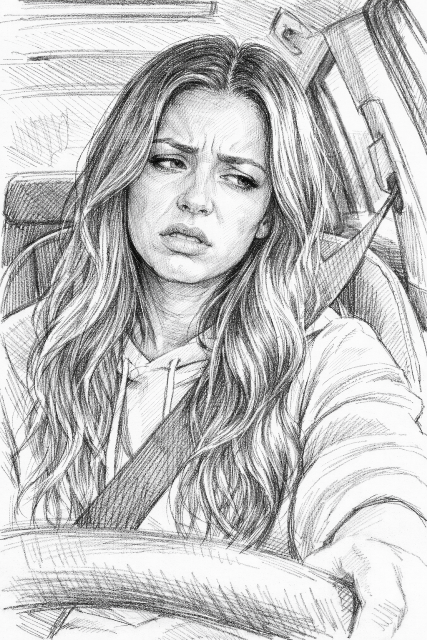
Things began to change in the traffic. Her car was stuck in the the metallic river of the Delhi-Gurgaon expressway. Today, the river was stagnant. A sea of brake lights glowed a hellish red. She drummed her fingers on the steering wheel, her patience thinning.She was upset. She was going to be late.
Then she heard it—a new sound—the desperate, rhythmic wail of an ambulance siren behind her.
Her first reaction was a sharp flare of irritation. “As if any of us can move,” she muttered,
But the siren kept going, sounding trapped and helpless. She looked in her mirror and saw the white ambulance, its red light flashing. A small, sharp worry hit her. Who was inside? Someone’s family? A child? A mother having a baby?
Then,From a side lane, a different siren approached—authoritative, clean, demanding. A police convoy, sleek and black, parted the traffic like a hot knife through butter The cars magically moved aside, creating a “Green Corridor” just for them. Zara felt empty as the important cars passed by, while the ambulance stayed stuck.The two sirens harmonized for a moment—one a plea for life, the other a declaration of power.
The VIPs were gone. The ambulance siren continued, but now it sounded tired and weak. Zara’s worry turned into a quiet, hot anger, a girl so expert at withholding her emotions.She rolled down her window to listen.
Then, suddenly, the siren stopped.
The silence was louder than the siren had ever been. It wasn’t a peaceful silence. It was a void, a sudden, chilling absence that sucked the sound out of the jam. Heads turned. Drivers peered out. It felt like the air had been sucked.Zara khan saw the driver of the ambulance slump forward, his head in his hands. Then, he got out, his face ashen, and spoke to a traffic policeman. The words were muffled, but their meaning travelled through the still air like a shockwave. The policeman removed his cap, ran a hand over his face.
Something compelled Zara to get out of her car. She walked to the policeman, “Officer? The patient…?”
He looked at her, his eyes tired. “Young boy. Accident on NH8. Head injury. Was being taken to AIIMS Trauma Centre.” He gestured at the immobilized traffic, at the now-silent ambulance. “Time… nahi mila.” (Didn’t get time.)
The words were simple. The truth they carried was monumental. A life, with all its loves, memories, and unfinished conversations, had just ended in a metal box on a road, waiting for a corridor that never came.
A sound tore itself from Zara’s throat. It was a raw, unfiltered sob, loud and shocking in the congested space. She didn’t cover her face. Tears streamed down her cheeks, for the boy, for his family, for the cruel, stupid waste of it all.
In that moment, the cityscape around her changed. The glittering IT parks in the distance, once symbols of her ambition, now looked like cold, indifferent monuments. The dream that had fueled her—the wide-eyed village girl from the valley of saffron, who had topped her district and yearned for the energy, the opportunity, the bigness of Delhi—came rushing back. She had dreamed of skyscrapers, but not of the canyons of indifference they created. She had dreamed of a fast-paced life, not of a pace that killed.
Something broke in her. Not her resolve, but a lens through which she saw the world. The code she wrote would compile, the deployments would happen, but the sirens would now have a face. The green corridors would taste of injustice. The city’s rhythm was now forever punctuated by that terrible, echoing silence in the jam.
She got back into her car, the tears still falling. The traffic began to inch forward, the system resetting as if nothing had happened. But Zara had changed. The journey from home to office had become a transformation ,a pilgrimage. She drove on, no longer just a professional who gave a back seat to emotions , in her life., but a human being, permanently tuned to a frequency of empathy, carrying within her the heavy, silent weight of a siren that stopped too soon.
Naheed Muneer
Sr Lecturer

