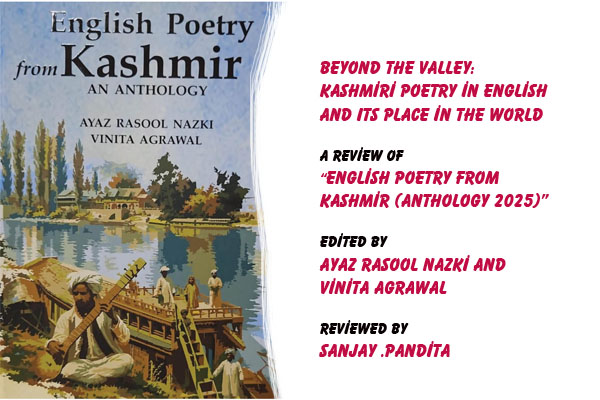
A Review of “English Poetry from Kashmir (Anthology 2025)”
Edited by Ayaz Rasool Nazki and Vinita Agrawal
Reviewed by Sanjay Pandita
What happens when a literature rooted in a particular landscape begins to speak in a language shared by readers across continents? Does it lose something of its local character in the process, or does translation into a wider linguistic space allow its deepest experiences to travel farther? These questions lie at the heart of English Poetry from Kashmir (Anthology 2025), edited by Ayaz Rasool Nazki and Vinita Agrawal. The anthology brings together a substantial body of poetic expression from Kashmir, presenting its writers in English and inviting readers to encounter a literary world shaped by history, landscape, memory, spiritual inquiry, displacement and the uncertainties of contemporary life.
The significance of such a collection extends beyond the act of assembling poems. It participates in the continuing effort to establish Kashmiri writing in English as a recognisable presence within contemporary Indian and world literature. It also raises an important critical question: what distinguishes this poetry when it enters the larger conversation of English-language writing? The answer cannot rest merely on the geographical origin of its poets. It must be found in their imaginative choices, their relationship with language, the emotional and intellectual tensions of their work, and their ability to transform local experience into something that speaks beyond its immediate setting.
The editors begin by placing English writing from Kashmir within a longer history of multilingual literary expression. Kashmir has produced literature in Sanskrit, Persian, Urdu and Kashmiri, among other languages, and its literary traditions have never existed in complete isolation from one another. English entered this landscape through different historical circumstances, gradually becoming a medium through which writers could address audiences beyond their immediate linguistic communities. Ghulam Rassul Galwan’s Servant of Sahibs, published in 1923, is cited as an early landmark in English writing from Kashmir. The subsequent emergence of writers, college publications and literary initiatives helped prepare the ground for the contemporary generation.
The importance of Agha Shahid Ali in this development is especially difficult to overlook. His achievement demonstrated how a poet could remain profoundly connected to Kashmir while engaging with the possibilities of international English-language poetry. His work also helped establish the ghazal as a form capable of crossing linguistic and cultural boundaries without surrendering its distinctive structure and emotional intensity. The anthology enters this literary history not as an isolated event but as part of an ongoing process through which Kashmiri voices are finding wider readership.
Its editorial premise is particularly relevant. The editors state that they have avoided interfering with the poems, allowing the writers to retain their individual expressions and locally rooted nuances. Such an approach respects the autonomy of the poet, especially when writing emerges from a culture whose idioms, associations and emotional references may not always be immediately accessible to outsiders. Yet editorial restraint also places a responsibility on the anthology itself: the selection must allow readers to recognise not only the diversity of individual voices but also the larger imaginative currents that connect them.
With 141 entries, each accompanied by a brief biographical note, the collection offers readers an opportunity to encounter a broad range of writers. The biographical sketches provide useful context, although the true measure of an anthology lies not in the number of contributors it accommodates but in the literary conversation its contents create. A successful anthology does more than gather poems under a shared geographical identity. It reveals differences of temperament, technique and vision, while allowing certain recurring concerns to emerge naturally.
In the poems considered here, Kashmir appears not simply as a scenic or historical location but as an inward presence. Its landscapes become repositories of memory; its changing light reflects states of mind; its damaged connections suggest emotional and historical ruptures. This relationship between the outer world and the inner life is among the most compelling features of the selected work.
Ayaz Rasool Nazki’s Evening, for instance, presents dusk as a moment when the natural world seems to conceal the injuries inflicted by the day. The trees cover the wounds, while birds exchange stories in an effort to keep a familiar fear at bay. The poem’s strength lies in the understated correspondence between landscape and human vulnerability. Fear is not explained, nor is the source of pain explicitly identified. Instead, the reader encounters an atmosphere in which ordinary natural activity carries an emotional burden. In Dawn, Nazki turns to a breeze whispering a forgotten name and a face emerging through fog. The image of recognition is delicate, suggesting how memory may return not as a complete recollection but as a presence felt at the edge of consciousness.
These poems demonstrate how the Kashmiri landscape can function as an emotional language rather than a decorative backdrop. Their restraint is significant: the feeling is allowed to arise through image and atmosphere instead of being fully explained. This quality gives the poems a potential appeal beyond their immediate cultural setting, since the experience of remembering what has receded, or fearing what may return, is not confined to any one place.
Chandrakanta Kantroo’s Wullar View from My Gable develops a different relationship between landscape and time. The view of Wullar Lake and the Old Bridge of Sopore becomes an encounter with accumulated history. Voices and footsteps appear to mingle with the waters, while ancient storytellers seem to address listeners whose capacity to hear them has grown faint. The poem suggests that a landscape may retain traces of lives and narratives even when the people who once animated it have disappeared or fallen silent. Its central concern is therefore not merely the beauty of a lake but the fragile transmission of collective memory.
The image is particularly resonant in a society where cultural inheritance depends upon stories, familiar places and the continuity of generations. Yet its wider significance is equally clear: every culture faces the possibility that its inherited narratives may become inaudible to those who come after. Kantroo’s poem brings this anxiety into focus without reducing it to a direct statement of cultural loss.
In Indu Kilam’s Broken Bridges, the metaphor becomes more explicit. Bridges that once promised connection lead nowhere after the river changes its course. A solitary bank, fallen chinar leaves and birds flying freely establish a contrast between human disconnection and the unimpeded movement of nature. The poem offers an accessible image of relationships and structures that lose their purpose when circumstances change. Its strength lies in the simplicity of its central metaphor, though the image of the broken bridge is familiar in poetry and depends on the precision of its surrounding details for freshness. The chinar and the altered river give it a recognisable Kashmiri atmosphere, while its emotional premise remains widely intelligible.
Mohammad Zahid’s The Moon Dream moves towards surrealism. Cold mountains, leafless chinar trees and shifting clouds create an unsettled dreamscape in which children point towards the moon. A madman imagines breaking it into balls of quicksilver scattered across water. The image is striking because it transforms a distant celestial object into something fragile and manipulable. The moon becomes at once a source of wonder and an object of impossible possession. The poem’s dream logic allows it to move away from straightforward landscape writing towards a more unstable imaginative terrain, where beauty, madness and desire overlap.
Other poems approach the contemporary human condition more directly. Amir Suhail Wani’s What’s the Point Now works through the images of flames and ashes, conveying the futility that follows when action comes too late. Its existential resignation is recognisable, although the poem’s larger impact depends on how much individuality its language brings to a familiar meditation on belatedness and loss. Aaliya Mushtaq Baba’s The Night presents night as an encompassing presence that enters the speaker’s hollowness until the soul itself seems dyed in darkness. The poem’s inwardness gives it an intimate intensity, while its movement from external setting to internal condition suggests a consciousness unable to maintain a clear boundary between the world and the self.
Aisha Syed’s Tell Me takes the form of repeated appeals for communication, remembrance and emotional continuity. Its accumulation of imperatives conveys urgency, as though the speaker is trying to preserve a relationship through the very act of addressing another person. The repetition can create a compelling sense of insistence, though it also risks diminishing the force of individual lines when the emotional register remains relatively constant. This tension is worth acknowledging: sincerity is an essential source of poetic feeling, but sustained intensity becomes more effective when shaped by variation, silence and surprise.
Such differences are important because they resist the temptation to treat the anthology as a single, uniform voice. The writers represented in the selected poems do not all approach their subjects in the same way. Some rely on compressed images and atmospheric suggestion; others prefer direct address, existential reflection or dreamlike transformation. Their common geographical and cultural inheritance provides a point of connection, not a substitute for individual poetic achievement.
The ghazals in the anthology deserve particular attention because they place the collection within a significant international literary conversation. The ghazal is not simply a poem divided into short sections or organised around a recurring phrase. Its traditional architecture, with its autonomous yet resonant couplets, patterns of repetition and movement between longing, separation, devotion and philosophical reflection, creates distinctive possibilities for poetic thought. When written in English, the ghazal must negotiate the relationship between inherited form and the natural rhythms of a different language.
Imran Yousuf’s Ghazal (1) addresses a figure as “O Master!”, returning to images of lost direction and a lamp whose light has faded. The recurring address establishes a devotional or supplicatory atmosphere, while the extinguished lamp suggests the speaker’s uncertainty and longing. The poem draws upon the ghazal’s affinity with absence and the search for guidance. Its success, however, must ultimately be assessed not only through its emotional sincerity but also through the precision of its individual couplets and the relationship between repetition and progression.
Mushtaque B Barq’s Ghazal develops its emotional world through the image of a locked door and a ruined hut, coloured by the crimson of the past. Confinement, secrets and keys gather around a repeated exclamation of “Ah!” The refrain gives the poem a recognisable emotional centre, and the ruined dwelling can suggest both personal enclosure and the burden of remembered experience. At the same time, the effectiveness of such repetition depends on whether each return deepens or alters the reader’s understanding. The ghazal is most compelling when its separate couplets possess their own force while contributing to a larger atmosphere of resonance.
These poems point towards both the promise and the difficulty of writing ghazals in English. The form offers Kashmiri poets a way to connect their work with a transnational literary tradition, particularly one shaped by Persian, Urdu and South Asian poetic cultures. Yet the use of a recognisable form is not in itself a guarantee of achievement. The challenge is to preserve the ghazal’s characteristic tensions and independence of thought while allowing English to function as a living poetic medium rather than as a container or inherited conventions. The presence of such work in the anthology is therefore significant not because it settles the question of how the ghazal should be written in English, but because it keeps that question open and artistically productive.
For Kashmiri poets, English offers an enlarged field of communication, but it also creates a delicate negotiation with cultural memory. A poem may carry the names of local places, the symbolism of a chinar, the atmosphere of a Kashmiri evening or the cadence of a devotional tradition. These details can give it specificity and depth. They do not need to be explained away for the benefit of an international reader. Indeed, a poem often becomes more universal when it remains faithful to the particularity of its experience. What travels across cultures is not an absence of local identity, but the human significance discovered within it.
This is where the anthology’s broader promise lies. It makes room for Kashmiri writers to participate in English-language poetry without requiring them to abandon the cultural landscapes from which their imaginations emerge. At the same time, a wider readership invites exacting standards. Poems must be read for their language, form, imagery, originality and emotional complexity, not praised simply because they represent a region or a community. An anthology can be culturally important while containing work of varying accomplishment; honest criticism strengthens, rather than diminishes, its literary value.
A definitive assessment of the collection as a whole would require engagement with all 141 entries, rather than only the introductory essay and selected poems considered here. Nevertheless, these samples reveal an interesting range of concerns and methods: landscape as memory, history as a fading conversation, broken connections, inward darkness, existential resignation, dream and devotion. They also suggest that contemporary Kashmiri poetry in English is not confined to the documentation of a troubled past. It is exploring questions of consciousness, relationships, faith and imagination that belong to the wider human condition.
English Poetry from Kashmir (Anthology 2025) is thus best approached as both a literary gathering and an invitation. It asks readers to encounter Kashmir through the voices of its poets, not merely through the familiar frames of conflict, nostalgia or scenic beauty. Its lasting contribution will depend on how effectively its diverse poems sustain that encounter and how fully future readers, critics and publishers engage with them. The anthology opens a door between a distinctive literary culture and a wider world. What matters now is not simply that the door has been opened, but that the voices passing through it are heard, read closely and judged on the strength of their art.
ABOUT THE REVIEWER
Sanjay Pandita is a poet, columnist & critical analyst , can be reached at sanjaypanditasp@gmail.com