

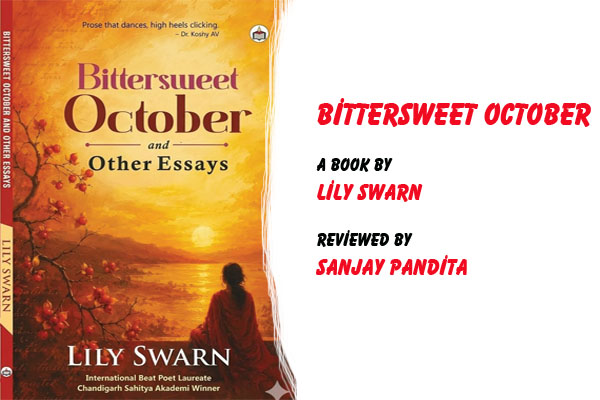
Name of the book : Bittersweet October.
Author : Lily Swarn
(International beat poet Laureate )
(Chandigarh Sahitya Academy Award
Winner)
Review: Sanjay Pandita
(Poet, Columnist author, critical Analyst)
A writer’s real material is not necessarily the extraordinary event; often it is the ordinary moment that refuses to remain ordinary in the mind. Lily Swarn’s Bittersweet October grows out of precisely such moments. Comprising fifty-four essays in two sections—forty in the first and fourteen in the second—the book creates a literary space where personal reflection, social observation, memory, humour, spirituality and engagement with the creative world coexist. It is a book that does not confine itself to one emotional register or one method of writing. Instead, it moves according to the temperament of the writer herself: observant, lyrical, inquisitive, occasionally playful and frequently contemplative.
The first section is largely made up of short reflective essays in which Swarn begins with something tangible and familiar and gradually allows it to open into a larger thought. Her method is more associative than argumentative. An image, an encounter, a memory or an everyday experience becomes the point of departure for reflection. For readers who enjoy contemplative prose, this creates an immediate sense of intimacy. At times, however, those looking for tightly structured arguments may find some pieces impressionistic, with the emotional or poetic impulse taking precedence over sustained analysis. Yet this is also central to the personality of the book: Swarn is less interested in proving an argument than in following where an experience leads her.
One of the book’s considerable strengths is this ability to transform observation into mood and reflection. Swarn writes as someone who notices. Nature, human behaviour, relationships, social conventions and seemingly insignificant experiences are rarely allowed to remain merely incidental. In “Autumn Ardour”, for instance, autumn becomes more than a season. The writer speaks of human beings becoming “mature and ripe” and carrying the “hues of acquired wisdom”, turning a natural transition into a meditation on ageing, experience and change. The observation is characteristically Swarnian: she begins with the visible world and then looks beyond it toward the inner one.
This habit of looking beneath the surface recurs throughout the collection. In “Bird Brains”, birds become a metaphor for minds imprisoned by their own limitations, while the courage of migratory birds evokes a longing for freedom and movement. Her description of their “gritty, determined flight” reveals how readily the natural world becomes a mirror for human existence. The metaphor is simple, but its implications are not. Freedom, conformity, fear and the human tendency to live within invisible boundaries are all suggested without being turned into an overt sermon.
Indeed, Swarn’s concern with conformity runs through several of her reflections. She questions the instinct to follow accepted patterns merely because society has made them familiar. Her observations of social behaviour often expose the tension between individuality and the pressure to belong. What makes these passages engaging is that the writer does not always place herself outside the world she examines. Humour and self-irony occasionally enter the picture, particularly when she writes about appearance, social expectations and everyday absurdities. This prevents the reflective voice from becoming excessively didactic.
Her poetic temperament is unmistakable. Images often arrive before conclusions, and emotions frequently determine the architecture of a piece. This lyrical quality is one of the book’s attractions, though it can occasionally become its limitation. At certain points, an evocative thought appears to stand where a fuller exploration might have taken the essay further. The strongest pieces are those in which lyricism and thought meet—where the beauty of expression does not merely decorate an idea but deepens it.
“Wondrous Waters” illustrates this quality particularly well. Water becomes an image of surrender, flexibility and the difficulty of possessing what is inherently fluid. The observation that “you can’t clutch at water, it can only drown you” becomes a compact meditation on attachment and letting go. Such passages demonstrate Swarn’s ability to turn an ordinary element of life into a philosophical prompt without making the reflection sound like a philosophical treatise.
Her treatment of human relationships is similarly grounded in lived feeling. The essays dealing with remembrance and loss are among the more emotionally affecting portions of the collection because they are most convincing when grief is allowed to remain grief rather than being immediately converted into wisdom. In the essay “Birthday Blessings in Heaven dear child Gobind Shahbaaz Singh”, the statement that “time heals. It only fools you into believing that it is healing you” carries the bitterness of an experience that refuses easy consolation. Later, gratitude for having had the child becomes inseparable from the pain of losing him. These moments reveal a more vulnerable dimension of the writer’s voice, and they gain their force precisely because they are personal without becoming emotionally manipulative.
Spirituality, too, exists in the book more as an undercurrent than as a formal system of belief. Swarn’s spiritual reflections generally emerge from experience rather than being imposed upon it. The same is true of her essay on listening, where attention becomes a form of human generosity. Her observation that “those who listen to the silences between your words” are the real bounty is characteristic of her tendency to look for meaning not only in what is spoken but also in what remains unspoken. It is this movement from the everyday to the inward that gives many of the essays their quiet philosophical dimension.
The book also has an unmistakably Indian cultural texture. Swarn moves comfortably between literary references, English prose and expressions rooted in everyday Indian speech. In “The Magical Beverage”, tea is not merely a drink but a social ritual, a companion and a cultural memory; the familiar expression “yaar cha pila” acquires a warmth that an abstract discussion of hospitality could never reproduce. Such moments give the collection an accessible quality and prevent its reflective passages from becoming detached from ordinary life.
The second section, comprising fourteen essays, changes the book’s centre of gravity. Here Swarn turns her attention towards personalities associated with literature, music, poetry and performance. The movement is significant because the writer who has spent the first section examining her own encounters with life now becomes a chronicler of other creative lives. These pieces extend the book beyond personal reflection and place it within a broader literary and cultural landscape.
The essays in this section are best understood as literary appreciations rather than conventional critical profiles. Swarn approaches her subjects with warmth and evident admiration, seeking to bring the person and the creative personality into the reader’s field of vision. This generosity is one of the section’s charms, though it also raises a critical question: appreciation and criticism are not always the same enterprise. Readers looking for sharply interrogative portraits or sustained critical distance may occasionally wish for greater analytical resistance. Nevertheless, the value of these essays lies in their act of literary fellowship. They preserve impressions of creative individuals and record the writer’s encounters with the cultural world around her.
Taken together, the two sections reveal an important characteristic of Bittersweet October: Swarn does not sharply separate intellect from emotion. Her writing is reflective without being academic, lyrical without being entirely ornamental, and personal without becoming inaccessible. She is equally interested in the world outside herself and in the meanings that world generates within her. Consequently, the book often feels less like a conventional collection of essays and more like a sustained conversation between experience and consciousness.
There are, nevertheless, places where the collection could have benefited from a more deliberate editorial sequencing. Since several essays return to related concerns—human behaviour, individuality, gratitude, memory, inner life and social convention—the accumulation can sometimes produce a sense of thematic repetition. Greater variation in placement might have heightened the contrasts between humour and grief, observation and meditation, the personal and the literary. Yet these are concerns of arrangement rather than substance, and they do not diminish the distinctive sensibility that holds the collection together.
What ultimately gives Bittersweet October its identity is not a single subject but a particular way of looking. Swarn notices the small things and then asks what they might mean. She finds metaphors in seasons, birds and water, emotion in memory, companionship in tea, and significance in the simple human act of listening. Her writing repeatedly suggests that the apparently ordinary is rarely as ordinary as it first appears.
That quality also explains the title. Bittersweetness is not confined to sorrow, nor is it merely the sweetness that follows pain. It is the recognition that human experience rarely arrives in pure emotional forms. Memory can comfort and wound; loss can contain gratitude; autumn can suggest both decline and ripeness; solitude can become reflection; and an everyday encounter can unexpectedly open a door into a larger understanding of life.
Lily Swarn writes with the conviction that life deserves to be observed closely. Her book reminds us that literature need not always arise from extraordinary events. It can emerge from a memory at the dining table, an unexpected encounter, an old wound, a moment of laughter, a conversation with a remarkable person, or simply from the strange experience of being alive and trying to understand what it means.
In that sense, Bittersweet October is not merely a collection of essays. It is a portrait of a consciousness in motion—remembering, questioning, laughing, grieving and discovering meaning in details that a hurried life might otherwise overlook. Its greatest achievement is perhaps this: it invites the reader to pause before the familiar and look again. And sometimes, in that second look, the ordinary begins to reveal the extraordinary.
ABOUT THE REVIEWER
Sanjay Pandita is a Poet, Columnist author, critical Analyst, can be reached at sanjaypanditasp@gmail.com

