

Vernacular languages are becoming endangered with each passing day. These languages like every medium of communication have contributed immensely to the literature. Everyday incidents, lived realities and challenges baffling humans are depicted in variegated manner. Urdu being an important vernacular language was systematically marginalized and retrograded to periphery in Independent India by different regimes. These regimes tried in vain to construct it as communal. Further the economic prospects of the vernacular language like Urdu were curtailed, so it offered little security to its upholders. To add insult to injury, the new means of communication, high tech gadgets took a serious hit on the habit of book reading culture. The subcontinent was no exception, thus reading in vernacular became rarer.
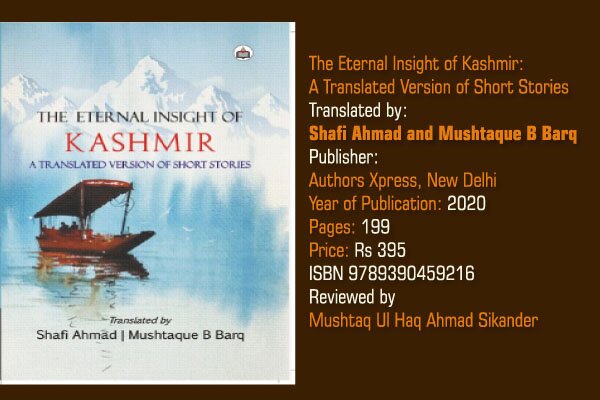
Attempts through translations are being made in order to acquaint the readers with vernacular literature. Translations always have played an inevitable role in making the literature of the world available to readers. Translators are versatile scholars who make vernacular literature available for the readers. The present title under review, The Eternal Insight of Kashmir: A Translated Version of Short Stories is an attempt to make the vernacular literature accessible to the readers. The translators Shafi Athar and Mushtaque B Barq are well known writers and have many books under their belt. With this publication they have proved their mettle as translators also.
This translation is a collection of thirty six short stories, including those penned down by the translators originally written in vernacular Urdu and Kashmiri. The authors of these short stories belong to varied hues, social strata and spectrum. These varied hues grant diversity to this collection in which plethora of voices can be found. In their Introduction the translators very well maintain that, “A faithful translator is the one who represents himself as a mouthpiece of the author and must be equipped with the ability to comprehend the original text and carry the ease of the original composition.” P-7-8 The book is a living testimony of this claim.
The dispute over Kashmir has given rise to political uncertainty that has percolated and later manifested as violence consuming numerous lives. Violence has surpassed generations; it is a burden of inheritance for each Kashmiri. The politics of violence has devoured numerous youth. People eating the dead carcass, depicting conscience as a metaphor has been evoked in many stories. The impact that violence creates has been depicted vividly so are its manifestations and its influence on common humans. The issue of caste, unemployment and gender based abuse and violence are themes around which various stories are woven. Gender based violence is something that is widespread in our society and many writers are giving voice to these oppressed souls through their writings. Further money, modernity and new ideas brought tradition and transcendence under huge strain. People are not able to look beyond their immediate material vested interests.
Love is also a recurrent theme in many of these short stories. Love and its aftershocks is a theme that has enchanted most writers. It will continue to ensnare people, demanding sacrifices while bestowing them with both affliction and bliss. The Love between two human beings is something that grants meaning to the lives and makes it worth living, whereas not achieving the objective of desire leads to chaos, confusion and anarchy.
The breakdown of Hindu-Muslim relations in Kashmir valley with the onset of armed insurgency is a theme that has been tackled in various angles, both by Pandit and Muslim indigenous writers. The migration of pandits, its impact on Hindu-Muslim relations, the distress sale of pandit properties and how the reverence for the shared spaces like water bodies has not died down despite the Hindu-Muslim tussle created by politics. The problem with Pandit-Muslim narrative is that the approach has always been vested. It has been reduced to the number game and contestation of pain. The pain can never be compared and politics over the number of dead, raped, incarcerated, and abused should be abhorred. The documented history is always a sanitized version of the events that have happened and no historian howsoever objective will always write a narrative wherein subjectivity is inevitable.
It is through creative expression only that emotions and facts can be discerned between the lines. Literature is essential for us to maintain our sanity, and these short stories do help us retain that emphatic aspect of our lives. The translators have been successful in conveying these subtleties to the readers. These short stories when read do not depict the mark of being translated. It depicts the hold of the translators over the original text and language. This collection certainly marks a new beginning of translation era in Kashmir. There is a wide range of material available in Urdu and Kashmiri language that needs to be translated for the wider dissemination. The short stories translated acquaint the reader with the fact that our vernacular languages have really a very broad canvass. There is a need for more translations and translators.
The translators need to be congratulated and appreciated for their efforts in bringing out the publication. It is a must read for anyone who is interested in the vernacular literature of J&K. It would have been more meticulous if the title of the short story collections would have been mentioned from which they have been adapted for translation.
ABOUT THE REVIEWER
Mushtaq Ul Haq Ahmad Sikander is Writer-Activist based in Srinagar, Kashmir & can be reached at sikandarmushtaq@gmail.com

