When I presided over the event today in a full capacity, packed audience at Srinagar’s Tagore Hall, I wondered what is it that Dr.Mushtaq Margoob &Tariq Margoob & AMK has done to attract such a disciplined crowd — that too Gen Z mostly.At the same time I must confess that I had a glimpse of the book till past midnight & as suggested rather advised by the author this creative deserves rather demands a serious read & then equally serious application….i was to despatch my copy to my kids in Berlin this morning ,so hade really very little time to give words a serious thought ,hence at places one may differ with my observation which i am ready to accept & incorporate later.
We are used to seeing our halls half full. We are used to seeing restless audiences checking their phones. Today was different. The hall was silent, attentive, alive. Young boys and girls in their twenties sat in rows, taking notes, asking questions that were not about jobs or degrees, but about purpose, self-trust, and inner clarity.
This crowd gave me hope, a hope for the future.

I am thankful to my organisation, Adbi Markaz Kamraz, to have associated with the Margoob Foundation in this event. The association again proved that AMK is beyond borders, languages and fields. When literature meets inner growth, when language meets life, AMK must be there. And it was an honour to be there today.
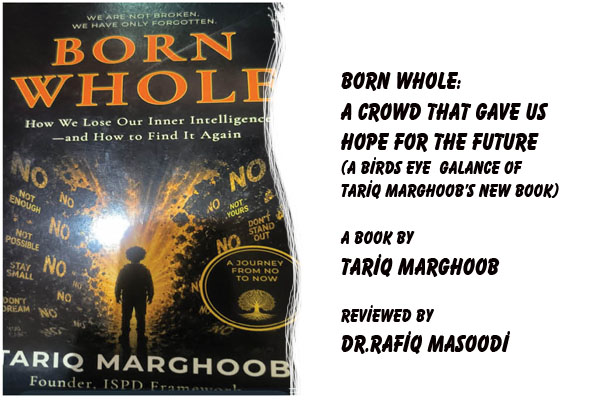
The occasion was the discussion around Tariq Marghoob’s new book, BORN WHOLE: How We Lose Our Inner Intelligence — and How to Find It Again, published by Clever Fox Publishing.
I have known Tariq Bhai as an educationist who has spent over two decades in classrooms and playgrounds, from government schools of Kashmir to institutions in Haryana. He is the Founder of the ISPD Framework and author of Today is Yours and Mastering the Future Today. But today I saw him as something else as a mirror in which a whole generation is seeing itself.
The book’s central argument is disarmingly simple and profoundly unsettling. We are not broken. We have only forgotten.
We measure childhood in marks and medals, Marghoob writes in his preface. Yet the five-year-old who could turn mud into a galaxy slowly begins to ask, “Is this correct?” At ten, “Will this come in the exam?” At fifteen, “What will people think?” The question is not what happened to our curiosity. The question is who taught us to apologize for it.
He calls it The Architecture of No. It is rendered powerfully on the cover of the book — a child walking through a wall inscribed with NOT ENOUGH, NOT POSSIBLE, STAY SMALL, DON’T DREAM, DON’T STAND OUT.
The No, he argues, is rarely a loud rejection. It is the quiet accumulation of thousands of small corrections. The loving but frightened parent who steers a child toward safety instead of discovery. The classroom that celebrates the right answer so enthusiastically that children stop risking a wrong one. The culture that rewards performance over presence. This is why the book does not blame teachers or parents. It speaks of damage that is real, recognisable and largely preventable.
To counter this, Marghoob offers what is the heart of the book — The ISPD Framework.
The framework, beautifully explained in the preface, redefines intelligence not as something to be acquired, but as wholeness already present in every child, with four interdependent dimensions:
I — Intellectual: The capacity to question, imagine and seek truth before anyone has taught you the rules.
S — Social: The wisdom to belong without losing yourself, to connect with empathy and honour boundaries.
P — Personal: The interior space of self-trust, where the voice that says “I can’t” slowly gives way to the quieter, truer voice that says “I am still learning.”
D — Developmental: The understanding that human growth has its own natural rhythm. As he writes, “Seeds do not bloom faster when you pull at them. Neither do children.”
His insight, and I think the reason the Gen Z audience at Tagore Hall was so disciplined and attentive, is this: “When these four dimensions are honoured together, something remarkable unfolds naturally. When one is suppressed — by fear, by urgency, by systems designed for standardisation rather than aliveness — the others struggle.”
We have all seen it. The intellectually brilliant child who has never learned to trust himself. The socially adept adult who has no relationship with his own inner life. Born Whole makes that invisible cost visible, without shaming anyone.
Structurally, the book is designed as a journey “From No to Now,” spread across six phases and twenty-nine chapters. From Foundations and Deconstruction to Reconstruction, Integration, Expansion and finally Embodiment. Chapters like Discipline Without Fear, From Performance to Presence, Leadership as Presence, and Educating for What Cannot Be Predicted speak directly to anyone who leads a classroom, a home or an organisation.
What makes this book travel beyond Kashmir is its universal language. It is endorsed by Lord Rami Ranger MBE and Baroness Sandip Verma, Members of the UK House of Lords, who call it “a roadmap for unlocking human potential.” Renowned psychiatrist Dr. Mushtaq Margoob, Prof. Sophia Bukhari of Qatar University and former Commissioner Dr. Abdul Kabir Dar have all seen in it what we saw in Tagore Hall today — a blueprint for future-ready schools and future-ready selves.
If there is a limitation, it is that the book offers principles rather than protocols. A teacher looking for a 40-minute lesson plan will find a philosophy to live by instead. A companion workbook of ISPD practices would be a natural next step.
But perhaps that is intentional. Because Born Whole is not meant to be finished in one sitting. It is meant to be kept close. It begins with an invitation: “Close your eyes for a moment. Think back to a time when you were so completely absorbed in something you loved that the world simply fell away.” That feeling, Marghoob says, is not a memory of who you used to be. It is who you actually are.
Today at Tagore Hall, I saw that feeling return. In the eyes of young Kashmiris who did not come for certificates or for show, but for meaning. That is why this crowd gave me hope.
Adbi Markaz Kamraz has always believed that literature is not only about language, it is about life. Our association with the Margoob Foundation today proved it again. AMK is indeed beyond borders and languages and fields.
ABOUT THE REVIEWER
Dr. Rafiq Masoodi, the author and former Secretary, Poet, Broadcaster & Literary Scholar