

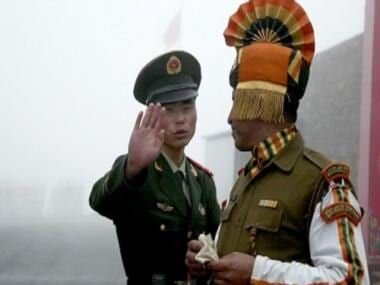
We were getting used to the uneasy calm, a sort of edgy interlude that occurs between high-tension conflicts as Indian and Chinese troops, along with all their arms and armaments, breathe down on each other’s necks in a tense deadlock on the Himalayan terrain. The onset of a brutal winter promised some respite and a fledgeling hope that a diplomatic solution could still be hammered out. China’s latest needling of India, however, shows that it is ready to raise the stakes even more.
The calm that prevails for now looks ominous. The IAF chief recently called it a “no war, no peace” situation and reiterated that defence forces are prepared for “any eventuality”. We have seen recent reports that troops on the ground have been given clear instructions to open fire if the PLA tries to pull any stunt.
As far as deployments go, India has reportedly rolled out 500 km-range Brahmos missiles or the long-range to neutralise the threat of Chinese SAM (surface-to-air missile) deployment in Tibet. Vido clips of Indian Army’s tank formations ” T-90 and BMP vehicles ” in Chumar-Demchock have also been leaked to the press.
The massive buildup of troops and the escalatory spiral leading to a deadly clash in Galwan has been described by India’s external affairs minister, as the “most serious situation since 1962”. Reports have emerged that the PLA had raised following on the northern bank of Pangong Tso just ahead of Jaishankar-Wang Yi meeting in Moscow.
It is by now clear that the decades-old architecture of patrolling protocols, CBMs and multi-layered talks and core principles to maintain peace and tranquillity at the border have collapsed and in need of urgent replacement in keeping with the revised geopolitical realities.
However, it is equally true that both nations have so far shown an unwillingness to let the escalatory spiral descend into a full-blown military conflict. The consultative mechanism is broken but both India and China have still persisted with it, though their motivations vary. For Beijing, a kinetic action is unnecessary. It would rather use the time provided by “talks” to consolidate its hold on the territory it occupies post April-May.
As this columnist pointed out previously , a protracted stalemate favours China because it is the aggressor and has managed to change the status quo with its stealth encroachments. Conversely, India’s options are either to accept China’s fait accompli or launch a military offensive to evict the PLA from the territory that India considers as own.
However, Since india has no more than one occasion reiterated that a solution to India-China border row “has to be found in the domain of diplomacy”, it has given rise to a belief that both countries will “muddle through” the crisis and eventually arrive at a solution even if it takes time, as former foreign national security advisor Shivshankar Menon said at a recent Webinar.
So, if the precarious, fragile calm has held so far, it is largely due to a combination of China’s lack of motivation for kinetic action at this stage and India’s pacifist stance. It seemed that the border crisis would persist in the foreseeable future but would deescalate from a flashpoint to a battle of attrition. In this context, China’s recent statements in reference to its fictitious 1959 claim line and dismissal of India’s sovereignty over Ladakh are provocative, unsettling and make for disturbing conclusions.
Chinese foreign ministry defined its perception of the LAC as proposed by former Chinese premier Zhou Enlai to Jawaharlal Nehru in 1959.
“Firstly, China-India border LAC is very clear, that is the LAC on November 7, 1959. China announced it in the 1950s, and the international community including India are also clear about it,” Beijing reportedly told the newspaper. China blamed Indian troops for “illegally crossing the border (and) unilaterally expanding the scope of actual control” and tied down disengagement to “India’s withdrawal of all illegal cross-border personnel and equipment,”according to the report .
If this marked the first time in recent years that China has sought to unambiguously redefine the LAC in accord with its 1959 claim line, a demand that India has consistently rejected, Chinese foreign ministry upped the ante further on Tuesday when it called into question India’s sovereignty over Ladakh. ( Yahoo News)

