

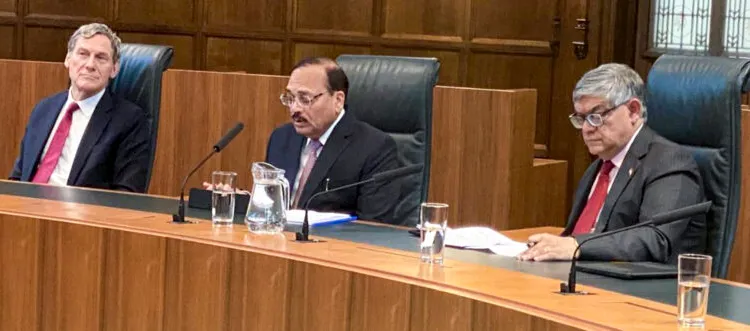
New Delhi, Jun 9 : Observing that international arbitration is increasingly facing procedural hurdles, Chief Justice of India Surya Kant said mediation is no longer an alternative but an essential instrument to achieve timely, amicable and lasting resolution of disputes.
He was delivering a lecture on “Mediation, Arbitration and the Courts: Converging Trends in the Indian and English Approaches in Commercial Dispute Resolution” at the Supreme Court of the United Kingdom on Monday.
Calling for a fundamental shift in how global corporations and legal systems approach conflict, the CJI said, “The primary question for a modern corporation should no longer be where to litigate, but rather how to resolve.” He said courts, arbitration and mediation should not be viewed as competing mechanisms but as complementary institutions serving distinct functions within a broader justice ecosystem.
“We must reject the archaic narrative that pits alternative dispute resolution against the majesty of formal courts,” he said.
“Traditional courts must continue to remain the ultimate guardians of public legal standard-setting and constitutional accountability. Yet, where the court provides the architecture of certainty, mediation serves as the adaptive mechanism for private commercial harmony. The two systems do not diminish one another; they sustain each other,” he said.
At the outset, the CJI dealt with arbitration, especially international arbitration, as one of the important alternate dispute resolution mechanisms and referred to the difficulties being faced across jurisdictions in getting disputes resolved through this.
“It is my earnest belief that as international arbitration has increasingly mirrored the very procedural complexities it was designed to escape, it is mediation that now emerges as the authentic frontier of commercial agility,” he said.
“Over the last several decades, arbitration has indubitably come to be viewed across jurisdictions as a response to some of the perceived limitations of court-centric adjudication, particularly in matters involving speed, technical complexity, party autonomy, and cross-border commerce,” he said.
Kant said that in India, the Arbitration and Conciliation Act came into being in 1996 and various judicial interpretations also advanced “a pro-arbitration approach”, keeping in harmony with internationally accepted principles governing commercial dispute resolution.
Indian courts have repeatedly reaffirmed the principle of minimal judicial intervention for preserving the sanctity of arbitral proceedings, he said.
“However, in spite of its virtues, arbitration seems to be on the verge of inheriting some of the very procedural burdens from which it originally sought to depart. At least within the Indian justice delivery system, arbitral proceedings have generated an expanding parallel layer of litigation, where nearly every stage of the arbitral process becomes susceptible to judicial challenge between contesting parties,” he said.
The CJI said arbitration proceedings get delayed due to questions on the very validity of the agreement, the appointment of arbitrators, the determination of the juridical seat, the distinction between seat and venue, issues of jurisdiction, and challenges to interim or final awards that frequently travel before courts at multiple stages.
“This, of course, is by no means a concern confined to the Indian judiciary alone. Jurisdictions across the world appear to be grappling with similar difficulties, whether in the context of domestic arbitration or complex cross-border commercial disputes,” he said.
The consequence is that disputes that were intended to be resolved with efficiency and expedition can, at times, become drawn into prolonged procedural contests, he said, adding that even the United Kingdom is witnessing such hurdles.
“It is my earnest belief that as international arbitration has increasingly mirrored the very procedural complexities it was designed to escape, it is mediation that now emerges as the authentic frontier of commercial agility,” he said, stressing the need to go for mediation.
Referring to steps taken by the Supreme Court to grant institutional support to mediation in India, he said it has been encouraging mediation in sectors such as insurance and motor accident compensation claims.
“The true paradigm shift arrived with the enactment of the Mediation Act, 2023. This legislative enactment established mediation as an autonomous, sophisticated pillar of commercial justice. The Act fundamentally elevates mediation by introducing a robust mandate for pre-litigation mediation, ensuring that parties must meaningfully explore consensus before they can cross the bar of a commercial court,” he said.
The Mediation Act also embraces the digital future and recognises online mediation and allows parties from different jurisdictions to settle disputes effectively without the burden of travel or procedural formality, he said.
“What these developments unmistakably reflect is a shift in India’s legal landscape and a burgeoning recognition that mediation is no longer an alternative, but an essential instrument for achieving timely, amicable and lasting resolution,” he said. PTI

