

SANJAY PANDITA
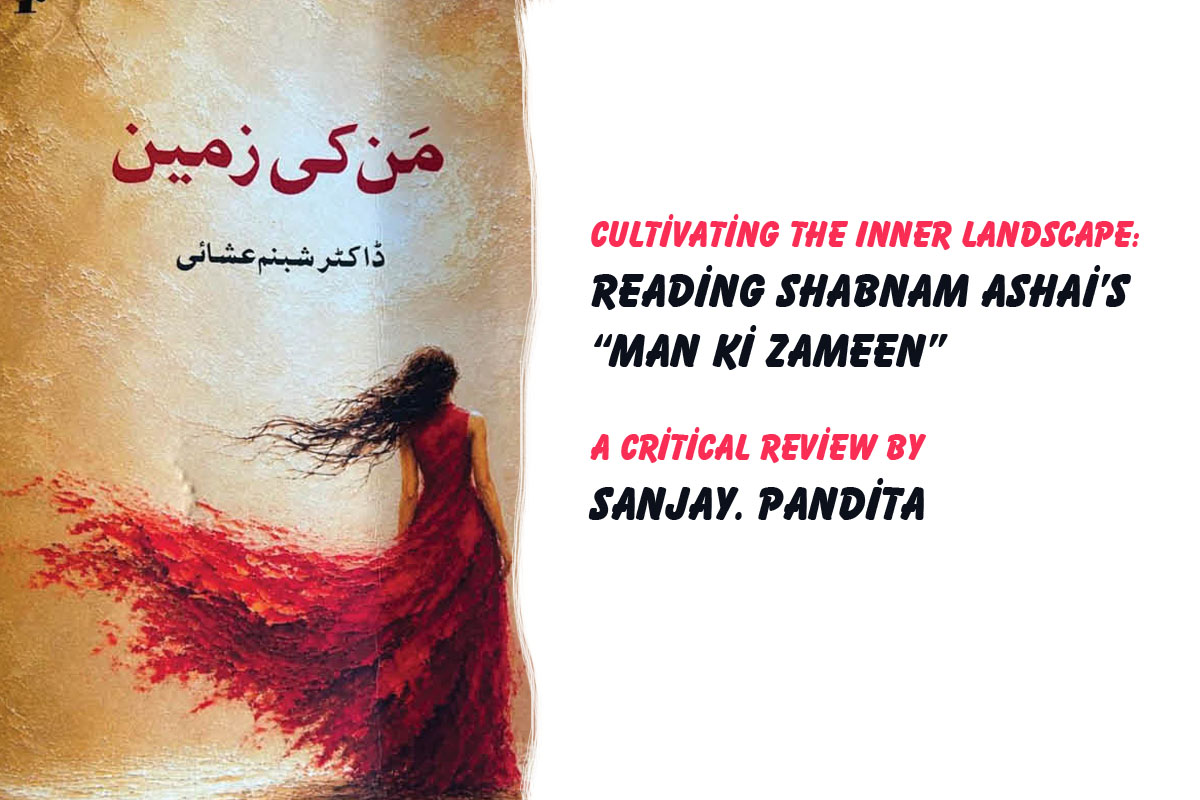
There are poetry collections that seek to narrate experience, and there are those that invite the reader to inhabit experience. Shabnam Ashai’s Man Ki Zameen belongs decisively to the latter category. Comprising 170 untitled poems across 234 pages, the collection unfolds as a sustained exploration of the inner world, where memory, silence, love, suffering, and selfhood are not merely themes but living presences. Rather than offering definitive answers, Ashai’s poems illuminate the fragile and often uncharted territories of human consciousness, making Man Ki Zameen one of the more thoughtful contributions to contemporary Urdu nazm.
The title itself serves as the key to the entire collection. Man Ki Zameen—The Soil of the Soul—suggests a space where memories germinate, emotions take root, and experiences, however painful or joyous, become the fertile ground from which poetry emerges. Ashai is less interested in the external drama of life than in its inward reverberations. Her poems are not descriptions of events; they are explorations of what those events leave behind in the mind and heart.
As one reads the poems, it becomes evident that Ashai belongs to that rare tradition of poets who do not merely describe reality but interrogate it. Her poetry is less concerned with external events than with the invisible movements of consciousness. The physical world exists only insofar as it mirrors the inner world. Consequently, landscapes, fragrances, spinning wheels, cotton, fire, bread, tears, and silence cease to be material objects; they become psychological and philosophical symbols.
One of the defining characteristics of this collection is the deliberate absence of titles. In an era where titles frequently guide or even predetermine interpretation, Ashai refuses to impose a single direction upon her readers. This stylistic decision is neither accidental nor merely experimental. It reflects a profound understanding of contemporary literary aesthetics, where meaning is not fixed but continuously negotiated between the text and its reader.
This condensed mode of writing recalls the finest traditions of modern Urdu nazm, where suggestion becomes more powerful than explanation. The reader is never told what to feel; rather, the poem opens an emotional space within which meaning gradually unfolds.
Without titles, each poem begins as an open space. The reader is free to enter from any emotional or intellectual direction, constructing meaning through personal experience. This openness transforms reading into participation. The poems do not announce themselves; they reveal themselves gradually, rewarding patience and repeated engagement.
One of the poems in the collection beautifully exemplifies this aesthetic:
“You were near;
I was living with myself.
When you left,
every moment of my being
began living with you.”
The poem begins with a paradox. Presence, ordinarily associated with togetherness, becomes the period in which the speaker remains rooted within herself. Absence, conversely, dissolves the boundaries of individuality until the self begins existing entirely within memory. This reversal of psychological expectations immediately establishes Ashai as a poet of inner complexity.
The concluding image is particularly striking:
“The fragrance
born when the heart is drenched
with the tears of fidelity…”
Fragrance here is neither botanical nor physical. It becomes an invisible testimony to remembered love. Loyalty itself acquires scent. Tears are transformed into rain, the mind into fertile earth, and fragrance into memory’s lingering presence. The metaphor functions on multiple levels simultaneously, demonstrating Ashai’s ability to compress emotional experience into sensuous imagery.
Throughout the collection, smell assumes symbolic significance. Unlike visual imagery, fragrance cannot be grasped; it survives only through memory. Ashai employs this intangible sensory register to suggest that genuine relationships never disappear completely. Their essence lingers long after physical departure.
Another poem in the collection moves into an altogether different emotional landscape:
“Pain alone
belongs to me…
These pains
never suspect,
never blackmail,
they simply embrace me.”
Few contemporary Urdu poems personify pain with such startling originality. Pain is not presented as an enemy but as the only trustworthy companion. Human relationships become suspect because they are vulnerable to manipulation, expectation, and betrayal. Pain, paradoxically, possesses moral integrity.
This inversion is psychologically profound. Ordinarily one seeks refuge from suffering. Ashai seeks refuge within it. Pain becomes the final sanctuary where authenticity survives.
The poem is remarkable for transforming emotional suffering into ethical certainty. Relationships may fail, but pain never deceives. Such existential inversion recalls philosophical traditions where suffering becomes the most reliable proof of being alive.
One also notices Ashai’s refusal to sentimentalize grief. There is no melodrama, no excessive lamentation. Instead, the language remains restrained, almost conversational. The emotional force arises precisely because the poet resists rhetorical excess.
Another distinctive feature of Ashai’s poetry is her existential orientation. This is unsurprising considering her scholarly engagement with existential philosophy, yet what impresses the reader is the effortless manner in which philosophy dissolves into poetry.
In another poem from the collection, Ashai shifts her focus to an altogether different landscape
“What once was sweetness
was life.
What now remains
is ache—
perhaps death.”
Life and death are not biological states but psychological conditions. Sweetness becomes existence; bitterness becomes decay. The poet is less interested in mortality than in emotional extinction.
The lines that follow—
“Someone,
let me search
for the face of reason…”
—suggest the impossibility of finding logical explanations for emotional suffering. Rationality itself appears masked. The search for meaning becomes endless.
This existential quest echoes not only European philosophical traditions but also the mystical heritage of Kashmir and the subcontinent, where the self continually seeks its own hidden reality. Yet Ashai remains unmistakably modern. Her poems are grounded neither in metaphysical certainty nor in religious consolation. They remain suspended between doubt and hope.
Another poem in the anthology of poems perhaps represents the strongest example of Ashai’s metaphorical imagination.
The opening image—
“Heaps of suffering,
cotton of torment,
threads spun from pain…”
—is extraordinary.
Cotton, thread, spinning wheel, cloth—objects associated with domestic labour—are transformed into metaphors of accumulated emotional experience. Suffering is no longer abstract. It acquires texture, softness, fibre, weight.
The spinning wheel of the mind becomes exhausted.
This is one of the most original metaphors in the poems presented. The mind is imagined as a spindle continuously spinning threads of suffering until it can spin no more. Such imagery simultaneously evokes feminine labour, emotional endurance, and psychological exhaustion.
Equally powerful is the image of placing a spark within bread.
Bread traditionally symbolizes survival and nourishment.
Ashai reverses this symbolism.
The bread now carries hidden fire.
The metaphor suggests that beneath ordinary existence lies suppressed rebellion. The daily rituals of survival conceal a burning interior waiting to erupt.
The concluding declaration—
“I am not livestock.”
—is quietly revolutionary.
Without raising slogans, the poet asserts human agency and feminine autonomy. The image rejects commodification, submission, and objectification in one brief statement.
This ability to derive political implications through intimate imagery distinguishes Ashai from poets whose social concerns rely upon explicit rhetoric.
One of the most significant achievements of Man Ki Zameen lies in its symbolic architecture.
Objects constantly migrate from the physical world into psychological meaning.
Fragrance becomes memory.
Rain becomes fidelity.
Pain becomes companionship.
Cotton becomes suffering.
Thread becomes endurance.
Bread becomes concealed resistance.
Fire becomes awakening.
The spinning wheel becomes consciousness itself.
This symbolic transformation allows Ashai to speak simultaneously on emotional, philosophical, and social levels.
Her imagery is remarkably tactile. Readers can smell the fragrance, feel wetness, touch cotton, sense thread passing through fingers, perceive the warmth of bread, and imagine hidden embers beneath its surface. Such sensory richness ensures that abstract philosophical concerns remain emotionally accessible.
Equally notable is her use of silence.
Many poems appear unfinished.
Sentences stop unexpectedly.
Thoughts remain suspended.
Meaning emerges in pauses rather than declarations.
These silences are not absences but active components of poetic structure. They compel readers to participate in constructing the poem’s significance.
Thematically, the collection revolves around four interconnected concerns: identity, memory, emotional alienation, and existential inquiry.
Identity is never stable.
Memory is simultaneously comforting and painful.
Relationships provide both intimacy and vulnerability.
Existence itself remains an unanswered question.
These concerns recur without becoming repetitive because each poem approaches them through fresh symbolic configurations.
Ashai’s language deserves special mention.
It is deceptively simple.
There is little ornamentation.
The diction remains close to everyday Urdu while generating extraordinary symbolic depth.
This simplicity reflects artistic confidence. Only accomplished poets can produce layered meanings through apparently uncomplicated language.
One also notices the absence of conventional romanticism.
Love, in Ashai’s poetry, is not celebration but remembrance.
Union occupies little space.
Absence generates the real poem.
Memory becomes more creative than presence.
This emotional inversion gives her work remarkable psychological maturity.
From a feminist perspective, Ashai’s poetry is equally compelling.
She does not write manifestos.
Instead, she reveals the invisible emotional labour performed by women.
Domestic objects become philosophical symbols.Household imagery acquires existential resonance.
Resistance emerges quietly through metaphor rather than ideological proclamation.
Consequently, her poetry remains aesthetically balanced while carrying significant social implications.
Her work also contributes meaningfully to the evolution of the modern Urdu nazm. She moves beyond narrative poetry into meditative lyricism, where thought itself becomes poetic material. The poems privilege suggestion over explanation, image over statement, and introspection over external description.
Perhaps the greatest strength of Man Ki Zameen is its confidence in the intelligence of its readers. These poems refuse simplification. They invite rereading because meaning continually expands with each encounter. Every metaphor possesses multiple interpretive possibilities, ensuring that the poems remain alive long after the initial reading.
In an era increasingly dominated by instant comprehension and performative emotionality, Shabnam Ashai reminds us that genuine poetry demands patience. It asks readers not merely to understand but to inhabit silence, uncertainty, and inward reflection.
Ultimately, Man Ki Zameen is a poetry of interior landscapes. It transforms the ordinary into the metaphysical, the domestic into the universal, and the personal into the philosophical. Through compressed language, evocative imagery, layered symbolism, and profound existential sensitivity, Shabnam Ashai has created a body of work that enriches the tradition of contemporary Urdu nazm. Her poems do not merely speak; they resonate. They do not offer conclusions; they awaken contemplation.
In the final analysis, Man Ki Zameen is not simply a collection of poems but a lyrical cartography of inner existence—where every metaphor becomes a path, every silence a destination, and every image an invitation to discover the unexplored terrain within oneself.
It reminds us that the richest landscapes are often invisible, the deepest journeys are inward, and the most enduring poetry is that which continues to grow within the reader long after the book has been closed.
Sanjay Pandita is a poet, columnist & critical analyst , can be reached at sanjaypanditasp@gmail.com

