

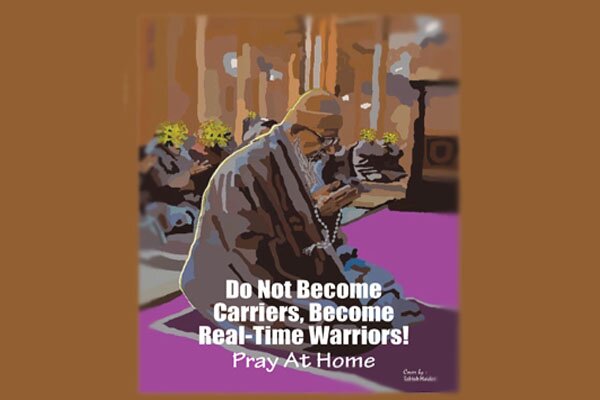
Indeed, one of the five higher objectives (maqasid) of the Sharia is the preservation of life. Therefore, Muslims are mandated to take all steps to prevent harm. This would obviously include taking all steps to prevent the spread of diseases.
It may be surprise to many that the Prophet preached the idea of quarantine almost 1,400 years ago when he said, “no person who is afflicted with a communicable disease should be brought near the healthy.”
He also said, “If you learn of a city with a contagious affliction, do not enter it; if you are in it, do not leave it [to prevent spreading the disease].” The Prophet also advised people to keep away from those with infectious diseases. In one incident when someone with what was considered a contagious disease stretched out his hands to give him the oath of allegiance, the Prophet did not take his hand but assured him gently, “We have already received your oath of allegiance.”
The Prophet himself set the precedent of canceling congregational prayers during natural phenomena, such as heavy rains or flooding. Indeed, he taught, “Where there is a potential tangible harm, it ought to be removed.”
Moreover, it is an often-quoted admonishment of the Prophet that those who consume garlic should stay away from public prayer gatherings until the foul smell is gone for the fear of being offensive to others. How can those who proclaim to follow him endanger the lives of others for the sake of gaining the additional benefits of congregational prayer? The all-powerful and most merciful God is everywhere, can accept prayers wherever performed and can certainly appreciate our concern with the global COVID-19 pandemic.
Recounting a Hadith wherein the Prophet told people not to go for a congregation if there was a danger of others catching the infection from him or vice-versa, a Jamaat-e-Islami Hind functionary asked the community members to establish prayer at home with spouse and children. The appeal followed a large congregation at the Jamaat headquarters last Friday.
Imam Ahmad Bukhari of Delhi’s historic Jama Masjid used a loudspeaker to appeal to Old Delhi residents to stay indoors and avoid coming to the mosque. “The country is under lockdown. Please stay at home. It is sufficient that the staff of the mosque offers prayers in the masjid. Others can do it at home.”
His words were not heeded by everybody. Two days after his address, police officials had to resort to a fresh appeal over microphones from smaller mosques. Meanwhile, the New Delhi Jama Masjid, which attracts many members of Parliament, besides foreign diplomats and others, shut its gates to outsiders.
While most mosques shut the doors on worshippers from outside, in some mosques under the influence of the Tablighi Jamaat skirmishes broke out between those in favour of continuation of prayers in collectivity and those asking for prayers in seclusion. Finally, it needed a word of caution from the internationally known Islamic scholar Tariq Jameel for the faithful to retreat. In a recorded appeal, Jameel asked them to avoid large congregations and instead pray at home.
In times like these, when we are confronted with uncertainty in politics and economy, relationship and world health and personal safety — especially with the looming threat and crisis globally brought about by COVID-19, the coronavirus disease outbreak that’s spreading and has caused thousands of deaths worldwide — our world needs prayer, cure and healing. It also needs all-out support and active involvement and participation by all, especially our local, national, and world leaders, to help prevent this phenomenon or disease from further spreading or becoming pandemic.
It is imperative to avoid close contact with anyone with cold or flu-like symptoms. Likewise, practice food safety, like cooking meat and eggs thoroughly. Avoid unprotected contact with live animals, too. If you’re sick and outside or visiting your doctor, you may wear a mask to help reduce the spread of infection.
The historic Makkah Masjid where perhaps the largest Friday congregation is held wore a deserted look. Only about 25 people were seen in the mosque. The people who offered Namaz there were the mosque staff, government officials and a few media persons. They entered the mosque before 12:30 noon. After that none was allowed.
Several mosques which would be seen crowded during Friday prayers were seen deserted today. They included Qutub Shahi Masjid, Jamia Masjid, Kulsum Begum Masjid, Masjid-e-Gulbano, Masjid-e-Raheem-O-Sughra Ahle Hadees, Bilal Masjid, Masjid-e-Aamera, Masjid-e-Azizia and Masjid-e-Sultan Jahan, Ek Minar Masjid and Mallepally Badi Masjid.
It is being observed that a few mosques called out the Azaan which stated perform Namaz at your own house whereas several others called out the same Azaan and made separated announcements to offer prayer at home. Meanwhile, online khutba’s (sermons) were given and topic for most of which was the coronavirus and its effects.
Under such circumstances each person must pay a certain cost (restricting essential items, no outside interaction) so that society, as a whole, can benefit in the future. While policing and social shaming keeps some people indoors, ultimately, the success of a lockdown is predicated upon the willingness of the people to abide by the restrictions. This willingness is a function of the extent to which people have the luxury of having a long-term view on well-being, and the magnitude of costs being imposed on individuals today.
This is where things went awry. The lockdown was imposed in a fashion that was unsustainable for the poorest population across the country.
There is still time to adjust and calibrate policy. But to do so, we must stop seeing economic costs and the lockdown to prevent disease as trade-offs. If certain economic conditions are not met at the individual level, a longer lockdown is unsustainable.
Many of us have heard that a person infected with the coronavirus will infect one to three others on average, but this hides significant variations. Most will infect few or none, but super-spreaders have a disproportionate “multiplier effect” as those infected by a super-spreader will then go on to infect others. This is why as we seek to regularise supply chains and perhaps reduce restrictions in the future, big crowds such as the ones seen in Delhi and Mumbai need to be avoided at all costs for the next few months.
Finally, we need to standardise relief efforts as much as possible. Charitable and state-specific responses are highly uneven, generating incentives for the most vulnerable populations to move when sufficient benefits are not given.
Looking around the world, it is becoming clear that some lockdown measures will be required for months into the future to prevent the spread of the coronavirus. We must begin crafting a policy, taking our political economy seriously, to sustain such a long shutdown.
