

Shazia Shah | Kashmir Pen
Srinagar, August 14,2026: The crisis confronting Jammu and Kashmir’s film and television fraternity is no longer merely an industry concern—it has become an issue of livelihood, cultural preservation and the future of hundreds of artists and technical professionals who have spent decades creating content for the public broadcaster.
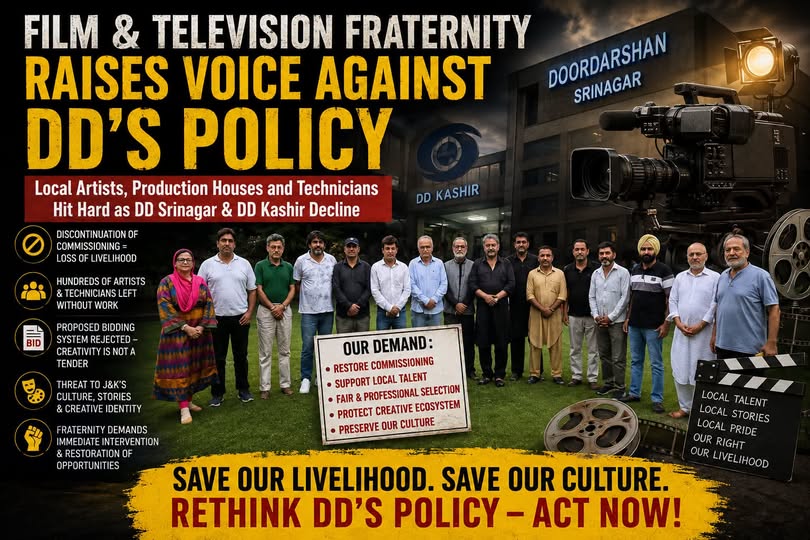
A landmark gathering of professionals from the Film and Television industry in Srinagar has now raised a strong and collective voice against what participants described as the deeply troubling and increasingly exclusionary policy being followed by Doordarshan towards local artists, production houses, technicians and other stakeholders.
The meeting brought together a broad cross-section of the creative community, including actors, singers, writers, producers, directors, technicians and equipment owners. Among those participating were Mushtaaque Ali Ahmad Khan, Dr. Ayash Arif, Mushtaq Bala and Shahzad Rasool, besides several other professionals associated with the region’s audio-visual industry.
The central concern was the continuing decline of DD Srinagar and DD Kashir as platforms for local talent. For decades, these institutions were not simply television channels. They functioned as a lifeline for Jammu and Kashmir’s creative economy, providing opportunities to artists, writers, musicians, directors, producers, cameramen, editors, make-up artists, light technicians, equipment suppliers and hundreds of others working behind and in front of the camera.
That ecosystem, the fraternity argues, has been systematically weakened.
A Public Broadcaster Turning Its Back on Its Own Creative Community
The participants expressed strong resentment over the discontinuation or substantial reduction of commissioning and in-house production opportunities that once enabled local professionals to remain connected with television production.
For many artists and technicians, DD Srinagar and DD Kashir were the primary avenues through which they could earn a livelihood while simultaneously contributing to the cultural and linguistic diversity of the region.
With production opportunities shrinking, a large pool of experienced professionals is now effectively sitting idle.
The question being raised by the fraternity is simple but fundamental: If a public broadcaster operating in Jammu and Kashmir does not provide meaningful space to the local creative community, who will?
Doordarshan has historically carried a public-service responsibility. Its mandate cannot, in the view of the fraternity, be reduced to merely filling transmission hours at the lowest possible production cost. A public broadcaster must also nurture local talent, document local culture, provide opportunities to regional creators and ensure that communities see their own stories, languages and artistic traditions reflected on screen.
Opposition to Outsourcing Through Bidding
Particular concern was expressed over the recent notification proposing a bidding mechanism for outsourcing programmes in formats including travelogues, documentaries, fiction, musicals and other productions.
The Film and Television fraternity strongly opposed the proposed mechanism.
Participants argued that creative production cannot be treated like the procurement of stationery, construction material or routine services where the lowest or most commercially competitive bid can automatically determine the successful applicant.
A television programme is the product of an ecosystem involving creative vision, writing, direction, acting, cinematography, music, editing, production design and technical expertise. Its quality cannot be adequately assessed through a conventional tendering formula.
The fraternity therefore questioned the wisdom of imposing a purely bidding-oriented approach on creative productions and demanded that professional competence, creative merit, experience, originality, technical capability and knowledge of the local cultural landscape should be central to the selection of production houses.
There is also a legitimate concern that such a mechanism could inadvertently favour entities with greater financial capacity rather than those with deeper creative experience and a demonstrated record of producing quality programmes in Jammu and Kashmir.
Local Production Houses Cannot Be Treated as Outsiders
One of the strongest sentiments emerging from the gathering was that local production houses must not be reduced to mere applicants in a procurement exercise.
For decades, J&K-based producers and directors have created programmes under difficult circumstances, often working with limited resources but immense professional commitment. They have trained generations of local technicians and provided employment to hundreds of people.
Their accumulated experience is an asset.
Instead of building upon this ecosystem, the fraternity believes that the present approach risks dismantling it.
If local production houses disappear, the damage will not be restricted to a few companies. The entire chain of employment will suffer—from actors and writers to cameramen, editors, musicians, equipment owners, drivers, set workers and other service providers.
The Cultural Cost Is Even Greater
The crisis is not only economic.
Jammu and Kashmir possesses an extraordinary cultural heritage, with its own literary traditions, folk music, theatre, oral histories, languages, landscapes, crafts and social narratives.
DD Kashir and DD Srinagar once played an important role in documenting and broadcasting this cultural wealth.
When local production declines, local stories disappear from the television screen.
Who will document the lives of Kashmir’s artists, craftsmen, musicians and storytellers? Who will produce programmes on the region’s folk traditions? Who will give emerging actors and writers an opportunity? Who will record the rapidly changing social landscape of Jammu and Kashmir?
These are precisely the questions that the authorities must answer.
Artists Are Not Seeking Charity
The fraternity has made it clear that it is not seeking charity or preferential treatment.
What local professionals are demanding is a fair opportunity to work.
They want transparent and professionally credible commissioning mechanisms, regular production opportunities, recognition of their experience and a policy framework that acknowledges the special role of regional talent in public broadcasting.
They also want the authorities to recognise that the creative sector is an employment-generating industry.
A single television production can support dozens of people directly and indirectly. Reviving commissioning at DD Srinagar and DD Kashir could therefore have a multiplier effect on the local economy.
Where Is the Public-Service Mandate?
The larger question confronting Doordarshan is whether its present approach is compatible with the very idea of public broadcasting.
A public broadcaster cannot operate as though local creative communities are merely external vendors to be invited occasionally through tender notices.
The broadcaster has a responsibility towards the ecosystem in which it operates.
Jammu and Kashmir has produced accomplished actors, directors, writers, musicians, cinematographers and technicians. Many have contributed to Doordarshan for decades. Their knowledge, experience and institutional memory constitute an important part of the broadcaster’s own history in the region.
Discarding that experience would be both economically wasteful and culturally short-sighted.
Immediate Policy Review Needed
The gathering has called for immediate intervention by the concerned authorities at both the Union Territory and national levels.
The fraternity wants the policy towards DD Srinagar and DD Kashir reviewed comprehensively, with particular attention to:
• Restoration of meaningful commissioning opportunities for local producers and production houses.
• Regular production of fiction, documentaries, travelogues, music and cultural programmes involving J&K-based professionals.
• A review of the proposed bidding mechanism for creative productions.
• Transparent selection criteria based on creative merit, professional experience and technical competence, rather than price competition alone.
• Greater opportunities for local actors, writers, directors, musicians and technicians.
• Protection and expansion of the local production ecosystem.
• A structured mechanism for consultation with the Film and Television fraternity before major policy decisions affecting the industry are implemented.
A Warning That Cannot Be Ignored
The Srinagar meeting should not be dismissed as another representation by an industry association seeking more work.
It reflects a much deeper crisis.
A generation of professionals that once found regular opportunities through Doordarshan is today staring at uncertainty. Equipment owners have invested in infrastructure that remains underutilised. Technicians trained over decades have fewer opportunities to work. Writers and directors are struggling to find platforms. Artists who once reached audiences through DD Kashir and DD Srinagar are increasingly being pushed out of the broadcasting ecosystem.
This is not sustainable.
Doordarshan cannot simultaneously claim the mantle of a public broadcaster and remain indifferent to the collapse of the local creative ecosystem in the region.
The authorities must understand that every closed production opportunity has a human cost, and every abandoned local programme represents a lost opportunity to preserve Jammu and Kashmir’s cultural memory.
The Film and Television fraternity has now spoken collectively.
Its demand is not unreasonable: restore opportunity, respect professional experience, protect local employment and allow Jammu and Kashmir’s own creative community to tell its own stories.
The ball is now firmly in the court of Doordarshan and the Government.
If immediate corrective measures are not taken, the crisis facing the region’s Film and Television fraternity could become irreversible—and with it, an important part of Jammu and Kashmir’s indigenous creative ecosystem could disappear from the public broadcasting landscape
| Kashmir Pen

