

HAROON RASHID BHAT
“Great souls do not disappear with death; they continue to live through the values they uphold, the words they leave behind, and the lives they inspire.”
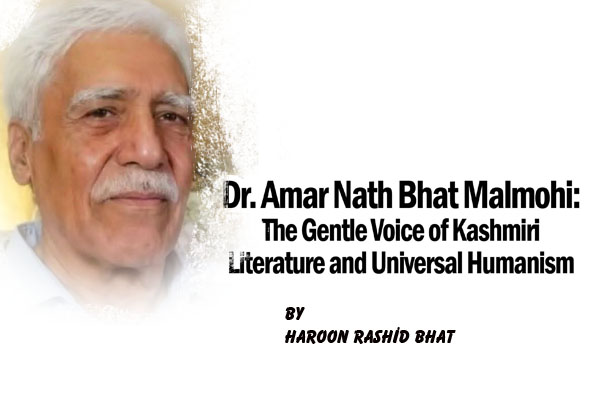
The passing of Dr. Amar Nath Bhat Malmohi on the evening of 28 June 2026 in Pune has left an irreplaceable void in the literary and cultural landscape of Kashmir. A distinguished playwright, eminent scholar, accomplished critic, and one of the foremost custodians of the Kashmiri language, Dr.Malmohi devoted his entire life to enriching literature, nurturing theatre, and preserving the cultural identity of his homeland. His departure is not merely the loss of a celebrated literary figure but the silencing of a voice that consistently advocated wisdom, tolerance, spirituality, and humanity.There are certain personalities whose influence extends far beyond their writings. They become institutions in themselves, shaping minds, inspiring generations, and preserving the intellectual heritage of a society. Dr. Amar Nath Bhat Malmohi belonged to this rare category. Through his literary works, scholarly essays, critical studies, and dramatic creations, he strengthened the foundations of modern Kashmiri literature while remaining deeply rooted in its classical traditions. Although I had long admired his literary stature, my first meaningful encounter with
Dr.Malmohi came not through a personal meeting but through his voice. It was on 8 July 2017, at approximately 10:30 p.m., when I happened to tune into an interview broadcast by Radio Kashmir. Conducted by two eminent personalities of the Valley, the interview soon became one of the most memorable conversations I have ever heard. His calm, composed, and gentle voice carried a rare warmth that immediately commanded attention. I instinctively put aside everything else and listened with complete absorption. As the conversation unfolded, every answer revealed another facet of his profound personality, intellectual depth, and remarkable humility. One aspect that particularly impressed me was his generosity in acknowledging the contributions of fellow scholars. He spoke with great admiration about Mohammad Ahsan and Professor MohiUl Din Hajini, acknowledging their remarkable contribution to the preservation and promotion of the Kashmiri language and its rich cultural heritage. His appreciation reflected not only his generosity of spirit but also his deep respect for those who dedicated their lives to the service of Kashmiri literature and culture. Such humility is the hallmark of truly great minds. The discussion gradually turned towards religion and spirituality, where Dr.Malmohi articulated a philosophy that remains profoundly relevant in today’s world. He remarked, “I am more fascinated by the spiritual aspect of religion, which I believe is common to all.” These few words reflected the essence of his worldview. For him, religion was never a cause of division; rather, it was a means of discovering the deeper unity of humankind. He believed that beneath diverse rituals and traditions lies one universal truth—the dignity of the human soul. Self-realisation, according to him, was the highest purpose of life.
His extraordinary scholarship became even more evident when he effortlessly recited verses of Mirza Ghalib, Dr. Muhammad Iqbal, and the revered Kashmiri mystic Shahi Shamas Faqeer. What made the experience exceptional was not merely his remarkable memory but his ability to illuminate the profound philosophical and spiritual meanings embedded in their poetry. Every verse became a lesson in literature, philosophy, and life itself.Perhaps the most revealing moment of the interview came when he was asked about the personality who had influenced him the most. Without hesitation, he named Ramakrishna Paramahamsa, explaining that he admired him because he practised and respected all religions. This response beautifully reflected Dr.Malmohi’s own intellectual and spiritual outlook. He believed that truth transcends religious labels and that genuine spirituality nurtures compassion, harmony, and mutual respect. His life stood as a testimony to this belief.As a literary critic, Dr.Malmohi displayed exceptional fairness and intellectual integrity. His essays and critical writings on numerous literary personalities of Kashmir were marked by objectivity, scholarly depth, and an unwavering commitment to truth. He evaluated literature on merit rather than personal affiliations, thereby setting an inspiring example of ethical criticism and academic excellence.His contribution to Kashmiri theatre occupies a distinguished place in the history of the Valley’s cultural renaissance. Through his plays, he portrayed the aspirations, struggles, and moral dilemmas of society while simultaneously preserving the linguistic beauty and cultural ethos of Kashmir. His dramatic works were not merely performances; they were reflections of social consciousness, cultural continuity, and artistic excellence.At a time when indigenous languages and cultural traditions face unprecedented challenges, Dr.Malmohi’s lifelong dedication acquires even greater significance. He understood that language is not simply a means of communication but the living repository of a people’s history, identity, and collective memory. His tireless efforts towards the preservation and promotion of Kashmiri language will continue to inspire future generations of writers, scholars, artists, and cultural activists.As we mourn the loss of this extraordinary literary giant, we also celebrate a life lived with purpose, humility, and unwavering commitment to knowledge. Great individuals never truly depart; they continue to live through their ideas, their writings, and the countless lives they touch.
Dr. Amar Nath Bhat Malmohi’s literary legacy will remain a guiding light for all who believe in the transformative power of literature, culture, and humanity.His gentle voice may have fallen silent, but its echo will continue to resonate in the hearts of those who value wisdom over prejudice, dialogue over division, and humanity above all else.May the Almighty grant eternal peace to his noble soul and bestow strength upon his family, friends, admirers, and the entire literary fraternity to bear this irreparable loss. Kashmir has lost one of its brightest literary luminaries, but his legacy shall remain immortal in the annals of its cultural and intellectual history.
Haroon Rashid Bhat is a teacher and columnist and can be reached at minamharoon123@gmail.com.

