

Amir Suhail Wani
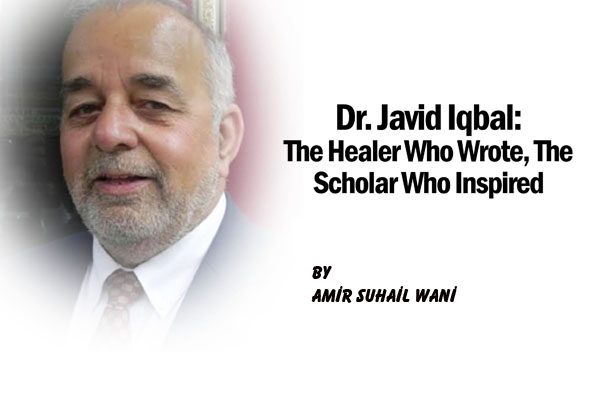
It was a cold winter afternoon at Nigeen Club some sixteen years ago. The weather was cold and, to be honest, the speeches were colder. I was seated somewhere in the back rows, far from the stage and even farther from the proceedings. Like many young attendees at public functions, I was physically present but mentally absent. Then a speaker rose to address the gathering. Within moments, the atmosphere changed. He began quoting Jalaluddin Rumi and Allama Iqbal—verse after verse, effortlessly and from memory. What was even more remarkable was the pronunciation. The Persian rolled off his tongue with an elegance and fluency that might have surprised even native speakers of Iran. The audience, which until then had been only partially attentive, suddenly found itself listening. The speaker was Dr. Javid Iqbal.
As happened on countless other occasions, Dr. Javid had seized the day. History, literature, philosophy, politics, religion and contemporary affairs flowed together in a single stream. One never had the feeling that he was delivering a speech; rather, one felt that a vast library had momentarilyfound a human voice. Long before I came to know him personally, I had known him through his writings.

As a school student, I developed an unusual habit. The bus fare I received from home would often be spent on a copy of Greater Kashmir. This meant that I frequently had to walk nearly six kilometres to school. Yet I never considered it a hardship. The newspaper became my travelling companion. I would read while walking, absorbing ideas and arguments that transported me far beyond the roads of Srinagar. There were certain columnists whose writings I eagerly awaited: Muhammad Maroof Shah, Z. G. Muhammad and, above all, Dr. Javid Iqbal. What fascinated me was not merely the quality of his writing but its astonishing range. On one day he would be writing about international geopolitics and shifting global power equations; on another, he would be discussing the scientific understanding of religion and the relationship between faith and reason; a few days later, he would transport readers into the world of Persian literature, Sufi metaphysics, or the intellectual history of Muslim civilisation. As a young reader, I often found myself wondering who this man was. How could one individual move so effortlessly between disciplines that most scholars spend a lifetime mastering only one of them?
The answer became clear much later. Dr. Javid Iqbal belonged to a generation of intellectuals for whom learning was not a profession but a vocation. Medicine may have been his formal training, but literature, history, philosophy, culture and civilisational inquiry constituted his larger intellectual universe. After graduating from Government Medical College Srinagar, he served as a physician for decades, including many years in the Middle East. Yet wherever life took him, he remained deeply attached to books, ideas and the intellectual traditions of Kashmir and the wider Muslim world. His experiences abroad broadened his horizons rather than narrowing them. He travelled widely, observed societies closely and cultivated an intellectual curiosity that remained alive throughout his life. These experiences later enriched his writings, which reflected not only scholarship but also lived experience. He wrote as a physician who understood human suffering, as a traveller who had encountered diverse cultures, and as a thinker who sought connections between civilizations.
My own relationship with Dr. Javid deepened through his son, Gabriel Iqbal, a remarkable polymath in his own right. Since Gabriel and I shared many intellectual interests, our conversations naturally revolved around books, ideas, history and philosophy. It was Gabriel who introduced me to his father. In characteristic fashion, he offered Dr. Javid a larger-than-life introduction of me, one that was undoubtedly more generous than I deserved. Yet what struck me was that Dr.Javid remembered it. More importantly, he remembered me. The affection and encouragement I received from both father and son played a significant role in sustaining my own intellectual journey. Every young student of ideas experiences moments of self-doubt. One wonders whether one’s efforts matter, whether one’s reading has any value, whether one’s writing deserves an audience. Dr. Javid possessed a rare gift: he knew how to nurture confidence without encouraging vanity.
One of his most admirable qualities was his complete absence of pedantry. Scholarship often produces arrogance. Learning sometimes tempts individuals into erecting walls between themselves and others. Dr. Javid was the opposite. He never wore his knowledge as a badge of superiority. He could discuss Rumi, Hafez, Iqbal, Islamic philosophy, international politics, modern science, Kashmiri history or comparative religion with astonishing depth, yet he never sought to intimidate his listeners. He treated young students with seriousness and respect. He listened as much as he spoke. Many scholars impress people; very few inspire them. Dr.Javid inspired. He was like a sun that never looked down upon candles. Instead, he illuminated them. He restored confidence to younger minds and made them feel that they too had a place in the larger republic of learning. He understood that intellectual traditions survive not through monuments but through mentorship.
Those who knew him closely remember his warmth, generosity and humaneness. Those who encountered him through his writings remember the clarity of his thought and the breadth of his interests. Those who heard him speak remember a man equally at home quoting Persian poetry, discussing world affairs or reflecting upon the moral challenges of contemporary society. His literary contributions extended far beyond journalism. Through essays, travel writings, reflections and pen portraits, he documented personalities, places and ideas with unusual sensitivity. His writings reveal a man deeply interested in human character and civilisational memory. They also reveal an intellectual who resisted narrowness in all its forms.
At a time when public discourse increasingly rewards simplification, Dr. Javid remained committed to complexity. He believed that understanding required reading widely, listening carefully and approaching disagreements with humility. His worldview was shaped by both scientific training and literary sensibility—a combination that allowed him to bridge worlds often considered incompatible. For Kashmir, his passing represents the loss of a particular kind of intellectual figure: the physician-scholar, the public thinker, the literary humanist and the mentor who moved effortlessly between disciplines and generations. Such individuals are not easily replaced. Their contribution cannot be measured merely through books published, articles written or positions held. Their true legacy lies in the minds they shaped, the conversations they enriched and the curiosity they awakened in others.
For many of us, Dr. Javid Iqbal was not simply a writer whose columns we read or a speaker whose lectures we attended. He was a companion in our intellectual formation. He belonged to that diminishing fraternity of scholars whose presence enlarged the horizons of everyone around them.
As we remember him today, one is reminded of a poignant verse of Iqbal:
Sarood-e-rafta baaz ayad ke nayad?
Naseem-e-az Hijaz ayad ke nayad?
Sar amad rozgar-e-een faqeere
Digar dana-e-raaz ayad ke nayad?
Will the lost melody of the past return, or not?
Will a gentle breeze blow from the Hijaz again, or not?
The life of this humble dervish has reached its end;
Will another knower of secrets come into the world, or not?
In remembering Dr. Javid Iqbal, the question acquires a renewed poignancy. Men of learning will continue to emerge, writers will continue to write and doctors will continue to heal. But whether another figure will appear who combined such intellectual breadth, literary refinement, humility, generosity and human warmth in equal measure remains a question only time can answer.
Amir Suhail Wani is an Engineer., Writer, Research Scholar, Freelance Writer and can be reached at amirkas2016@gmail.com
