

Dr. Rizwan Rumi
In an age where our fingers scroll faster than our minds can reflect, it is rare for a fleeting moment on social media to leave a lasting impression. Every day, thousands of reels compete for our attention, only to disappear into the endless stream of digital content. Yet, every once in a while, an unfamiliar voice breaks through the noise and compels us to stop.
That is precisely what happened to me.
While casually browsing Instagram, an old Kashmiri folk song appeared on my screen. I was about to swipe past it, but something in the singer’s voice made me pause. There was no elaborate studio production, no visual extravagance, and no attempt to chase modern trends. It was simply a voice—deep, soulful, and profoundly human. Within seconds, I found myself listening with complete attention.
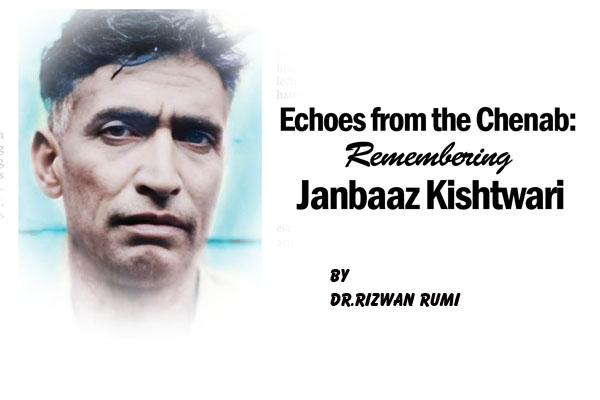
The singer was Janbaaz Kishtwari.
Curiosity soon replaced casual listening. I searched for more of his songs, read about his life, and discovered that I had stumbled upon one of Kashmir’s most remarkable yet underappreciated cultural icons. What began as an ordinary Instagram reel gradually transformed into an exploration of a musical legacy that deserves renewed recognition.
Janbaaz Kishtwari, born as Ghulam Nabi Doolwal in the scenic district of Kishtwar, was much more than a folk singer. He was a poet, composer, storyteller, and a guardian of the cultural memory of the Chenab Valley. At a time when music emerged from lived experiences rather than digital algorithms, he gave voice to the emotions, aspirations, and collective identity of ordinary people.
His songs carried the fragrance of mountain villages, the melody of flowing rivers, the silence of snow-covered peaks, and the resilience of communities whose stories rarely found a place in mainstream narratives. Every composition reflected an intimate relationship with the land and its people.
Listening to Janbaaz Kishtwari today is an entirely different experience from consuming contemporary music. His voice does not seek attention through loud arrangements or sophisticated technology. Instead, it reaches the listener through honesty. One hears not merely a singer but a life deeply connected to its surroundings. His songs speak of love without superficiality, sorrow without bitterness, hope without illusion, and faith without division.
Perhaps this explains why his music continues to resonate decades after it was first recorded. Genuine art does not depend upon time; it transcends it.
One of the most remarkable aspects of Janbaaz Kishtwari’s artistic journey was his ability to preserve regional traditions while appealing to universal human emotions. Through his poetry and music, he safeguarded the linguistic richness of Kishtwar and the broader cultural heritage of Kashmir. In every performance, he transformed local experiences into timeless expressions of humanity.
His artistic philosophy also reflected Kashmir’s centuries-old tradition of coexistence. His verses celebrated compassion, humility, and unity, reminding listeners that different paths ultimately lead towards the same human values. Long before conversations about communal harmony became political slogans, Janbaaz expressed these ideals naturally through poetry and melody.
Unfortunately, cultural memory is often fragile.
Many young people today recognise fragments of his songs circulating on social media without knowing the extraordinary life behind them. In an era where popularity is measured through likes, shares, and trending hashtags, artists like Janbaaz Kishtwari remind us that true greatness is measured by endurance. His music continues to move listeners not because it follows changing fashions, but because it speaks directly to the human heart.
This experience also made me reflect upon the unexpected role of social media. We often criticise digital platforms for encouraging superficial engagement and shortening our attention spans. Much of that criticism is justified. Yet, occasionally, these same platforms become unlikely custodians of cultural memory. An old recording uploaded by an admirer can introduce an entirely new generation to voices that might otherwise have faded into obscurity.
Sometimes, preserving heritage begins with something as simple as refusing to scroll past.
Kashmir possesses one of South Asia’s richest traditions of folk music. These songs are not merely forms of entertainment; they are repositories of history, language, customs, spirituality, and collective memory. They narrate stories of migration, harvests, love, separation, festivals, resilience, and everyday life. When such voices disappear, entire chapters of cultural history risk being forgotten.
That is why artists like Janbaaz Kishtwari deserve renewed scholarly attention. Their works should be documented, digitised, translated, researched, and introduced in educational institutions. Universities should encourage research on regional folk traditions. Cultural organisations should archive original recordings before they are lost forever. Radio stations and digital platforms should actively revive the works of legendary folk musicians whose contributions remain insufficiently acknowledged.
Preserving folk music is not an exercise in nostalgia. It is an investment in cultural continuity. A society that disconnects itself from its artistic roots gradually loses the emotional vocabulary through which generations once understood themselves.
As I continued listening to Janbaaz Kishtwari’s songs, I realised that I had not simply discovered an old singer. I had rediscovered an entire cultural landscape that modern life often encourages us to overlook. His melodies carried me back to a Kashmir where music was woven into everyday existence, where poetry belonged to ordinary people, and where songs travelled from one generation to another without needing digital promotion.
In many ways, Janbaaz Kishtwari represents the enduring spirit of Kashmir itself—resilient, lyrical, compassionate, and deeply rooted in its cultural traditions. His legacy reminds us that while technology changes the way we consume music, it should never change the values that music preserves.
That brief Instagram reel lasted less than a minute.
Yet it opened a door to decades of artistic brilliance, cultural wisdom, and human emotion. It reminded me that sometimes the most meaningful discoveries are made not inside libraries or concert halls, but in the quiet moment when we choose to listen.
Perhaps that is the greatest gift Janbaaz Kishtwari continues to offer us. Even years after his voice first echoed through the valleys of Kishtwar, it still has the power to make us pause, reflect, and reconnect with the soul of Kashmir.
In a world constantly rushing towards the next trend, his music gently asks us to remember where we came from. And perhaps there is no greater purpose for art than that.
Dr. Rizwan Rumi is a writer, columnist and author with a doctorate degree. He regularly writes for various national and international publications and has published extensively on education, society and contemporary issues.

