

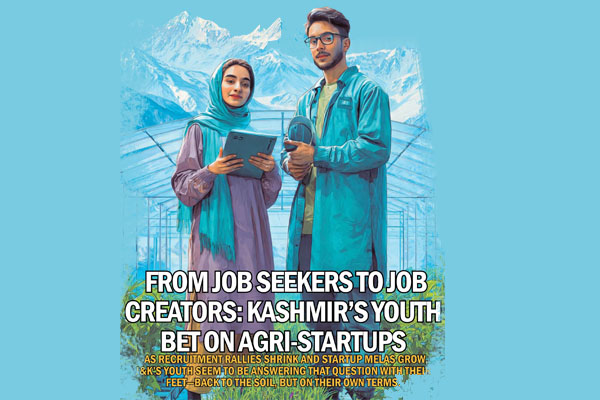
As recruitment rallies shrink and startup melas grow, J&K’s youth seem to be answering that question with their feet—back to the soil, but on their own terms.
The 24-year-old from Pulwama used to stand in line outside government offices with his MA degree. Today, Abrar Bhat checks his phone for orders of saffron-infused honey from Mumbai and Dubai. His 3-kanal farm, once used only for paddy, now runs a small processing unit employing 6 other young people.
Bhat is not alone. Across Jammu and Kashmir, a quiet shift is underway. Faced with government job saturation and private sector hesitancy, educated youth are returning to the land—but with laptops, Instagram pages, and cold-chain logistics. The “agri-startup” is becoming J&K’s unexpected new career path.
The Push Factor: Where Are The Jobs?
J&K’s unemployment rate for ages 15-29 stood at 18.3% in 2025, well above the national average of 10%. For graduates, the figure crosses 30%. With nearly 5 lakh youth registered at employment exchanges and recruitment drives drawing tens of thousands for a few hundred posts, the math no longer works.
“I applied for Naib Tehsildar, SI, Bank PO—nothing clicked for 4 years,” says Saima Jan, 27, from Anantnag. “My father said, ‘the land won’t reject you like these exams do.’” In 2023 she started a high-density apple nursery on 2 kanals. Last year, she sold 40,000 saplings at Rs. 180 each to farmers in Shopian and Himachal. Revenue: Rs. 72 lakh.
The Pull Factor: Policy, Tech, and Market
Three things changed the game after 2020.
First, policy. The J&K Agriculture Production Department’s Holistic Agriculture Development Programme (HADP) earmarked Rs. 5,013 crore with 29 projects. Subsidies now cover 50-80% of polyhouses, cold stores, and food processing units. More importantly, land-leasing was liberalized, letting youth without inherited land start ventures on leased farms.
Second, technology. Soil health cards, drone spraying demos, and YouTube tutorials in Kashmiri have cut the knowledge gap. “My grandfather farmed by instinct. I farm by data,” laughs Mudasir Wani, who runs a 1,000-bird poultry unit in Budgam monitored through a mobile app. Mortality is down from 15% to 3%.
Third, market access. Srinagar’s e-commerce boom and better road links mean a Baramulla lavender farmer can ship essential oil to Bengaluru in 48 hours. Niche J&K products—saffron, walnut oil, exotic mushrooms, trout—now have D2C brands. Platforms like JK Agro Mart and Kashmir Box aggregate small growers.
The New-Age Farmer: Young, Skilled, Branded
Walk through the Agriculture Mall in Lal Mandi, Srinagar, and the shift is visible. Next to fertilizer shops are stalls for “Himalayan Hearth Mushrooms” and “Peer Panjal Apiary.” The owners wear hoodies, not pherans, and talk GST, not just weather.
- Value Addition: Rather than selling raw apple, Tanveer Mir of Sopore slices, dehydrates, and sells “Apple Chips” at Rs. 450/100gm online. A crate that fetched Rs. 800 now yields Rs. 6,000 after processing.
- Contract Farming: Groups of MBA grads in Jammu are leasing land in RS Pura for exotic vegetables like broccoli and cherry tomato, with buy-back deals from Delhi hotels.
- Agri-Tourism: In Pahalgam, a botany postgrad turned 5 kanals into a “Lavender Park” charging Rs. 200 entry. Visitors get photos, tea, and a small bottle of oil.
The Hurdles: Not All Rosy
For every success, there are stalled projects. Banks remain wary of agri-loans without collateral. “They still want my father’s land papers, though HADP says CGTMSE cover is enough,” complains a startup founder in Samba. Power outages spoil cold stores. And climate shocks are real—March 2026 hailstorms wiped out 40% of Shopian’s blossom.
Social stigma lingers too. “Relatives still ask when I’ll get a ‘proper job’,” says Saima. Parents who sold land to fund http://B.Tech degrees struggle to see their children return to it.
The Ecosystem Responds
Incubators are stepping in. SKUAST-Kashmir’s Innovation Centre has mentored 400+ agri-startups. J&K Bank’s “Startup Fund” disbursed Rs. 130 crore last fiscal, 60% to agri-allied units. NABARD’s FPO drive has created 200+ farmer collectives, giving youth bargaining power.
The government is also pushing “One District, One Product.” Pulwama for milk, Ramban for anardana, Kishtwar for saffron. The idea: create clusters so a single youth isn’t fighting alone.
Beyond Romanticism: Is It Scalable?
Critics warn that not everyone can sell premium honey. J&K’s landholding average is just 0.59 hectares. “Agri-startups work for high-value crops, not wheat and rice,” says an economist at Kashmir University. “We need mass employment, not just boutique success.”
Yet the numbers suggest momentum. In 2023-24, J&K registered 1,742 new agri-startups, up from 300 in 2020-21. The sector contributed 18.5% to GSDP and employed 52% of the workforce, but now that workforce is younger and more profitable per kanal.
The Way Forward
Three things could lock in the gains. One, crop insurance that actually pays within a season. Two, rural internet and cold-chain at block level, not just district. Three, mindset campaigns in colleges that de-stigmatize farming as “last option.”
Abrar Bhat puts it simply: “A government job gives salary to one. My unit gives salary to six. Which is better for Kashmir?”
As recruitment rallies shrink and startup melas grow, J&K’s youth seem to be answering that question with their feet—back to the soil, but on their own terms. - KP Bureau

