

Dr. Rafeeq Masoodi
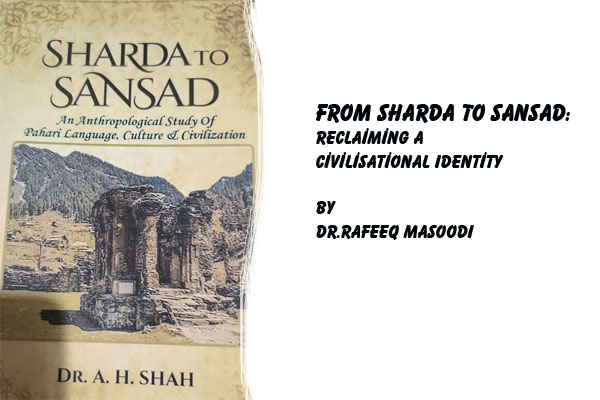
History is rarely written by those who live on the periphery. It is usually recorded by courts, empires, and dominant languages. In “SHARDA TO SANSAD: An Anthropological Study of Pahari Language, Culture & Civilisation”, Dr. A. H. Shah, a senior JKAS officer and committed scholar, attempts to fill that historical gap. He presents the story of the Pahari people of Jammu and Kashmir — a community that has preserved its language, culture and dignity not through state support, but through collective resilience.
The title of the book is both symbolic and historical. Sharda refers to the ancient Sharda Peeth in the Neelum Valley, once a great centre of Sanskrit learning, philosophy, logic and the Sharda script. Sansad refers to the Parliament of India. The journey between the two encapsulates a thousand years of intellectual heritage, political marginalisation, cultural survival, and finally, constitutional recognition.
Dr. Shah’s central argument is that the history of languages and scripts is never merely linguistic. It is deeply social and political. The decline of the Sharda script and the fall of Sharda Peeth were not just the loss of an institution. They represented the breaking of a knowledge ecosystem. Yet, civilisations do not vanish with institutions. They continue to live in oral traditions, folk practices, rituals, and the structure of everyday speech. The survival of the Pahari language is the best example of this continuity.
One of the most important sections of the book deals with the Pahari Renaissance Movement. For decades, Pahari remained a spoken language of the home and the bazaar, denied space in education, administration and media. The establishment of the Pahari Section in the J&K Academy of Art, Culture and Languages in 1978, the introduction of Pahari programmes on radio and television, and the constitution of an Advisory Board for Pahari Speaking People were turning points. These were not just bureaucratic decisions. They were milestones in a cultural assertion — an effort to claim public space, literary respectability and political visibility for the Pahari identity.
Dr. Shah also places the Pahari region in a larger civilisational context by discussing its links with Gandhara. The Gandhara tradition was not confined to geography. It was a confluence of South Asian, Central Asian and Hellenistic ideas in art, religion and thought. By connecting Pahari culture to this heritage, the author reminds us that the mountains were never isolated. They were always a meeting ground of civilisations.
The book reaches its most significant point with the events of February 2024, when the Parliament of India granted Scheduled Tribe status to the Pahari Ethnic Group. Dr. Shah describes this as a “civilisational correction”. After decades of socio-economic backwardness and administrative neglect, the community now has access to reservations in education, employment and political representation. This decision marks the formal inclusion of Paharis in the constitutional framework of social justice.
In this light, “Sharda to Sansad” is no longer just a metaphor. It is a real journey — from an ancient seat of learning to the highest democratic institution of the country.
This book is an important contribution to the cultural and anthropological literature of Jammu and Kashmir. It is written with scholarship, empathy and a deep sense of belonging. It tells us that a nation becomes stronger not by erasing diversity, but by recognising and respecting it.
Verdict: Sharda to Sansad is a timely, well-researched and humane work. It honours the past, explains the present, and offers hope for the future of the Pahari people.
Dr. Rafeeq Masoodi is an acclaimed poet, author & IBS (Retd.)

