

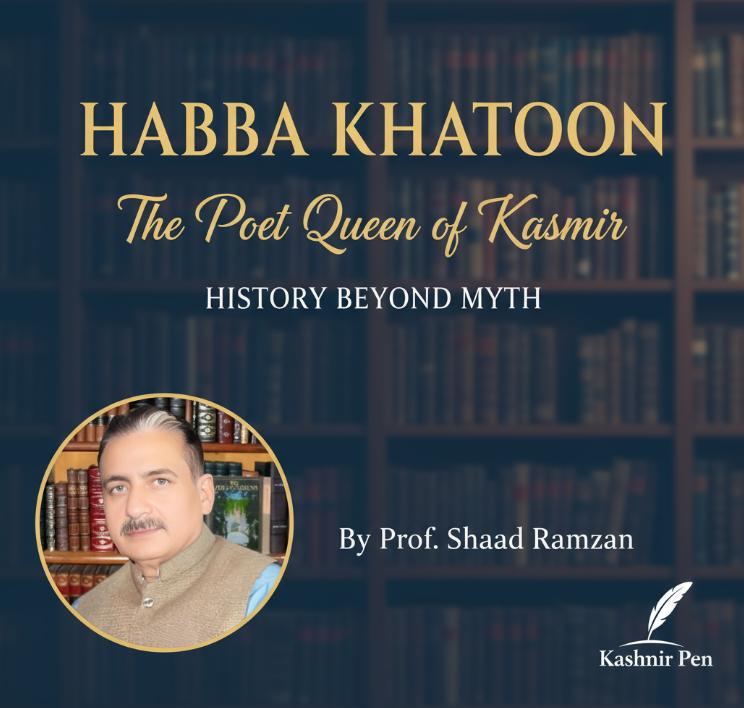
By prof.Shaad Ramzan
Habba Khatoon is not a mere fabricated figure but a historical character — a 16th-century poet whose life and legacy hold an enduring place in Kashmiri cultural and literary history. The Gulistan-e-Kashmir, written by Abdul Wahab Shayiq nearly fifty years after her death, offers one of the earliest recorded accounts of her life. Shayiq mentions that Habba Khatoon belonged to the noble lineage of Amir Kabir Mir Syed Hamdani, being a relative of Syed Bahar and Badwal Jamal. This indicates that she was a Syed by birth, and internal evidence within her poetry reflects spiritual refinement and Sufi sensibility consistent with such a background.
مٲلِس ناو چُھم سیدالبہار ماجہِ ناو چُھم بدوالجمال
سید کور چھس پُر کمالو وۄتھٕ لالو نیدرے
According to Shayiq, Habba Khatoon — whose original name was Habbiba — was first married to her cousin, Syed kamal-ud-Din. She mentions this in her poetry which goes like this,
یار میون جمال لٹہِ کمال تس چُھ ناو
سُہ چُھم تتہِ بہ کس مٹہِ اکہِ لٹہِ ییہمنا
The marriage, however, ended in divorce due to certain personal circumstances. Later, she married Yousuf Shah Chak, the last independent ruler of Kashmir. The title Khatoon was not an alias but an honorific used for women of dignity and grace, hence the name “Habba Khatoon” simply means “Lady Habba.”
Being from a family of spiritual and noble descent, it is implausible to believe that Habba Khatoon’s relationship with Yousuf Shah Chak was anything less than a legitimate marriage. The notion that she was merely a romantic or fictional figure is contradicted by solid historical and literary evidence.
Mirza Akmal Din Badakshi popularly known as Mirza kamil who lived shortly after her time, mentions Habba Khatoon in his poetry, affirming her historical existence. Kashmiri folk songs and oral traditions are also rich with references to her, celebrating her both as a poet and as a queen. Moreover, contemporary figures such as Mirza Akaml din Badakshi and Habbibullah Nowshehri — who lived around the same period — have preserved graveyards that are still known today. Given Habba Khatoon’s immense popularity and her revered status among the masses, it is inconceivable that her grave alone would have gone unrecognized had it been located within the Valley of Kashmir.
From the 16th century up to the 1950s, no historical record from Kashmir mentions her graveyard being in the Valley. The claim that her grave lies near the Habba Khatoon Masjid emerged much later and lacks historical verification. It is particularly striking that this site never became a place of collective remembrance or reverence, despite the deep emotional connection Kashmiris hold for her.
Historical accounts reveal that around 1950, Sheikh Mohammad Abdullah, accompanied by the poet Ghulam Ahmad Mehjoor, visited Athwajan to inspect a site believed to be her grave. Yet, no written record or confirmation followed. In 1978, Sheikh Abdullah, along with Mohammad Yousuf Taing, travelled to Biswak in Bihar to examine the graves of Habba Khatoon and Yousuf Shah Chak. Both later documented their observations — Sheikh Abdullah in Urdu and Taing in Kashmiri — giving the first credible recognition to Biswak as the likely burial site.
I recently visited Biswak myself to understand the local perspective. The residents there identify a site known as “Habba Bibi ki Qabar,” which they believe to be the grave of Habba Khatoon. Interestingly, descendants of Yousuf Shah Chak still live in the area, further strengthening the historical link between Kashmir’s last queen and this distant region of Bihar.
Habba Khatoon was not only a gifted poet but also a master of Sufi music. Her verses, suffused with longing, spiritual wisdom, and lyrical beauty, continue to resonate through Kashmiri folk culture. From the 16th century to the modern era, historians and researchers have recognized her as a genuine historical figure rather than a mythical creation.
It is, therefore, imperative that historians and scholars undertake a serious and evidence-based inquiry into the life and legacy of Habba Khatoon — a woman who transcended her time to become an enduring symbol of Kashmir’s cultural and spiritual identity. Based on existing historical and literary evidence, and supported by oral traditions and local testimonies, it appears most plausible that the final resting place of Habba Khatoon lies in Biswak, Bihar — beside her beloved, Yousuf Shah Chak.

