

A Cultural World Rediscovered…..
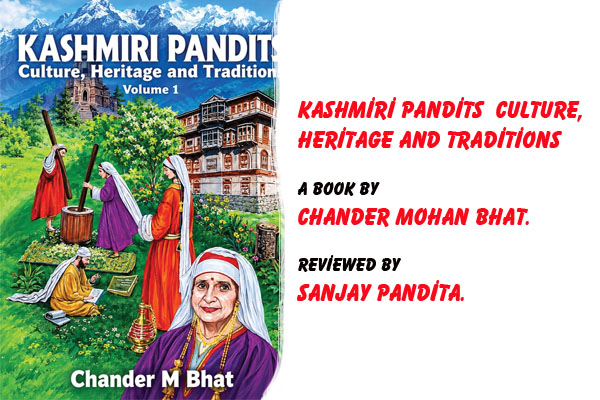
Some books preserve information; others preserve memory. Chander Mohan Bhat’s Kashmiri Pandits: Culture, Heritage and Traditions, spread across 462 pages and encompassing more than three hundred subjects, belongs to the latter category. It is an ambitious and deeply engaging attempt to document not merely the rituals and Sanskaars of the Kashmiri Pandit community, but the texture of an entire way of life—a world expressed through its ceremonies, flowers, birds, fruits, household objects, food, traditional pickles, marriage customs, thread ceremonies and countless other details that once formed the natural vocabulary of everyday existence.
The value of the book lies precisely in this breadth. Culture is not created only in temples or preserved in scriptures. It lives equally in the kitchen, the courtyard, the garden and the household; in the objects handled every day, the foods prepared according to season, the ceremonies observed at significant moments of life and the names given to things that were once so familiar that nobody thought it necessary to record them. Bhat has recognised the importance of these seemingly ordinary details and brought them together in a work that can be read as a portrait of a civilisation in its intimate, lived form.
At the heart of the book is the author’s effort to rediscover the Sanskaars and traditional practices that shaped the life of Kashmiri Pandits. But the book does not stop at describing a ritual. It attempts to place these practices within their cultural setting and, wherever possible, to preserve the knowledge associated with them. This is important because a ritual separated from its meaning can eventually become an empty form. The Sanskaars represented stages of human life accompanied by ideas of refinement, responsibility, family, social order and spiritual awareness. To record them is therefore to preserve not only ceremonies but the philosophy of life that lay behind them.
Yet it is the book’s movement beyond formal ritual that makes it particularly distinctive. Bhat turns his attention to the natural and material world that surrounded Kashmiri Pandit life. The flowers and birds he records belong to the landscape of an earlier Kashmir; the fruits recall seasonal rhythms and household practices; traditional household articles speak of ways of living that have gradually been altered or replaced. Many of these things were once too ordinary to be regarded as heritage. Their very familiarity made them invisible. It is only when they begin to disappear that we realise that they too were carriers of memory.
The same is true of food. Traditional Kashmiri pickles and other culinary practices may appear at first to be peripheral to a discussion of culture, but they are an intimate expression of it. Food preserves the memory of seasons, kitchens, family habits and inherited knowledge. A particular preparation can evoke an entire household; a taste can bring back a season or a festival; a recipe passed from one generation to another can contain more cultural history than a formal description ever could. By including such material, Bhat widens the meaning of heritage and makes the book a record of lived culture rather than merely ceremonial culture.
Marriage customs receive similar attention. The traditional Kashmiri Pandit wedding was not confined to the principal ceremony itself; it unfolded through a series of observances before and after the wedding, each occupying its own place in the social and ritual order. By documenting these practices, along with thread ceremonies and other rites of passage, the author preserves a social world in which important transitions in human life were accompanied by a rich network of customs, relationships and meanings. For younger readers who may have encountered only fragments of these practices, such documentation can be especially illuminating.
This comprehensive approach gives the book an unusual character. It is simultaneously a record of religious practice, social custom, material culture, food tradition and the natural environment. The seemingly disparate subjects—Sanskaar, marriage ceremony, thread ceremony, pickle, household object, fruit, flower or bird—begin to acquire a relationship when viewed together. They are individual pieces of the same cultural mosaic.
The need for such documentation becomes more compelling in the context of migration. When the Kashmiri Pandit community left the Valley, the rupture was not only geographical. The everyday environment through which cultural knowledge had traditionally passed from one generation to another was also disrupted. Earlier, much of this knowledge was acquired without formal teaching. Children watched elders perform rituals, heard traditional expressions, recognised objects in the household, tasted seasonal preparations and grew up surrounded by the landscape that gave meaning to many of these practices. After migration, that natural chain of transmission became increasingly fragile.
Consequently, what had once been lived began to require conscious remembrance.
This is where Bhat’s work assumes its larger significance. He has gathered knowledge that might otherwise remain scattered in individual memories and family recollections and has given it a durable form. His book can thus be read as an attempt to arrest the quiet disappearance of cultural vocabulary—the names, practices, objects, ceremonies and customs that tell a people who they are and how their ancestors lived.
The photographic dimension of the work adds considerably to this achievement. Many of the photographs were taken by the author himself during his travels through villages of the Kashmir Valley over nearly thirty-seven years. They provide visual testimony to a cultural landscape that has undergone enormous change. The photographs are not merely illustrations accompanying the text; they constitute an additional layer of documentation. An object, a ritual setting or a traditional practice photographed in its actual environment can sometimes preserve a dimension of memory that words alone cannot fully convey.
The fact that the author undertook this extensive documentation over such a long period gives the work an added archival quality. He was not simply collecting information from books; he was travelling, observing and recording. His photographs and descriptions preserve details encountered in villages and communities, making the book an important repository of material that might otherwise have remained undocumented.
There is, therefore, a quiet urgency behind the book. Much of what it records may still exist in fragments, but fragments are not enough to sustain a cultural tradition indefinitely. A word forgotten today may take with it the object it described; an abandoned ceremony may eventually leave behind no memory of its meaning; a traditional food preparation may disappear when the last person who knows how to make it is gone. Cultural extinction often happens silently, one small disappearance at a time.
Bhat’s book works against that silence.
Its greatest relevance, perhaps, is to posterity. The younger generation of Kashmiri Pandits is growing up in circumstances vastly different from those of its ancestors. For many, Kashmir exists as an inherited memory rather than a lived environment. They may know the names of festivals and ceremonies without knowing their sequence, meaning or cultural background. They may recognise a traditional dish without knowing how it was prepared, or hear the name of an old household object without ever having seen it. A book such as this can bridge that distance.
It can become a starting point for questions, conversations and rediscovery.
For the older generation, the pages may evoke recognition; for the middle generation, they may recover memories that have remained dormant; for the younger generation, they may offer an introduction to a heritage that would otherwise reach them only in fragments. In this sense, the book becomes more than a record of what was. It becomes a resource for understanding what has been inherited.
And this distinction matters. Preservation does not necessarily mean reproducing every old practice exactly as it existed. Nor does respect for tradition demand resistance to change. What matters first is knowledge. One must know what existed before one can meaningfully decide what should be remembered, revived, adapted or allowed to pass into history.
That is why the book’s contribution extends beyond nostalgia. It does not ask the reader merely to look backward with longing. It asks the reader to look backward with curiosity and understanding. What did our ancestors practise? What objects shaped their domestic lives? What foods marked their seasons? What ceremonies accompanied their important transitions? What did the natural world around them look and sound like? What meanings did they attach to the ordinary things of life?
These questions transform heritage from something inherited passively into something understood consciously.
The real achievement of Chander Mohan Bhat, therefore, lies in recognising that the history of a community is not contained only in its celebrated figures and major events. It is also preserved in the small details of ordinary life. A flower, a bird, a fruit, a household utensil, a traditional pickle, a marriage custom or a thread ceremony may appear insignificant in isolation. Together, however, they reveal the character of a society.
This is what makes Kashmiri Pandits: Culture, Heritage and Traditions valuable. It gathers those details before they disappear completely and places them within the reach of readers who may otherwise never encounter them. In doing so, Bhat has created something that is part reference book, part cultural record and part memory repository.
Perhaps the deepest significance of the work lies here: when a community has been separated from the physical setting in which its traditions once lived naturally, documentation can become a form of continuity. A book cannot recreate an ancestral home, a lost courtyard or the social world of an earlier Kashmir. But it can preserve the knowledge of that world. It can keep its vocabulary alive. It can give a future generation something more substantial than nostalgia—a record through which memory can be examined, understood and passed on.
At a time when the distance between generations is widening and many inherited practices are disappearing from everyday life, Bhat’s 462-page volume arrives as a timely act of cultural remembrance. Its pages preserve not simply rituals but the details that gave those rituals a setting and a meaning. They preserve not merely the past as history, but the past as lived experience.
In the end, the book’s greatest accomplishment may be that it teaches us to look again at what we once considered ordinary. For a civilisation, nothing is entirely ordinary. The flower in the courtyard, the bird outside the window, the fruit of a particular season, the pickle prepared in a household, the object kept in a corner, the ceremony performed before a wedding—all can become vessels of memory.
Chander Mohan Bhat has gathered many of these vessels into one volume. What he has preserved in its pages is, therefore, more than a collection of customs and traditions. It is the imprint of a way of life—and a cultural inheritance placed, with care, in the hands of those who will come after us.
ABOUT THE REVIEWER
Sanjay Pandita is a Poet , writer, Columnist,critical Analyst and can be reached at sanjaypanditasp@gmail.com

