

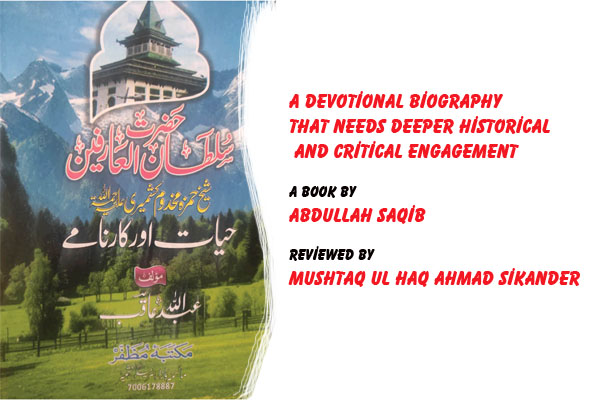
This review critiques the book for its devotional tone, highlighting its rich
narrative of Sheikh Hamza Makhdoom while calling for deeper historical
and analytical treatment.
Hazrat Sultan Ul Arifeen Sheikh Hamza Makhdoom Kashmiri (R.A): Hayat Aur Karnamey
Author: Abdullah Saqib
Publisher: Maktaba Muzaffar, Maisuma, Srinagar, Kashmir
Year of Publication: 2025
Pages: 396
Price: Rs 750
Abdullah Saqib’s Hazrat Sultan Ul Arifeen Sheikh Hamza Makhdoom Kashmiri (R.A): Hayat Aur Karnamey is a substantial biographical work that seeks to present the life, spiritual journey, and miraculous deeds of one of Kashmir’s most revered Sufi saints. The book is structured around a devotional conception of the saint’s personality, foregrounding tales of miracles, spiritual feats, and the traits of piety that distinguish him from ordinary believers. While it provides a rich narrative of Sheikh Hamza’s life, it is also marked by serious lacunae, particularly in the areas of historical analysis, political context, sectarian nuance, and critical evaluation of the saint’s intellectual contributions.
Preliminary Material and the Introductory Framework
The book opens with multiple introductions contributed by various scholars, Mufti Muzaffar Hussain Makhdoomi, Mufti Nazir Ahmad Qasmi, Mufti Shafiq ur Rahman Qasmi, Prof Syed Mohammad Tayyib Kamili, and Maulana Showkat Hussain Keng. These introductions serve to establish the religious legitimacy of the work and to express reverence for Sheikh Hamza Makhdoom as a spiritual icon. The foreword is written by Mohammad Abdullah Saqib, a retired teacher and the author himself, who presents the book as both a devotional tribute and a scholarly effort to preserve the memory of the saint.
However, these introductory pieces, while valuable in asserting the book’s spiritual orientation, also reveal a tendency to treat the saint’s life as a matter of faith rather than historical inquiry. The introductions do not interrogate the book’s methodology, nor do they offer a critical perspective on the use of miracle narratives, the reliability of the sources cited, or the broader socio-political context of Sheikh Hamza’s era. Instead, they largely function as endorsements of the book’s religious credibility, reinforcing a devotional rather than analytical approach to the saint’s biography. Mufti Nazir Ahmad Qasmi in his introduction calls Mughal Emperor Aurangzeb a Just ruler (P-14) How can this claim be justified, when he killed all his brothers for the throne and also imprisoned his father, Emperor Shah Jahan? This informs us of the myopic vision of our scholars regarding history.
Historical Positioning and the Problem of Ancestry
The book correctly identifies that Sheikh Hamza Makhdoom’s ancestors were Hindu Rajputs who later converted to Islam. This is a significant fact, as it situates the saint within the broader process of religious transformation in Kashmir, where local elites and families gradually adopted Islam over several centuries. Yet the author does not explore the implications of this conversion in any meaningful way. There is no discussion of how such conversions were negotiated socially, politically, or spiritually, nor is there any attempt to analyse the continuity or rupture between the pre-Islamic and Islamic identities of the Rajput families.
By treating the conversion as a mere biographical datum, the book reduces a complex historical process into a static fact. This omission is particularly problematic because it ignores the larger dynamics of religious identity in medieval Kashmir, where the conversion of Rajput clans was often intertwined with the rise of Islamic rule, shifts in power structures, and the reconfiguration of local social hierarchies. The absence of such analysis leaves the reader with a superficial understanding of the saint’s background and fails to engage with the historical significance of his ancestry.
Similarly, the book provides a brief background of the kings who ruled Kashmir before and after the establishment of Islamic rule. While it mentions key figures such as Bulbul Shah, a Suharwardi Sufi and disciple of Shah Naimatullah Farsi, the treatment remains largely narrative and descriptive. There is no attempt to analyse the political, religious, or cultural consequences of the rule of these kings, nor is there any discussion of how their reigns influenced the spiritual and social landscape of Kashmir. The result is a chronology that lacks critical depth, offering little insight into the broader historical context in which Sheikh Hamza lived and taught.
The Saint’s Early Life and Spiritual Journey
The book narrates the saint’s childhood and student days with a focus on miracles and spiritual virtues. It describes his practice of Tahajjud (night) prayer, his devotion to worship, and the miraculous events that are said to have accompanied his early life. These narratives contribute to the hagiographical tone of the book, presenting Sheikh Hamza as a figure born with spiritual gifts and destined for greatness. However, this emphasis on miracles and childhood wonders overshadows the more substantive aspects of his spiritual and intellectual development.
The book also recounts the saint’s metaphorical meeting with Khizar (A.S), an event that symbolizes his spiritual quest and his search for divine guidance. This encounter is presented as a pivotal moment in the saint’s life, marking his transition from a seeker of knowledge to a seeker of spiritual truth. Yet the author does not explore the symbolic or theological significance of this meeting, nor does he analyse its place within the broader tradition of Sufi narratives. The encounter is treated as a devotional story rather than as a meaningful element of the saint’s spiritual biography.
The need for a Murshid, or spiritual guide, is another theme that the book addresses. It presents the idea that true spiritual progress requires the guidance of a teacher who can lead the seeker along the correct path. In this context, the book identifies Syed Jamal Uddin Bukhari as the Murshid of Sheikh Hamza Makhdoom. This relationship is described in detail, including the saint’s desire to leave Kashmir and join his Murshid, only to be debarred from doing so. While this narrative is significant in illustrating the saint’s spiritual submission and his commitment to the path of Tasawwuf, the book does not explore the implications of this relationship for the saint’s later teachings or his role in Kashmiri Sufism.
Furthermore, the book mentions that Sheikh Hamza was associated with both the Suharwardi and Chishti Silsilas, yet it does not examine the theological or practical differences between these two traditions. There is no discussion of how the saint navigated these affiliations, how he integrated their teachings into his own spiritual practice, or how his association with both orders influenced his role as a spiritual leader in Kashmir. The absence of such analysis reduces the saint’s affiliation to a mere biographical detail, rather than a significant element of his spiritual identity.
Spiritual Practices, Ethics, and the Path of Faqr
The book details the saint’s spiritual practices, including his devotion to Tahajjud, his adherence to Halal Rizq (lawful income), and his cautious approach to food and dress. It also highlights his decision to opt for Faqr, or pauperization, as a means of renouncing worldly attachments and pursuing spiritual purity. These elements are presented as evidence of the saint’s piety and his commitment to the path of Tasawwuf.
However, the book does not critically examine the significance of these practices within the broader framework of Islamic spirituality. There is no discussion of how the concept of Faqr was understood in different Sufi traditions, how it was practiced by other saints, or how it was interpreted by scholars of Islamic law. The saint’s practices are presented as isolated acts of devotion rather than as part of a larger spiritual and ethical system.
The book also addresses the concepts of Shariat, Tareeqat, and the real path of Tasawwuf, distinguishing between true spirituality and the practices of “scholars of the world” and “Sufis of apparent cause.” It presents Sheikh Hamza as a figure who upheld the authentic path of Tasawwuf, which has gained a bad name due to the actions of “criminal Sufis.” This distinction is significant, as it reflects the saint’s concern with maintaining the integrity of spiritual practice and guarding against corruption and hypocrisy.
Yet the book fails to analyse the historical and theological context of this distinction. There is no discussion of the debates within Sufi tradition about the relationship between Shariat and Tareeqat, nor is there any exploration of the criticisms levelled against Sufism by various Islamic scholars. The saint’s stance is presented as a matter of faith rather than as a position within a larger intellectual and spiritual discourse.
The Problem of Fake Disciples and Guides
One of the notable themes in the book is the issue of fake disciples and guides. The author describes how Sheikh Hamza sought to protect his disciples spiritually and how he devised methods to distinguish between true and false spiritual authorities. The book explains that fake Pirs and disciples are to be identified and shunted out, while real ones are characterized by genuine spirituality. This theme is significant, as it reflects the saint’s concern with the authenticity of spiritual practice and the dangers of spiritual deception.
However, the book does not provide a clear methodology for distinguishing between authentic and counterfeit spiritual authority. The criteria for identifying fake Pirs and disciples are presented as moral assertions rather than as analytically grounded distinctions. There is no discussion of the historical or textual evidence that supports these claims, nor is there any exploration of the broader debates within Sufi tradition about the nature of spiritual authority. The result is a narrative that lacks critical depth and fails to engage with the complexities of spiritual legitimacy.
The Debarment of Music and the Ethics of Discipleship
The book mentions that Sheikh Hamza was against music, unlike other Sufis who incorporated it into their spiritual practices. This stance is presented as evidence of the saint’s adherence to the strict principles of Shariat and his rejection of practices that may be seen as innovations or deviations from Islamic law. However, the book does not explore the historical or theological context of this position. There is no discussion of the debates within Islamic tradition about the permissibility of music, nor is there any analysis of how the saint’s stance on music influenced his role as a spiritual leader.
The book also addresses the concept of Tasawur e Sheikh, or imagining and concentrating on the face and personality of the Sheikh, as a means of spiritual connection. It describes the etiquette to be followed when in the presence of the Sheikh, including how to speak, talk, eat, and behave, with an emphasis on obedience, even blind obedience. These elements are presented as essential components of the disciple’s relationship with the spiritual guide.
However, the book does not critically examine the implications of these practices. There is no discussion of the potential dangers of blind obedience, nor is there any exploration of the historical or theological debates about the role of spiritual imagination in Sufi practice. The saint’s teachings on discipleship are presented as matters of faith rather than as elements of a broader spiritual and ethical system.
Miracles, Quran, Hadith, and the Authority of Awliya
The book devotes a significant portion of its narrative to the miracles attributed to Sheikh Hamza and his disciples. It quotes Quranic verses and Hadith that discuss the miracles performed by the Awliya (saints), presenting these as evidence of the authenticity of the saint’s spiritual powers. The author also quotes the views of Imam Ibn Taimiyyah and Ibn Juzi on miracles and other issues, using these to support his own stance on the legitimacy of the saint’s miracles.
This reliance on miracle narratives is one of the most problematic aspects of the book. While miracles are an important element of Sufi tradition, the author’s disproportionate emphasis on them overshadows the need for a critical examination of the saint’s intellectual and spiritual contributions. The miracles are presented as self-evident truths rather than as symbolic or rhetorical devices that served to bolster the saint’s spiritual stature in the eyes of his followers.
Furthermore, the book’s invocation of Ibn Taimiyyah and Ibn Juzi is problematic, as both scholars are known for their skepticism toward the miraculous claims of Sufis and their emphasis on a literalist interpretation of Islamic doctrine. By quoting their views without contextualizing their theological positions, the book risks misrepresenting their stance and undermining its own argument about the authenticity of Sheikh Hamza’s miracles.
The book also states that scholars of the world and Sufis of apparent cause are not on the real path, and that authentic Tasawwuf has been tarnished by “criminal Sufis.” This claim is presented as a moral assertion rather than as a historically grounded analysis. There is no discussion of the debates within Islamic tradition about the nature of spiritual authority, nor is there any exploration of the criticisms leveled against Sufism by various scholars. The saint’s stance is presented as a matter of faith rather than as a position within a larger intellectual and spiritual discourse.
Political Affiliations and Sectarian Silences
The book mentions that Qazi Chak, the maternal uncle of Sheikh Hamza Makhdoom, wanted him to accept a high post and land. This relationship is significant, as it places the saint within the political structures of his time and suggests that his spiritual authority may have had political ramifications. However, the book does not explore the implications of this relationship or how the saint’s spiritual teachings interacted with the political dynamics of the Chak dynasty.
More importantly, the book fails to address Sheikh Hamza’s views on Shia Muslims and Islamic sects. While it mentions that he was a staunch follower of Shariat and Sunnah and denounced innovations, it does not elaborate on how his stance intersected with the broader sectarian dynamics of Kashmir. The silence on this issue is particularly significant, given that the Chak rulers were known for their Shia sympathies and that Sheikh Hamza’s teachings may have been part of a larger Sunni response to Shia influence in the Valley.
The Legacy of Caliphs and the Problem of Authentic Narratives
The book dedicates considerable space to Sheikh Hamza’s caliphs and disciples, recounting stories and miracles attributed to them. It acknowledges that many of these stories are not correct, yet it does not provide a methodology for distinguishing between authentic and spurious narratives. This omission is particularly problematic, given that the tradition of Sufi biography is rife with fabricated stories that serve to enhance the spiritual stature of the saints.
Without a critical framework to evaluate these narratives, the book risks perpetuating misinformation and undermining its own claim to scholarly rigor. The caliphs and disciples are presented as figures of devotion rather than as historical subjects whose lives and teachings can be examined critically.
Concluding Assessment
Abdullah Saqib’s Hazrat Sultan Ul Arifeen Sheikh Hamza Makhdoom Kashmiri (R.A): Hayat Aur Karnamey is a work of considerable devotional ambition but limited critical depth. It provides a rich narrative of the saint’s life, spiritual practices, and miraculous deeds, yet it fails to engage with the historical, political, and theological complexities that shaped his legacy. The book’s apologetic tone, its treatment of controversial figures, its silences on sectarian and political issues, and its reliance on miracle narratives all point to a deeper reluctance to confront the ambiguities of Kashmiri Sufi history.
For readers seeking a devotional portrait of Sheikh Hamza Makhdoom, the book may offer some satisfaction. However, for those interested in a critical and historically grounded account of his life and thought, the book falls short. It prioritizes reverence over analysis, and in doing so, it misses the opportunity to contribute meaningfully to the scholarly discourse on Kashmiri Sufism. What is needed is not merely a compendium of miracles and stories, but a rigorous examination of the saint’s intellectual contributions, his political engagements, and his role in the broader religious and cultural transformations of medieval Kashmir.
ABOUT THE REVIEWER
M.H.A. Sikander is Writer-Activist based in Srinagar, Kashmir and can be reached at sikandarmushtaq@gmail.com
First publsihed in NewAgeIslam
