Humour has always occupied an ambiguous yet powerful position in literature. While tragedy and philosophical seriousness are frequently perceived as the markers of profound literary expression, humour often performs a subtler but equally penetrating function. The finest humour is rarely frivolous; it acts as a mirror reflecting the incongruities and contradictions embedded in everyday life. Beneath laughter often lies a sharp awareness of social realities, human follies, and the strange theatre of behaviour that unfolds in ordinary situations. Satire, irony, and wit have therefore remained essential literary tools through which writers interrogate society without the weight of overt moral preaching.
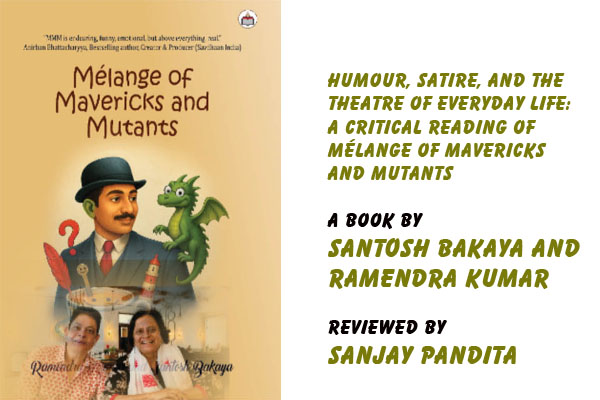
The collaborative volume Mélange of Mavericks and Mutants by Santosh Bakaya and Ramendra Kumar emerges within this long tradition of reflective humour. The book presents a collection of essays and anecdotal narratives that transform commonplace experiences into literary reflections on human behaviour. At a time when contemporary literature often gravitates toward themes of crisis, alienation, and socio-political upheaval, this work reminds readers that humour can also function as a mode of social commentary—one that reveals uncomfortable truths while maintaining an atmosphere of amusement.
At first glance, the book appears deceptively simple in its structure. Comprising 109 pages and divided into two parts, it contains eleven essays each by the two authors. Yet this structural symmetry conceals an important literary dynamic. The volume is not merely an anthology of humorous pieces but rather a dialogue between two distinct narrative voices. Each writer approaches humour through a slightly different lens, allowing readers to observe how similar themes can generate varied stylistic expressions.
The title itself offers an important clue to the book’s conceptual framework. The word “mélange” suggests a mixture of diverse elements, while “mavericks” and “mutants” evoke individuals who deviate from accepted norms. In other words, the title signals an exploration of eccentric personalities and unpredictable situations. The world depicted in the book is populated by characters whose actions often defy logic or conventional expectations. By focusing on such figures, the authors highlight the absurdities that frequently shape social interaction.
Humour in literature often arises from exaggeration, irony, or the exposure of contradictions between appearance and reality. Both writers employ these techniques, though their methods differ significantly. Ramendra Kumar tends toward anecdotal satire rooted in conversational storytelling, whereas Santosh Bakaya displays a more descriptive and observational approach that frequently incorporates linguistic playfulness and cultural references.

SANTIOSH BAKAYA
One of the most striking aspects of Ramendra Kumar’s writing is his ability to transform casual dialogue into satirical commentary on contemporary society. His essays often begin with seemingly innocent conversations that gradually evolve into reflections on social institutions, cultural values, and political behaviour. The humour emerges not from elaborate plot construction but from the unexpected directions that these conversations take.
A representative example can be found in his essay On Becoming Extinct. The narrative unfolds through a dialogue between the narrator and an elderly acquaintance engaged in their favourite pastime—“SOS: Satirizing of Society.” What begins as a discussion about wildlife conservation soon shifts into a broader commentary on disappearing social values. Through exaggerated speculation, the characters imagine a future in which national pride, marital stability, and institutional integrity have vanished. The satire becomes particularly pointed when the conversation turns to corruption, which is ironically predicted to flourish as the nation’s most successful export.

RAMENDRA KUMAR
The brilliance of the piece lies in its rhetorical strategy. By projecting contemporary trends into an absurdly exaggerated future, the author exposes the anxieties underlying present social realities. The imagined establishment of “Indian Institutes of Corruption” may appear humorous on the surface, yet the satire carries an unmistakable sting. The essay ultimately concludes with the observation that satire itself might become obsolete in a world where absurdity has become normal—a paradox that reflects the uneasy relationship between humour and reality in modern society.
Ramendra Kumar’s humour often operates through hyperbole and conversational irony. His narrative voice resembles that of a raconteur recounting stories to an attentive audience. Everyday situations—shopping trips, domestic incidents, encounters with eccentric acquaintances—become opportunities for comic reflection. Even personal experiences are treated with self-deprecating humour, allowing the writer to present himself not as a detached observer but as a participant in the very absurdities he describes.
Another dimension of his writing involves the portrayal of family life. Characters such as his wife, his Labrador, or his mother-in-law appear as recurring figures in humorous anecdotes. Through these domestic episodes, the author explores the dynamics of affection, irritation, and misunderstanding that often define family relationships. The humour here is gentle rather than caustic, inviting readers to recognise familiar situations within their own lives.
If Ramendra Kumar’s humour is primarily conversational and anecdotal, Santosh Bakaya’s style reveals a different literary sensibility. Her essays display a remarkable flair for descriptive observation and linguistic experimentation. She often constructs vivid scenes populated by colourful characters whose actions illuminate the contradictions of urban life.
An excellent illustration of her narrative technique appears in the essay The Invisibles versus the Visibles. The story unfolds within a bustling marketplace where the narrator observes a series of encounters involving a wealthy father, his gluttonous child, a struggling rickshaw puller, and a humble street vendor. What initially appears to be a casual scene gradually develops into a sharp commentary on social inequality and moral blindness.
Bakaya’s strength lies in her ability to blend humour with moral observation without becoming overtly didactic. Her descriptions are often infused with playful exaggeration. The obese father is portrayed as a “betel-chewing behemoth,” while his son becomes a “tiny behemoth” devouring food with astonishing enthusiasm. These exaggerated images create comic effect while simultaneously revealing the grotesque imbalance between privilege and poverty.
At the same time, the narrative contains moments of quiet poignancy. The coughing rickshaw puller who pleads for fair payment gradually fades into invisibility as the wealthy father dismisses his request with indifference. Through this juxtaposition of humour and pathos, the essay raises questions about the moral blindness that often accompanies social privilege. The title itself—The Invisibles versus the Visibles—encapsulates the central theme: the contrast between those whose presence dominates public spaces and those whose struggles remain unseen.
Bakaya’s writing is also notable for its linguistic richness. She frequently employs alliteration, playful metaphors, and code-switching between English and Hindi. Phrases such as “pesky piglets, mangy mongrels, dozing donkeys” illustrate her fondness for rhythmic wordplay. This stylistic exuberance contributes significantly to the comic atmosphere of her essays.
Another distinctive feature of her work is the integration of literary references into everyday situations. Quotations from poets and dramatists appear unexpectedly within mundane contexts, creating humorous contrasts between high culture and ordinary experience. In one anecdote, a casual conversation with a taxi driver evokes lines from Robert Browning and William Blake, transforming an everyday encounter into a playful literary performance.
Such intertextual playfulness demonstrates the author’s extensive literary awareness. Rather than using quotations merely for ornamentation, she employs them to create ironic parallels between classical literature and contemporary life. This technique enriches the narrative texture of her essays while also revealing the cultural breadth of her reading.
The collaborative structure of the book allows these two narrative styles to complement one another. While Ramendra Kumar’s essays emphasise conversational satire and anecdotal humour, Santosh Bakaya’s pieces introduce vivid descriptive scenes and linguistic experimentation. The juxtaposition of these approaches creates a dynamic reading experience in which readers encounter different shades of humour within a single volume.
Despite these stylistic contrasts, both authors share a common thematic concern with the peculiarities of human behaviour. Their essays repeatedly highlight the contradictions that shape social interaction. People who appear respectable may behave selfishly; institutions that claim moral authority may reveal underlying hypocrisy; everyday situations may conceal unexpected absurdities.
This thematic emphasis places the book within a broader tradition of humorous literature that explores the comic potential of ordinary life. Writers such as P. G. Wodehouse and Jerome K. Jerome demonstrated how mundane situations could be transformed into memorable comic narratives through wit and exaggeration. Similarly, Indian writers like R. K. Narayan and Khushwant Singh employed humour to illuminate the complexities of social life.
While Mélange of Mavericks and Mutants does not attempt the elaborate fictional architecture associated with these classic humourists, it nevertheless shares their fundamental insight: that comedy often arises from the incongruities of everyday behaviour. The book therefore participates in a long literary tradition that regards humour as a vehicle for both entertainment and reflection.
The episodic structure of the collection contributes to its thematic focus on ordinary experience. Each essay functions as an independent narrative centred on a specific incident or observation. This format allows the authors to explore a wide range of situations—from domestic quarrels to social satire—without being constrained by the demands of a continuous plot.
However, this structure also introduces certain limitations. Because the essays are relatively brief and self-contained, some themes remain only partially explored. Readers seeking sustained analytical engagement with social issues may find the narratives more suggestive than argumentative. Yet this brevity may also be viewed as part of the book’s charm. Humour often depends on concise storytelling and well-timed punchlines; extended analysis might diminish the spontaneity that gives these essays their vitality.
Another noteworthy aspect of the book is its portrayal of contemporary Indian society. The essays capture the rhythms of urban life—crowded markets, chaotic traffic, noisy public transport, and the endless negotiations that occur within shared spaces. Through these settings, the authors reveal the everyday negotiations between class, privilege, and survival that shape modern social interactions.
Humour in such contexts becomes more than mere entertainment; it functions as a subtle form of social commentary. By presenting exaggerated yet recognisable situations, the authors encourage readers to reflect on their own participation in the social theatre they describe. Laughter becomes a means of acknowledging the absurdities that surround us.
Stylistically, the language of the book remains accessible and conversational. Both writers avoid excessive ornamentation, preferring clarity and rhythm over complex literary structures. This simplicity enhances the immediacy of their observations. Readers feel as though they are listening to engaging storytellers rather than encountering distant literary narrators.
At the same time, the apparent simplicity of the prose conceals a careful sense of timing and narrative structure. Successful humour often depends on the gradual buildup of expectation followed by an unexpected twist. Both authors demonstrate a keen awareness of this rhythm, allowing the comic effect to emerge naturally from the situation rather than forcing it through overt exaggeration.
Ultimately, the significance of Mélange of Mavericks and Mutants lies in its affirmation of humour as a legitimate and valuable form of literary expression. The book reminds us that the raw material of literature is not confined to grand historical events or philosophical speculation. The small incidents that punctuate everyday life—the misunderstandings, eccentricities, and ironies that we encounter daily—can also become sources of meaningful reflection.
Through their collaborative effort, Santosh Bakaya and Ramendra Kumar present a portrait of contemporary life that is both entertaining and perceptive. Their essays capture the fleeting moments of absurdity that often pass unnoticed in the rush of daily routine. By pausing to observe these moments, they transform them into miniature narratives that illuminate the unpredictable nature of human behaviour.
In an age when public discourse is frequently dominated by tension and confrontation, such humour acquires particular relevance. Laughter, in this context, becomes not merely an escape from reality but a means of confronting it. The humour of Mélange of Mavericks and Mutants does not deny the complexities of social life; rather, it acknowledges them with a smile.
Viewed within the wider landscape of contemporary humour writing, the book stands as an engaging example of how collaborative authorship can enrich literary expression. By combining two distinct voices within a single volume, it offers readers a diverse yet coherent exploration of the comic dimensions of everyday existence.
The world portrayed in these essays is populated by mavericks and mutants—figures whose actions challenge conventional expectations and reveal the strange logic underlying human behaviour. Through wit, irony, and affectionate satire, the authors remind us that the theatre of everyday life is filled with characters whose eccentricities deserve both laughter and reflection.
In the end, the enduring appeal of the book lies in this delicate balance between amusement and insight. By encouraging readers to laugh at the absurdities that surround them, Mélange of Mavericks and Mutants demonstrates that humour, when guided by perceptive observation and literary skill, can illuminate the human condition with remarkable clarity.
ABOUT THE REVIEWER
Sanjay Pandita is a Poet, Columnist, critical Analyst, can be reached at sanjaypanditasp@gmail.com