

By Amir Suhail Wani
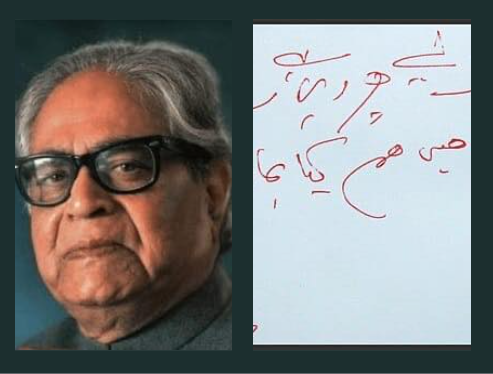
Poetry has historically been inseparable from passion. In every creative act, passion functions not merely as a catalyst but as the very substratum that sustains the imaginative universe of the poet. The poet, in this sense, is not simply an observer of life but one who internalizes its anxieties, hopes, alienations, and possibilities. Passion becomes the treasure of the heart, and those who respond to the existential pathos of human life find their hearts beating not merely to biological rhythms but to deeper emotional and spiritual impulses. The poet thus participates in a universal quest for beauty, truth, justice, and transcendence. It is perhaps in this sense that Jalaluddin Rumi once described sages as “spies of the divine,” diving into the secrets of the universe and becoming intimate with its hidden workings. Such a description aptly characterizes the poetic universe of the eminent Urdu poet Iftikhar Arif. His poetry emerges from an intense engagement with life and its complexities. It does not remain confined to technical virtuosity or rhetorical elegance; rather, it becomes an existential dialogue with history, culture, displacement, memory, and spirituality. Arif belongs to that rare class of poets who transform personal experience into universal poetic insight.
The role of the poet has often been interpreted as the ability to perceive “the whole in the part,” a formulation famously invoked in discussions of classical Urdu poetry and echoed by critics reflecting on the legacy of poets such as Mirza Ghalib. But the poet’s responsibility goes beyond mere perception; it also involves rendering that perception accessible and meaningful to readers. Such a task becomes possible only when the poet himself has been deeply touched by the flow of life — by its joys and sorrows, its anxieties and hopes. As literary critics have often suggested, there can be no profound poetry without profound pain. In the poetry of Iftikhar Arif, themes are never external to the poet’s own existence. Each motif arises from sustained mental and emotional engagement with the realities surrounding him. Yet this intimate association between life and poetry does not reduce his work to autobiography. On the contrary, Arif achieves what may be described as the transformation of autobiographical experience into universal narration. The French philosopher Jacques Derrida once suggested that autobiography need not exist as a separate literary category, since every creative text already carries within it traces of the author’s life. Arif’s poetry exemplifies this insight: although rooted in specific historical and personal circumstances, it transcends them to speak to readers across time and space.
Consider, for instance, the celebrated couplet:
“Mere Khuda mujhe itna to mo’tabar kar de
Main jis makaan mein rehta hoon usko ghar kar de.”
The longing expressed here appears deeply personal, yet its resonance extends far beyond the poet’s own life. The distinction between “house” and “home” evokes a universal human yearning for belonging and emotional anchorage. Likewise, in another couplet Arif writes:
“Mitti ki mohabbat mein hum aashufta-saron ne
Vo qarz utare hain jo wajib bhi nahin the.”
Here the poet reflects on the deep attachment to land and memory — a theme that speaks not only to his own experience but to the broader human condition shaped by history, migration, and identity. One of the most defining elements of Iftikhar Arif’s poetry is the persistent theme of separation and displacement. The sense of being distanced from homeland, from familiar spaces, and even from one’s own past emerges repeatedly in his ghazals and nazms. This theme is not unique to Arif alone; many poets of the subcontinent who witnessed the upheavals of the twentieth century — including Nasir Kazmi, Nida Fazli, Gulzar, and Amrita Pritam — grappled with similar experiences of dislocation. Yet in Arif’s work, this motif assumes the status of a central leitmotif that shapes the entire architecture of his poetic universe. The pain of separation, however, is not presented merely as tragedy. Arif transforms this anguish into aesthetic expression, converting loss into creative energy.
He writes:
“Khaak mein daulat-e-pindar-o-ana milti hai
Apni mitti se bichhadne ki saza milti hai.”
These lines articulate the psychological cost of estrangement from one’s homeland. Yet they also reveal how such experiences deepen the poet’s awareness of identity and belonging. In Arif’s poetry, the idea of “home” assumes dimensions far beyond the physical. It becomes a symbolic and spiritual concept. The poet often portrays himself as a perpetual nomad whose heart never finds permanent rest in any geographical location. The longing for home thus evolves into a metaphysical quest. For Arif, home is not merely a physical dwelling but a cultural and spiritual space that gives meaning to existence. Critics have often noted that in Arif’s poetic imagination, Medina emerges as the ultimate spiritual homeland. All other physical spaces appear transient when compared with this sacred locus of spiritual belonging. The poet’s yearning for Medina is therefore not simply devotional; it represents a search for spiritual anchorage in a fragmented world.
The experience of homelessness naturally gives rise to another recurring theme in Arif’s poetry: migration and journey. Migration appears both as a historical reality and as a metaphor for the existential condition of modern humanity. The poet observes:
“Shikam ki aag liye phir rahi hai shehr ba shehr
Sagay zamana hain, hum kya hamari hijrat kya.”
Migration here is depicted not merely as movement across geographical boundaries but as a consequence of economic necessity and historical circumstance. The modern individual becomes a wanderer compelled by forces beyond his control. Yet despite the pervasive sense of loss and displacement, Arif’s poetry never descends into despair. His voice of protest remains restrained and dignified. Rather than adopting the rhetoric of revolution or ideological denunciation, he expresses suffering through subtle poetic gestures. The critic Gopi Chand Narang once remarked that Arif’s protest is not loud or rebellious; instead, it resembles a muted lament, the quiet cry of a soul wounded by circumstances. This artistic restraint distinguishes Arif from many contemporary poets whose attempts at social commentary sometimes reduce poetry to mere political statement. In Arif’s case, social consciousness remains embedded within the aesthetics of poetry. His verses register pain without abandoning the delicacy and ambiguity that characterize great literature.
Another remarkable feature of Arif’s poetry is his engagement with history and cultural memory. He frequently invokes historical symbols and cultural references, weaving them into contemporary contexts. In doing so, he transforms abstract aestheticism into what critics have described as “cultural aestheticism.” His poetry becomes a site where the past and present encounter each other in a dynamic dialogue. Arif is acutely aware of the fragile nature of cultural heritage in an age of rapid change. He mourns the erosion of traditions and values inherited from previous generations, yet he does not succumb to nostalgia. Instead, he seeks to reinterpret tradition in ways that remain relevant to the present. This interplay between tradition and modernity recalls T. S. Eliot’s famous formulation of “tradition and the individual talent.” According to Eliot, a poet’s originality does not consist in rejecting tradition but in entering into a creative dialogue with it. Arif exemplifies this principle. His poetry moves along a trajectory parallel to that charted by classical masters such as Mir, Ghalib, and Faiz Ahmed Faiz, yet it retains a distinctive voice shaped by contemporary sensibilities.
One of the most striking aspects of Arif’s symbolic repertoire is his use of Karbala as a universal metaphor. Drawing upon the tragic narrative of Imam Husain’s martyrdom, Arif reimagines Karbala as an ethical and existential symbol. The conflict between justice and tyranny, loyalty and betrayal, becomes an enduring theme that transcends historical boundaries. He writes:
“Wahi pyaas hai, wahi dasht hai, wahi gharana hai
Mashkize se teer ka rishta bahut purana hai.”
In such lines, the imagery of Karbala becomes a lens through which the poet interprets contemporary moral dilemmas. The symbolism of thirst, desert, and sacrifice evokes the eternal struggle between truth and falsehood. Equally significant is Arif’s mastery of poetic craft. His ghazals demonstrate remarkable control over metre, rhythm, and diction. He employs classical Persianate idioms alongside contemporary language, creating a rich tapestry of expression. Even in his nazms — which often allow greater structural freedom — he remains attentive to rhyme and rhythm, ensuring that his poetry retains its musical quality. A notable characteristic of many of his nazms is the dramatic twist introduced in the final stanza. After leading the reader through themes of darkness or despair, Arif often concludes with an unexpected note of hope or insight. This technique echoes the classical Persian tradition in which the second hemistich of a couplet often overturns the meaning suggested by the first.
Beyond ghazals and nazms, another significant dimension of Iftikhar Arif’s literary contribution lies in his Naats — poems in praise of the Prophet Muhammad (peace be upon him). The Naat genre in Urdu poetry has sometimes suffered from repetition and imitation, with poets borrowing themes and motifs from earlier Arabic and Persian compositions. In many cases, the genre has been reduced to rhetorical display rather than genuine devotional expression. Arif’s Naats, however, stand apart from such superficiality. They arise not from a desire to demonstrate poetic mastery but from deep spiritual attachment to the Prophet, his companions, and the household of Ahl al-Bayt. His devotion is neither ostentatious nor conventional; rather, it reflects an inward spiritual commitment grounded in faith and ethical values. The distinguished scholar Abul Syed Khair Kashfi has observed that Arif may not outwardly display conventional religiosity, yet his Naats reveal the profound richness of his spiritual life. They testify to a sincere devotion that permeates both his poetry and his worldview.
A representative Naat of Arif beautifully illustrates this spiritual sensibility:
Madina o Najaf o Karbala mein rehta hai
Dil ek waz’e ki aab-o-hawa mein rehta hai
Darood pehle bhi padhta hoon aur baad mein bhi
Isi liye to asar bhi dua mein rehta hai
Mayassar aati hai jis shab qayam ki taufeeq
Woh sara din mera zikr-e-Khuda mein rehta hai
Ghulam-e-Buzar-o-Salman dil, khushi ho ki gham
Hudood-e-zaviya-e-hal ata mein rehta hai
These verses reflect an intimate spiritual geography in which the sacred cities of Islam become symbolic spaces inhabiting the poet’s heart. The act of sending blessings upon the Prophet becomes a source of spiritual transformation, infusing the poet’s prayers with meaning and efficacy. Taken together, the various strands of Iftikhar Arif’s poetry — passion, migration, cultural memory, restrained protest, and spiritual devotion — form a richly textured poetic universe. His work demonstrates how poetry can simultaneously engage with the historical realities of displacement and the timeless quest for spiritual meaning. In an age marked by fragmentation and alienation, Arif’s poetry reminds us that the human search for home, identity, and transcendence remains enduring. His verses transform personal experience into universal insight, allowing readers to encounter their own anxieties and aspirations within the mirror of poetry. For this reason, Iftikhar Arif occupies a distinctive place in modern Urdu literature. He stands at the intersection of tradition and modernity, history and memory, earth and transcendence — a poet whose work continues to illuminate the human condition with quiet intensity and profound grace.
