

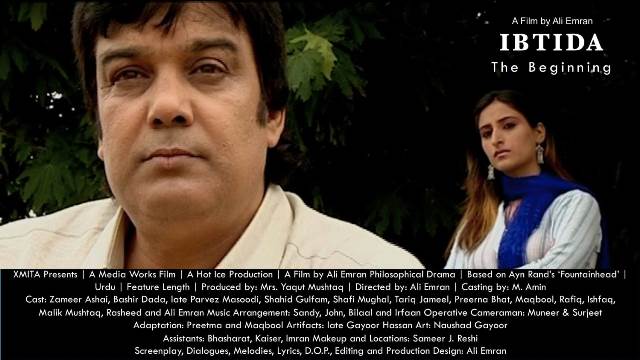
Integrity, the quality of being honest and having strong moral principles, is an ideal that resonates deeply across cultures, disciplines, and art forms. Both literature and cinema explore this theme in various ways, challenging and reaffirming our understanding of what it means to live with integrity in a world that often values conformity and compromise. Ayn Rand’s The Fountainhead and Ali Emran’s cinematic adaptation, Ibtida, offer rich portrayals of integrity, particularly through the journeys of their protagonists—Howard Roark in The Fountainhead and Zahir in Ibtida. These works explore how the adherence to one’s moral code, even when faced with extreme adversity, can shape a person’s destiny and the world around them.

The Concept of Integrity in The Fountainhead
Ayn Rand’s novel The Fountainhead is a passionate exploration of individualism and integrity. The story follows Howard Roark, a young architect whose refusal to conform to conventional architectural styles makes him a pariah in the industry. Roark’s uncompromising integrity is reflected not only in his professional work but also in his personal life. He refuses to follow trends, bend to societal pressures, or compromise his ideals for personal gain.
Roark’s commitment to his principles is not without its challenges. His path is filled with rejection, ridicule, and financial struggle. Yet, through it all, Roark remains resolute, adhering to his own vision and moral compass. Rand’s portrayal of Roark is a celebration of integrity as a form of self-realization and artistic purity. His work, which challenges the status quo, becomes a symbol of both personal and professional integrity—a refusal to compromise on one’s vision and purpose in life.

Rand defines integrity not merely as moral honesty but as a complete alignment of one’s actions with their deepest values. Roark’s integrity is a reflection of his inner strength and his understanding that true success is not defined by wealth or approval but by the ability to remain true to oneself.
Zahir in Ibtida: A Cinematic Exploration of Integrity
Ali Emran’s film Ibtida, an adaptation of The Fountainhead, introduces us to Zahir, a character who embodies many of the same virtues and challenges as Howard Roark, albeit in a different cultural and cinematic context. In the film, Zahir is portrayed as an architect whose struggle for integrity within a corrupt and traditional society mirrors Roark’s journey in Rand’s novel.
Zahir is not just a creator of buildings; he is a creator of ideas, principles, and values. His commitment to innovation and individuality in his architectural designs makes him an outcast in a society that favors conformity. The film’s narrative explores Zahir’s internal battle, as he faces immense pressure from peers, mentors, and even loved ones who expect him to compromise his artistic vision for the sake of success, reputation, or financial security.
Like Roark, Zahir’s life is marked by solitude, but it is not a solitary path of despair; rather, it is a journey towards self-fulfillment. His integrity forces him to confront both personal and societal expectations, and much like Roark, Zahir’s path is not one of easy triumphs but of painful, often alienating choices.
In Ibtida, Zahir’s integrity is also closely linked to his relationships. The way he handles conflict, particularly in his personal life, reflects his inability to compromise on his core beliefs. His romantic entanglements and his professional challenges are always filtered through the lens of his commitment to truth and self-expression. Unlike many other characters in the film, Zahir refuses to lie to himself or to the people around him, a quality that often places him in direct opposition to societal norms.
Comparing Integrity in The Fountainhead and Ibtida
Despite the differing mediums—one being a novel and the other a film—the portrayal of integrity in both The Fountainhead and Ibtida shares striking similarities. The protagonists, Howard Roark and Zahir, both serve as archetypes of the “independent man,” a figure whose personal code of integrity remains unshaken in the face of overwhelming external pressure. The core theme of both works is that true integrity is not something that can be easily compromised or negotiated. Both Roark and Zahir are willing to sacrifice personal happiness and social acceptance for the sake of their beliefs, which they view as central to their purpose in life.
However, there is a marked difference in how each work approaches the theme. While The Fountainhead often treats Roark’s journey as an almost philosophical exploration of individualism, Ibtida roots Zahir’s integrity in a more human, emotional context. The film emphasizes the personal struggles Zahir faces within his community, often focusing on the emotional cost of his refusal to compromise. The internal conflict that Zahir experiences, especially in terms of his relationships, offers a more intimate exploration of the toll integrity can take on an individual’s personal life.
In contrast, Rand’s portrayal of Roark is more impersonal, focusing less on the emotional aspects of his life and more on the philosophical and professional consequences of maintaining integrity in a world that resists change. Roark is a figure of almost heroic stoicism, embodying the idea that integrity is the ultimate form of self-realization, whereas Zahir in Ibtida is more nuanced and multi-dimensional, reflecting the human complexities of navigating a world that challenges individual ideals.
The Moral Message: Integrity as the Foundation of True Success
Both The Fountainhead and Ibtida ultimately convey that integrity is not merely a moral choice but the foundation upon which true success is built. Roark and Zahir both achieve greatness, not because they conform to societal expectations but because they refuse to compromise on their own principles. Their success is not defined by external validation but by their inner sense of purpose and their unwavering belief in the value of their work.
In the case of Zahir, Ibtida suggests that integrity is not only about self-expression but also about the courage to stand firm in one’s beliefs, even when those beliefs conflict with the demands of love, tradition, and family. For Roark, The Fountainhead illustrates that integrity, when practiced unyieldingly, leads to an ultimate sense of personal fulfillment and a reshaping of the world on one’s own terms.
Conclusion: The Enduring Relevance of Integrity
The themes explored in The Fountainhead and Ibtida are timeless. Integrity, as embodied by Roark and Zahir, continues to resonate with audiences because it speaks to a universal human struggle: the tension between societal pressure and personal truth. Both works highlight that living with integrity is often a difficult and solitary journey, but one that leads to the most profound forms of success. Whether in the domain of architecture, relationships, or personal development, integrity remains the cornerstone of a life well-lived.
In the end, both Howard Roark and Zahir teach us that integrity is not simply about adhering to a set of moral principles—it is about remaining true to one’s authentic self, no matter the cost. Their stories are a powerful reminder that the pursuit of truth and the commitment to personal values can, and often do, change the world.

