

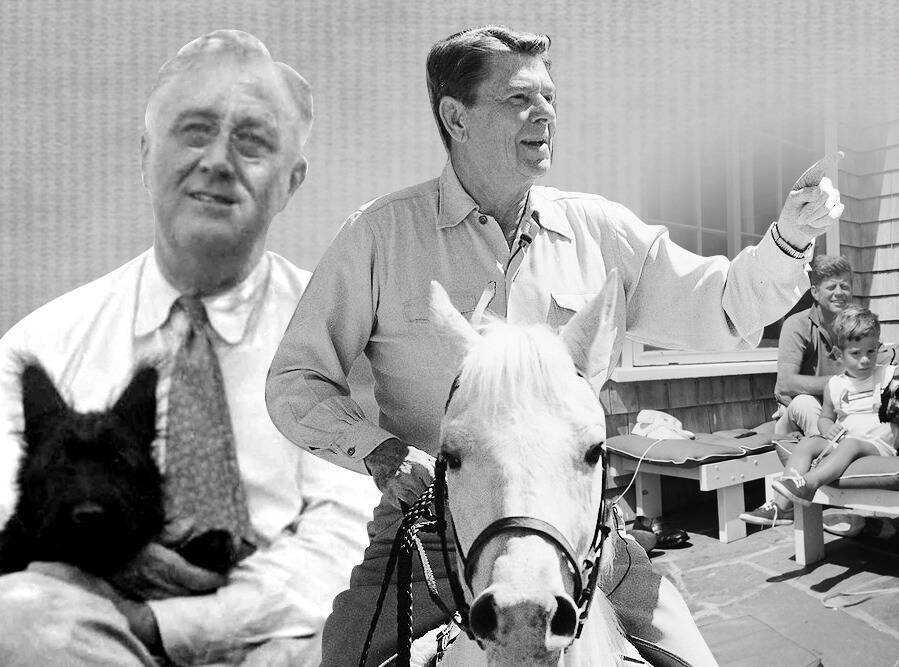
A centuries old tradition would soon be restored at the White House with pets set to return to the Presidential residence after a gap of four years.
The president elect, Joseph R. Biden, is expected to bring in his two German shepherds, Champ and Major, to the executive residence when he moves in next January. Donald Trump was the first president in more than a hundred years to not have a pet in the White House. Before him, the only other presidents to not own a pet was James K Polk (1845-49) and Andrew Johnson (1865-69), although the latter is famously known to have fed a family of white mice during his impeachment.
Presidential pets have been at the centre of public attention since the earliest days of the republic. “Varied assortments of animals living at the executive mansion mirrored those found in many American homes,” writes White House social expert Jennifer B. Pickens in her book, “Therefore horses, cows, goats, chickens and even sheep could be found at the White House, along with the more domestic animals such as dogs, cats, birds and other small pets.”
More exotic animals too have made their presence felt in the company of the first family. For instance, President Theodore Roosevelt, a well-known naturalist, had a large collection of animals, including a bear, badger, and hyena.
But apart from making an interesting and joyful presence in the presidential quarters, the white house pets are also known to be of political significance. They have frequently found mention in important presidential speeches and even made some historic headlines.
“Evidence abounds that presidential pets are an integral part of White House political strategy,” write political scientists Forrest Maltzman, James H. Lebovic, Elizabeth N. Saunders, and Emma Furth in a 2012 published research paper titled, ‘hey elaborate how presidents make a strategic use of pets in public: “In times of war or scandal pets are welcome public companions, but not so in periods of economic hardship.”
The domestic and exotic White House pets in American history
America’s first president George Washington was an ardent animal lover, as is evident from the large number of horses, dogs and livestock that lived at his residential estate in Mount Vernon in Virginia. He gave his pooches unique and colourful names such as Sweet Lips, Madame Moose Cornwallis, and Truelove. Washington is also known to have received a pair of donkeys as a gift from the King one of which died in the course of the journey. The other one was named Royal Gift. The first president is believed to have spent a good amount of time and effort in breeding the donkey with his American mares.
The third president of America, Thomas Jefferson, made some of the most interesting animal additions to the White House. In 1803, he commissioned an expedition to the newly acquired territories in the western portion of the country. His two trusted soldiers and explorers who led the expedition, Meriwether Lewis and William Clark, dispatched a wide variety of animals, both alive and dead, for the president to study.
“The most memorable were two grizzly bear cubs that he kept in a cage at the White House,” writes Pickens. Also dear to the public eye was Jefferson’s pet mockingbird, Dick, who would be frequently seen flying around freely in the President’s office and would sit on his master’s shoulders. Jefferson is also credited to have built the famous horse stables which are now part of the West Colonnade.
The sixth president of the USA, John Quincy Adams, had a reputation for an alligator that he kept in a bathtub at the White House’s unfinished east room. He is known to have been gifted the alligator by the French aristocrat and military officer Marquis de Lafayette, who fought in the American revolutionary war. The story goes that Lafayette received a number of gifts during his tour of the 24 states in 1824 and 1825, the most unusual among them being the alligator that he later presented to President Adams.
Adams was not the only one with an unusual taste in pets. Martin Van Buren, who took office in 1837, was delighted to receive a pair of tiger cubs from the Sultan of Oman early on in his presidency. As he began making arrangements for their lodging at the White House, the Congress expressed its disapproval of the situation. Van Buren argued vehemently with the Congress to be allowed to keep his tiger cubs. He had to concede in the end and the cubs were confiscated by the Congress which sent it to the local zoo.
But, of course, it has always been the dogs of White House that receive the most amount of public affection. Ever since William McKinley’s administration in 1897, every single president of America has owned a dog. The first presidential pet dog to receive regular newspaper coverage was an Airedale that Warren G. Harding (1921-23) received as gift from one of his supporters at Toledo in Ohio. Named Laddie Boy, the dog was treated like a member of the Harding family. He was allowed to roam around the White, attend meetings with the President and even given his own custom-made cabinet chair. “President Harding himself would take the time to write letters to children on Laddie’s behalf,” says a report on the dog published in The Toledo Gazette in 2012. It adds that “children across the country loved Laddie and on July 26th each year, he was given White House birthday parties at which other neighborhood dogs were invited to join.”
Laddie Boy began disappearing from the public eye with the sudden illness of Harding in 1923. Reportedly, the dog howled for three days before Harding passed away. Soon after though, in an attempt to build a memorial for Harding and his canine companion, thousands of newsboys across the country donated a penny each, which were melted down and cast into a life-size sculpture of Laddie Boy.
Writing about the strategic use of presidential pets in public, the writers of the 2012 paper argue, “in time of war, they tell the country that they and the rest of the nation are in good hands… In times of personal scandal, they convince us that the president is only human.”
At the same time, the scholars observe that pets are less likely to be seen during times of economic duress when the sight of a pampered puppy is least appealing to the public.
Consequently, the absence of a dog or any pet in the White House during the course of the Trump administration has been closely scrutinised as a mark of his personality. In 2019, during a rally at El Paso in Texas, Trump explained that he didn’t own a dog since the idea seemed ‘phony’ to him. “I wouldn’t mind having one, honestly, but I don’t have any time. How would I look walking a dog on the White House lawn?” he had asked.
Soon after, an carried by the Washington Post analysed Trump’s lack of affection towards dogs. “There’s evidence that Trump doesn’t like dogs very much, possibly because of his germaphobic tendencies,” said the article written by Antonia Noori Farzan. She bases her analysis on the memoir written by Trump’s first wife Ivana Trump, wherein she speaks about why Trump is not a dog fan. The Washington Post article further notes, “Trump has a long-standing habit of comparing people who he perceives as enemies to dogs, often while accusing them of behavior not normally associated with canines.”
The prospect of Biden bringing back dogs to the White House has expectantly received a wide amount of positive attention from the American press. Biden is expected to ‘heal’ America after four years of Trump administration, and his furry friends in the White House are perhaps just the right companions on that journey. ( Indian Express )

