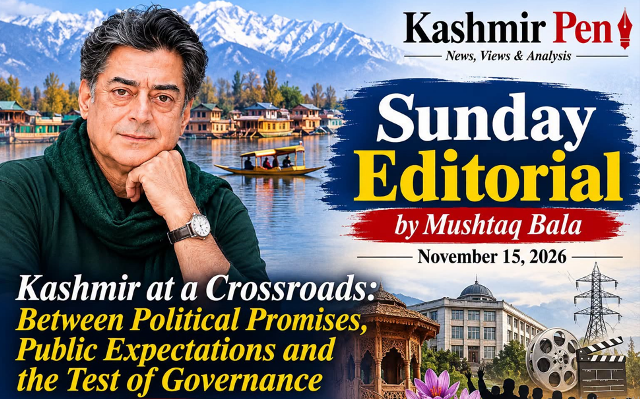
The past week in Jammu and Kashmir has offered a revealing picture of a society negotiating multiple realities at the same time. Political activity, administrative decisions, cultural assertions, economic concerns and the familiar anxieties of approaching winter have once again brought governance and public accountability into sharp focus.
There is no shortage of announcements, policy discussions and public assurances. What remains uncertain, however, is how effectively these translate into tangible improvements in the lives of ordinary people.
The recently held cabinet meeting chaired by Chief Minister Omar Abdullah, which cleared important proposals relating to hydropower development, urban asset monetisation and fruit mandis at Pattan, Tral and Kulgam, represents an attempt to address long-standing developmental requirements. These decisions deserve attention, particularly because infrastructure, agricultural marketing and energy security are central to Jammu and Kashmir’s economic future.
But policy approval is only the beginning. The real test lies in implementation, timelines, transparency and measurable outcomes. Farmers awaiting better marketing facilities, consumers struggling with electricity shortages and unemployed youth looking for opportunities cannot be expected to remain satisfied with announcements indefinitely.
Winter’s First Warning: Electricity and Preparedness
Perhaps the most immediate concern emerging this week is the growing electricity deficit. Reports indicating a daily shortfall of approximately 4,400 megawatt-hours come at a time when temperatures are dropping and households are preparing for the harshest months of the year.
For Kashmir, electricity is not simply another public utility. It is directly connected with domestic comfort, education, healthcare, commercial activity and the functioning of essential institutions.
Every winter, consumers are confronted with familiar explanations involving declining hydropower generation, increased demand and dependence on external supplies. These factors are real, but they cannot become permanent excuses for inadequate preparedness.
The administration must communicate realistic power schedules, strengthen distribution infrastructure, minimise unscheduled outages and ensure that vulnerable areas and essential services receive priority.
Winter preparedness should be judged not by review meetings but by the experience of consumers sitting in cold homes.
Artists’ Voices and the Question of Cultural Recognition
Another significant development was the AAWAAZ – The Collective Voice of Artists convention in Srinagar. The gathering brought together members of the artistic fraternity around a set of long-pending demands, including a comprehensive artists’ welfare policy, industrial recognition for the creative sector and protection of Jammu and Kashmir’s cultural identity.
This was more than an industry gathering. It represented a collective attempt by artists to seek institutional recognition for a sector that contributes substantially to the region’s cultural representation and creative economy.
For decades, artists, theatre practitioners, filmmakers, musicians, writers and other cultural professionals have worked under difficult circumstances, often without adequate social security, structured financial support or sustainable professional opportunities.
The irony becomes even more apparent when one examines the region’s film policy. Jammu and Kashmir has reportedly granted 495 film-shooting permissions since 2021, while no subsidy has yet been disbursed from the proposed Film Development Fund, despite applications remaining under process.
This raises an important question: Can a creative industry flourish merely through shooting permissions, promotional campaigns and attractive policy documents?
A genuine film and cultural ecosystem requires financial accessibility, transparent incentives, production infrastructure, training institutions, exhibition platforms and a mechanism to support local talent.
The AAWAAZ convention should not end as another well-attended gathering followed by official silence. Its demands deserve structured consideration and a time-bound response.
Political Activity Must Translate into Public Accountability
The political atmosphere has also remained active. The continuing discussions within the National Conference, including the recent gathering of its legislators and questions surrounding internal communication, reflect the natural complexities of a political organisation navigating governance and its own institutional dynamics.
Political parties are entitled to internal discussions, disagreements and organisational adjustments. Such developments are neither unusual nor inherently undesirable.
However, the larger responsibility of the ruling establishment is to ensure that internal political conversations do not overshadow public priorities.
People voted with expectations concerning employment, electricity, economic revival, administrative responsiveness and the restoration of their political aspirations. These concerns must remain central to the government’s agenda.
The Chief Minister and his colleagues must recognise that public confidence is sustained through delivery, not merely political communication.
At the same time, the Opposition has a responsibility to offer constructive scrutiny and credible alternatives rather than limiting its role to political criticism.
Public Safety Cannot Be an Afterthought
Two other developments this week deserve serious attention.
The tragic death of a nine-year-old girl following the collapse of a school boundary wall in Kupwara is a painful reminder that the safety of children in and around educational institutions cannot be compromised.
Similarly, the recovery of a substantial quantity of allegedly rotten meat from railway cargo in Budgam raises questions about food inspection, transportation standards and the effectiveness of monitoring mechanisms.
Both incidents point towards a larger administrative responsibility: prevention.
Whether it concerns school infrastructure or the food reaching consumers, regulatory systems must function before tragedies or public health concerns emerge. Accountability should extend beyond immediate statements and inquiries to corrective action and institutional responsibility.
A Moment of Pride for Kashmir’s Heritage
Amid these concerns, the international recognition of Kalhana’s Rajatarangini through its inclusion in UNESCO’s Memory of the World Asia-Pacific Regional Register is a moment of considerable pride.
It is a reminder that Kashmir’s contribution to civilisation extends far beyond its geographical and political circumstances. Its historical scholarship, literary traditions, artistic expressions and intellectual heritage constitute an extraordinary cultural inheritance.
Equally encouraging are emerging technological initiatives in saffron cultivation, including experiments involving robotics and artificial intelligence. Such innovations could help address labour shortages and improve productivity in an important traditional sector.
These developments demonstrate that Kashmir’s future need not be confined to conventional economic models. Its cultural wealth and agricultural strengths can become foundations for modern, knowledge-driven growth.
But this potential requires sustained institutional investment and opportunities for local talent.
The Larger Question: Who Measures Governance?
As another Sunday arrives, the developments of the past seven days leave us with a fundamental question: How should the performance of a government be measured?
Not by the number of meetings conducted, policies approved, conventions organised or promises made. The real measure is whether an electricity consumer receives reliable supply, whether a farmer gets better returns, whether an artist finds professional dignity, whether a young person sees a future at home and whether an ordinary citizen can approach the administration without frustration.
Jammu and Kashmir has no shortage of talent, natural resources, cultural wealth or developmental possibilities. What it needs is consistency in governance, institutional accountability and a willingness to convert public expectations into practical outcomes.
The government deserves recognition wherever it takes meaningful initiatives, but it must also remain open to criticism wherever delivery falls short. This is not opposition for its own sake; it is an essential component of democratic accountability.
The coming winter will once again test administrative preparedness. The months ahead will also test the government’s commitment to economic revival, cultural development and political responsiveness.
For the people of Jammu and Kashmir, the time has come to move beyond assurances and judge governance by results.
Because ultimately, the credibility of any government is not established by what it promises, but by what people experience