

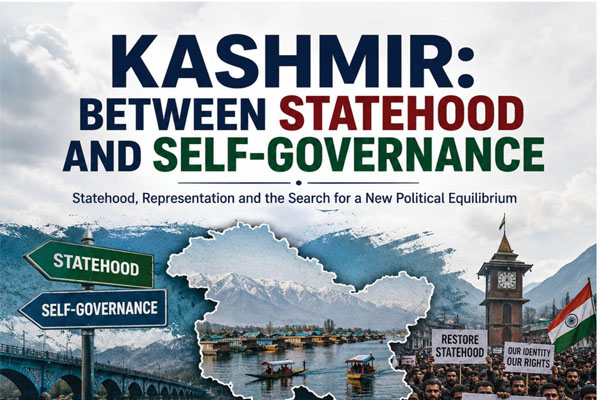
Statehood, Representation and the Search for a New Political Equilibrium
Seven years after the constitutional changes of August 2019, Jammu and Kashmir’s political landscape remains defined by an uneasy combination of electoral politics, demands for restored statehood, questions of identity and an evolving relationship between Srinagar and New Delhi. The return of an elected government under Chief Minister Omar Abdullah has restored an important democratic institution, but it has not resolved the larger political question: what kind of political autonomy and institutional space will Jammu and Kashmir have in the years ahead?
The present political moment is therefore less about a return to the past than about negotiating a new political equilibrium.
The 2024 Assembly elections were a significant milestone. After a prolonged period without an elected Assembly, voters participated in a competitive electoral process that produced a government led by the National Conference. The Election Commission continues to list the 2024 Jammu and Kashmir Assembly election among the territory’s most recent electoral contests. The exercise demonstrated that electoral politics remains a powerful avenue through which people express aspirations, grievances and expectations.
Yet an elected government operating within a Union Territory presents a fundamentally different political arrangement from that of a full-fledged state. This distinction lies at the heart of the current debate.
The Statehood Question
For the National Conference government, restoration of statehood has become the central political demand. Omar Abdullah has repeatedly argued that the Union Territory arrangement limits the authority of an elected government and has pressed the Centre for a clear commitment on restoring statehood. In July, his campaign moved beyond government resolutions and meetings, with a planned political mobilisation at Delhi’s Jantar Mantar. The issue is not merely constitutional. It is also psychological and political.
For many in Jammu and Kashmir, statehood represents recognition of political dignity and institutional normalcy. The argument is that elections acquire greater meaning when the government elected by the people possesses substantial authority over governance. The Centre, however, retains a decisive role in the Union Territory’s administrative structure.
This creates a persistent tension between electoral mandate and administrative power.
The question confronting New Delhi is therefore not simply whether statehood should eventually be restored, but when and under what institutional framework. For Srinagar, the challenge is to convert political pressure into a sustained constitutional and democratic argument rather than allowing the issue to become another cycle of confrontation.
Article 370: A Political Question That Refuses to Disappear
Article 370 remains another major fault line. Although its constitutional status was fundamentally altered in 2019, the issue continues to occupy a prominent place in Kashmir’s political discourse.
On Independence Day this year, Omar Abdullah again spoke critically about the 2019 changes and linked the debate to Kashmir’s political history and the situation across the Line of Control. The remarks triggered sharp criticism from the BJP, demonstrating how deeply the issue continues to divide political opinion.
The PDP, too, continues to foreground the restoration of the region’s former constitutional position in its political rhetoric. Recent exchanges between PDP president Mehbooba Mufti and the National Conference illustrate that the pro-restoration camp itself is not politically homogeneous. This internal disagreement is important. Kashmir’s politics is no longer simply a contest between Kashmir and Delhi. It is increasingly a competition among Kashmiri parties over who can best represent the region’s political aspirations.
NC, PDP and the Opposition Space
The National Conference enters this phase with the advantage of leading the elected government. But governing is fundamentally different from campaigning.
The party must simultaneously manage expectations over statehood, employment, development, constitutional questions, security and relations with the Centre. Its political credibility will ultimately depend not only on what it says about Kashmir’s larger political status but also on how effectively it addresses everyday governance.
Within the NC itself, disagreements have surfaced over the pace and intensity of the campaign for Article 370 and statehood. MP Aga Ruhullah Mehdi has publicly criticised the party leadership over what he sees as insufficient pursuit of its constitutional promises. The PDP, meanwhile, faces the challenge of rebuilding political space after the electoral setbacks of recent years. Its emphasis on Article 370 gives it a distinct ideological identity, but converting that identity into a broader electoral coalition remains difficult.
The BJP occupies a different position. Its political expansion in Jammu and its larger national narrative have transformed the traditional electoral geography of the region. The result is a more competitive political field in which Jammu and the Kashmir Valley often display different political priorities.
Jammu and Kashmir: Two Political Conversations
One of the most important features of contemporary politics is the widening need to understand Jammu and Kashmir not as a single political constituency but as a territory containing diverse regional aspirations.
Jammu’s politics increasingly revolves around development, representation, security, employment and concerns over political balance. The Valley’s political discourse remains much more closely connected with statehood, identity, constitutional change and the political legacy of 2019.
A durable political settlement cannot ignore either conversation.
The challenge for any government is to prevent regional differences from becoming permanent political polarisation. The future of Jammu and Kashmir will depend partly on whether its political class can construct a common language around development, representation and dignity without denying legitimate regional differences.
Beyond Security: The Politics of Normalcy
There is also another important change. Kashmir’s political debate is gradually moving beyond a purely security-centred narrative.
The reduction in violence and the return of tourism and public economic activity have created space for questions about jobs, education, infrastructure, investment and governance. Yet the apparent calm should not be mistaken for the disappearance of political grievances. Recent analysis has noted that beneath the surface of relative normalcy, questions about political alienation and the region’s future remain unresolved.
For the younger generation, politics is increasingly measured through tangible outcomes. Employment opportunities, quality education, digital connectivity, entrepreneurship and mobility may matter as much as traditional political slogans.
This creates an opportunity for Kashmir’s political leadership: to connect the larger constitutional debate with the everyday aspirations of young people.
The Road Ahead
The central political contest in Jammu and Kashmir is therefore entering a new phase.
The old binary of security versus separatism no longer fully explains the political landscape. The emerging contest is between different visions of governance, federalism, representation and political identity.
For the National Conference, the challenge is to demonstrate that an elected government can deliver governance while pursuing its political agenda. For the PDP, it is to recover organisational and electoral relevance. For the BJP, it is to consolidate its influence while responding to the distinct political expectations of Jammu and Kashmir. For the Centre, the larger challenge is to balance national security and constitutional authority with the democratic legitimacy of an elected government.
Ultimately, the most important political demand may be simpler than the constitutional language surrounding it: people want their vote to matter.
Jammu and Kashmir has entered a period in which political participation is returning to the centre of public life, but participation alone will not settle the region’s deeper questions. Statehood, constitutional identity, regional balance and democratic accountability will continue to shape the political agenda.
The future will depend on whether these questions are addressed through confrontation or conversation.
Kashmir’s next political chapter may therefore not be defined by another dramatic rupture, but by the slower and more difficult work of rebuilding institutions, restoring trust and creating a political system in which Delhi’s authority, Srinagar’s aspirations and the people’s democratic mandate can coexist without permanently cancelling one another out.
That is the real crossroads facing Kashmir today.
KP BUREAU

