

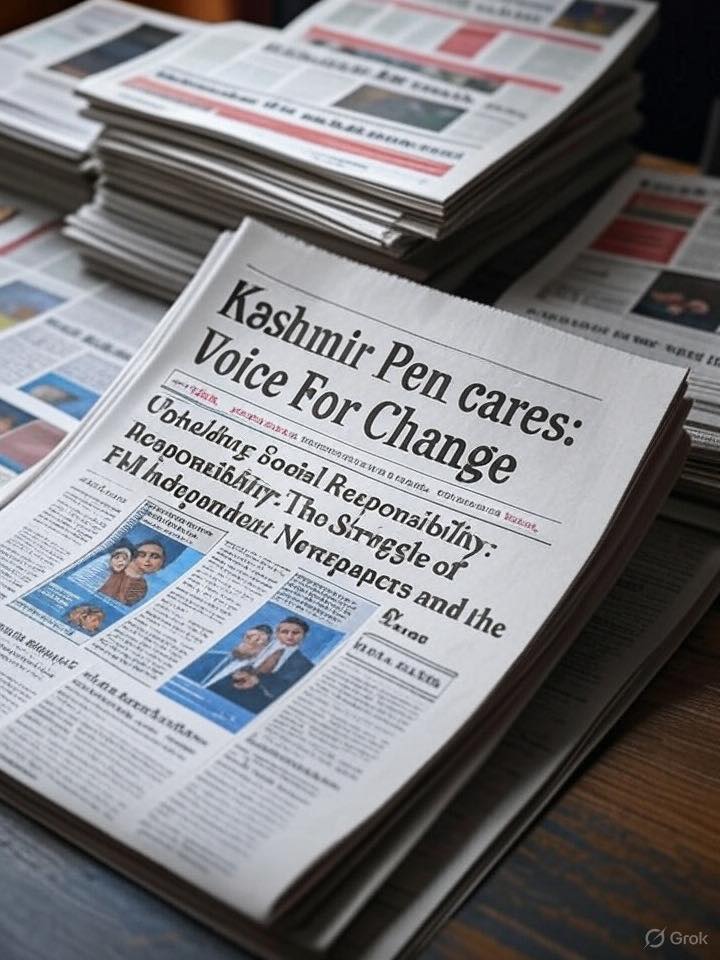
Upholding Social Responsibility:
The Struggle of Independent Newspapers and the Silence of the State
In a democratic society, a vibrant and diverse media landscape is not merely a hallmark of free expression—it is the very lifeblood of a well-informed public. While the government routinely reiterates its commitment to press freedom, the lived reality for many small and medium-sized newspapers in Jammu and Kashmir tells a starkly different story.
Over the past 8 to 10 years, several fresh newspapers have been published consistently in Kashmir with sincerity, determination, and sheer public spirit. These are not fly-by-night ventures or seasonal publications—they are credible platforms committed to journalistic ethics, local reporting, and amplifying the voices of the unheard. Yet, despite years of continuous publication, they remain outside the government’s empanelment system. As a result, they have received no advertising support—no financial aid, no official recognition—while larger or politically-aligned publications enjoy regular government patronage through advertisements.
This discrepancy raises critical questions about fairness, transparency, and accountability. How is it justifiable that newspapers which have weathered every storm—from communication blackouts to political upheaval—continue to be treated as invisible entities by the administration? What message does this send to the next generation of journalists who aspire to serve society through honest reporting?
Kashmir Pen believes that social responsibility must extend beyond rhetoric. The government has a moral and institutional duty to recognize and support all genuine journalistic endeavours, especially those that have stood the test of time without any financial cushion. Media houses that have built trust with their readers deserve more than indifference; they deserve institutional support that empowers them to continue serving the public interest.
The criteria for empanelment must be revisited—not as a bureaucratic checklist, but as a dynamic, inclusive process that appreciates the role of independent journalism in building civil society. The denial of advertisements to these publications amounts not only to financial suffocation but to an unjust attempt at marginalizing their voice.
In times when narratives are often bought and sold, the newspapers that stand on principles, surviving without state backing, represent the real conscience of our society. It is high time the government acknowledged their contribution and acted responsibly to level the playing field.
Let not policy be a tool of exclusion. Let it be a means to uplift and empower every sincere voice in Kashmir’s media ecosystem.
