

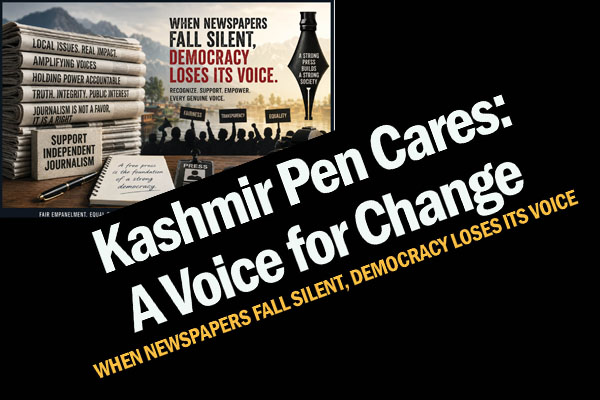
When Newspapers Fall Silent, Democracy Loses Its Voice
The debate surrounding the empanelment of newspapers in Jammu and Kashmir is not merely about advertisements, financial support, or administrative procedures. At its core, it is about the future of independent journalism and the preservation of democratic values in a region that has long depended on a resilient and responsible press.
For decades, newspapers have served as bridges between the government and the people. They have informed citizens, highlighted public grievances, celebrated achievements, documented history, and provided a platform for debate and dialogue. Yet today, many independent newspapers that continue to publish regularly find themselves struggling for survival—not because of a lack of readership or commitment, but because of systemic neglect.
The challenge facing these publications extends far beyond economics. When a newspaper is denied access to government advertising despite fulfilling its role as a responsible media institution, it faces a gradual erosion of its capacity to operate. Staff salaries become difficult to sustain, printing costs rise, distribution networks weaken, and the ability to invest in quality journalism diminishes.
The real casualty in this process is not the newspaper alone—it is the public.
A shrinking media landscape means fewer voices, fewer perspectives, and fewer opportunities for citizens to engage with issues that directly affect their lives. Local stories that may never find space in national media risk disappearing altogether. Rural concerns, cultural developments, social issues, and community achievements become less visible when independent regional newspapers are forced to operate under severe constraints.
The irony is striking. At a time when misinformation and unverified content spread rapidly through social media platforms, genuine newspapers continue to follow professional standards of verification, accountability, and editorial responsibility. These publications remain committed to facts rather than rumours, public interest rather than sensationalism, and constructive criticism rather than divisive narratives.
Such institutions should be strengthened, not sidelined.
A transparent and inclusive empanelment policy would not be an act of charity; it would be an investment in democratic governance. Governments benefit from a healthy media ecosystem because it facilitates communication with citizens, increases public awareness of developmental initiatives, and encourages constructive feedback. Excluding credible newspapers serves neither the administration nor the public.
The issue also raises an important question of equality. If two newspapers meet the standards of publication, maintain regular circulation, and comply with legal requirements, should one be privileged while the other remains excluded indefinitely? Public resources must be distributed through fair, transparent, and objective mechanisms that inspire confidence rather than suspicion.
Kashmir has a proud tradition of journalism. Despite difficult circumstances, its media fraternity has continued to inform society with courage and dedication. Many independent newspapers have survived without institutional support, relying solely on determination and the trust of their readers. Their perseverance deserves recognition.
The time has come for policymakers to engage meaningfully with these concerns. A comprehensive review of pending empanelment cases, the establishment of clear timelines for decision-making, and greater transparency in the allocation of government advertisements would go a long way in restoring faith among media stakeholders.
A democracy flourishes when every genuine voice has an opportunity to be heard.
The question before us is simple: Do we want a media landscape defined by diversity and fairness, or one where only a select few can survive?
The answer will shape not only the future of journalism in Jammu and Kashmir but also the quality of public discourse for generations to come.
Kashmir Pen believes that empowering independent newspapers is not merely a media issue—it is a democratic imperative.
KP BUREAU

