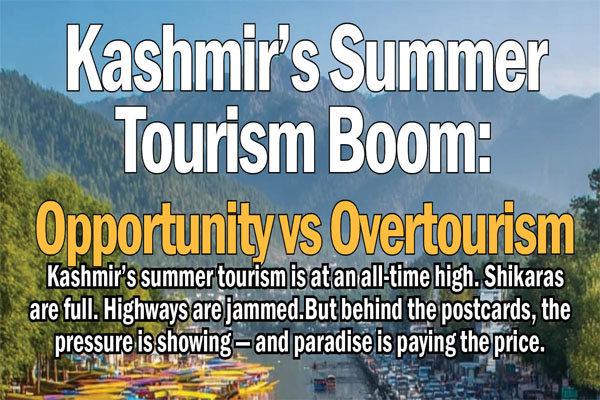
Kashmir’s summer tourism is at an all-time high. Shikaras are full. Highways are jammed.But behind the postcards, the pressure is showing — and paradise is paying the price.
It is 9:30 AM in July and the road to Pahalgam is already crawling. Taxis, tempo travelers, and private cars are nose to tail for 3 kilometers. A child in the backseat presses his face to the window, asking his father, “Papa, Betaab Valley kitni door hai?” The father wipes sweat and checks his phone. Google Maps says 45 minutes. The locals know it will be 2 hours.
This is Kashmir in 2026.
After years of uncertainty, the Valley is experiencing its biggest summer tourism boom yet. Hotels in Srinagar are at 90% occupancy. Houseboats on Dal Lake are booked 3 weeks out. Travel executives in Lal Chowk are handling 40-50 calls a day. For an economy that depends on tourism for nearly 15% of its GDP, this feels like oxygen after holding its breath.
But on the same roads, in the same meadows, another conversation is starting. Shopkeepers in Gulmarg complain the grass is turning brown by August. Waste collection in Sonamarg can’t keep up. Guides say the “Kashmir experience” is now a queue for a photo. The question is no longer “Can tourists come?” It is “How many is too many?”
The Numbers Don’t Lie
Official data from the J&K Tourism Department shows 1.2 million tourists visited Kashmir between April and June 2026. That is a 22% jump from last year. Domestic travelers from Gujarat, Maharashtra, West Bengal, and Delhi lead the surge. International footfall, especially from Southeast Asia and the Middle East, has also doubled.
Why now? Three reasons.
First, improved connectivity. The Vande Bharat to Katra and better road infrastructure has cut travel time. Second, “revenge travel” post-pandemic has not slowed down. Families who postponed trips for 3 years are now coming. Third, Kashmir is being marketed differently. It is no longer just “Paradise on Earth.” It is “affordable Switzerland,” “wedding destination,” and “film shooting hub.”
For businesses, this is gold. Mr. Adil Shafi, a Travel Executive in Srinagar, has seen his client list grow every year since 2021. “In 2021 we handled mostly local and religious tourism. In 2026, we are planning honeymoons, corporate retreats, and adventure tours. People want 7-day packages, not 3-day.” He adds, “But the pressure is also more. Clients want instant bookings, and in peak season, nothing is instant.”
Hotels have raised tariffs by 25-30%. A shikara ride that was ₹800 is now ₹1500. Ponies in Pahalgam have waiting lists. The money is flowing into taxi unions, handicraft shops, dhaba owners, and home-stays in villages that never saw tourists before. For many families, 4 months of summer pay for the entire year.
The Other Side of the Meadow
Drive 20 minutes out of Sonamarg and you will see the problem. Plastic bottles along the Sindh Nallah. Toilet paper near Thajiwas Glacier. Parking lots where there used to be wildflowers.
Dr. Mehnaaz, an environmentalist based in Srinagar, has been studying carrying capacity in the Valley for 8 years. “Gulmarg was designed for 5,000 visitors a day. On weekends we are seeing 18,000. The soil cannot absorb that. The sewage cannot handle that. We are loving Kashmir to death.”
The signs are subtle but growing. Water shortages in Pahalgam in late July. Traffic jams that turn a 1-hour drive into 4 hours. Locals in Gurez and Keran now say “it is getting too crowded” — places that were empty 2 years ago.
Then there is the cultural friction. A houseboat owner on Dal Lake says, “Tourists want music till 1 AM. Our neighbors wake up at 4 AM for Fajr. Both are right. But who adjusts?”
The 2024 flash floods and the 2025 glacial melt warnings added urgency. Scientists say the Himalayan ecosystem is fragile and warming faster than the global average. More footfall means more pressure on that system.
Opportunity: The Economic Lifeline
To dismiss the boom as only a problem would be unfair. For Kashmir, tourism is not a luxury industry. It is survival.
Take Nazir Ahmed, who runs a 6-room guesthouse in Aru Valley. Before 2021, he did odd jobs in Srinagar. “Now my daughters are in college because of the guesthouse. We employ 3 people from the village.” Or take the women’s self-help group in Yusmarg selling homemade jam and woolens. “Earlier we sold 10 jars a month. Now we sell 100 in a weekend,” says group leader Shaheena.
The government is also pushing “offbeat tourism” — Doodhpathri, Bangus, Bungus, Gurez — to decongest Gulmarg and Pahalgam. The logic is simple: spread the tourists, spread the income.
The private sector is adapting too. Travel companies are now selling “slow travel” packages. 10 days in one village instead of 2 days in 5 places. Homestays are being trained in waste management. Some operators have started “carbon offset” add-ons for flights.
“We are not against tourists,” says a taxi union president in Srinagar. “We are against chaos. Give us better roads, better parking, better waste systems, and we can handle double the people.”
Overtourism: The Warning Signs
The world has seen this movie before. Venice, Bali, Manali. The pattern is the same: boom, complaints, damage control, regulations, and often, damage done.
In Kashmir, the warning signs are already here:
- Infrastructure gap: There are 12,000 hotel rooms in Srinagar. On peak weekends, demand is 18,000. The overflow goes to illegal constructions and unregulated homestays.
- Waste: The Srinagar Municipal Corporation collects 400 tonnes of waste daily in summer, 30% more than winter. Landfills near Achan are overflowing.
- Water: Dal Lake’s pollution levels spike every July. Borewells in tourist areas are running dry by August.
- Experience dilution: When a meadow has 2000 people and 50 photographers, is it still “serene Kashmir”? Tourists themselves are posting “too crowded” reviews.
The risk is a boom-bust cycle. Crowds come, experience degrades, bad reviews spread, and tourists go to Himachal or Uttarakhand instead.
The Middle Path
The solution is not “no tourists.” The solution is “better tourists and better management.”
What could that look like? - Caps and Slots: Like Vaishno Devi, popular spots could move to online slot booking. 8000 people for Gulmarg Gondola per day, not 15,000.
- Differential Pricing: Higher fees in peak months, lower in shoulder seasons. Use the extra revenue for waste management.
- Village Tourism: Incentivize travel companies to take 30% of clients to new destinations. Subsidies for homestays in Keran, Tulail, Warwan.
- Tourist Education: Every booking confirmation should include “Leave No Trace” rules. Fines for littering, enforced.
- Local First: 70% of jobs in tourism should go to locals. Training programs for guides, chefs, and managers so profits stay in the Valley.
The J&K government’s new “Sustainable Tourism Policy 2025-30” talks about all of this. Implementation is the test.
The View from the Shikara
Back on Dal Lake, evening is setting in. The water turns gold. A shikara walla sings an old Kashmiri song while a family from Mumbai films it for Instagram.
This is the paradox of Kashmir 2026. The same beauty that draws millions is the thing most at risk from those millions.
Tourism executives like Adil Shafi are optimistic but realistic. “We want business for 12 months, not just 4. We want tourists who respect the place. And we want our children to see the same glaciers we saw.”
The boom is an opportunity. A chance to build an economy that doesn’t depend only on 4 months. A chance to showcase Kashmir’s culture, crafts, and cuisine beyond postcards.
But it is also a deadline. Act now on waste, water, and crowd management, or in 10 years we may be writing a different cover story: “What We Lost.”
For now, the cars are still moving toward Pahalgam. The child is still asking “kitni door hai?” And Kashmir is still deciding what answer it wants to give.
KP Bureau