

SANJAY PANDITA
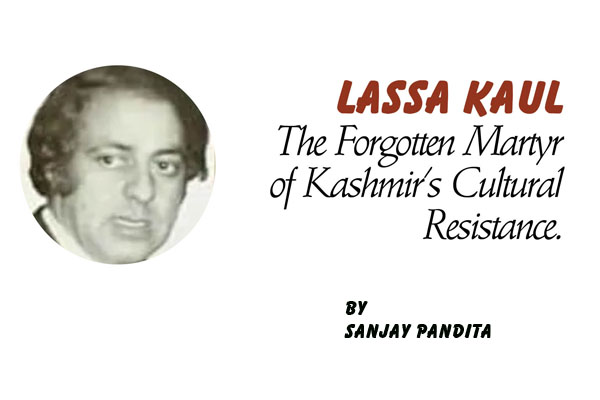
Lassa Kaul’s life was one of extraordinary devotion—to his work, his family, and the ideals he cherished. He was a man who embodied resilience, a professional who understood the transformative power of media, and a visionary who believed in the unifying strength of culture. His journey was marked by brilliance, his choices by integrity, and his end by the cruel hands of those who could not understand the depth of his commitment.
Today, over three decades after his brutal assassination, his name remains absent from the pages of national memory. Why was this son of the soil not given the recognition he deserved? Why has the country he served so selflessly not honored him as a martyr of cultural resistance? This is not just a question—it is an indictment of our collective amnesia.
Born in the serene neighborhood of Sathu Barbarshah in Srinagar, Lassa Kaul’s very existence was a testament to fate’s peculiar will. He was the only surviving child among his seven siblings, a lone warrior who carried forward the hopes and dreams of his family.
From an early age, responsibility was his constant companion. He was not just another boy growing up in the valley; he was the embodiment of his parents’ resilience, their silent strength wrapped in a child’s frame. He carried the weight of their expectations with grace, excelling in his studies and proving himself to be an exceptional student. His intellect was razor-sharp, his ambition unwavering. But what set him apart was not just his academic prowess—it was his innate ability to connect with people, his warmth, and his effortless charm.
Lassa Kaul was not merely a scholar; he was a man of art and culture. He had a poet’s heart, a soul that found solace in words and music. He could recite verses that would leave listeners spellbound, weaving emotions into lines that spoke of love, longing, and the beauty of the land he adored. Kashmir, to him, was not just home; it was poetry, a living, breathing entity that pulsed in his veins.
His striking presence—tall, handsome, and elegant—made him unforgettable. But beyond his physical appeal was a character that radiated sincerity. He was a man of deep convictions, of unshakable faith in humanity. Perhaps that was his greatest strength—and his most tragic flaw. He believed in people, sometimes too much, trusting blindly, loving without conditions. He could never imagine that his goodness could be met with anything but kindness in return.
When he joined All India Radio, Lassa Kaul stepped into a world that perfectly aligned with his passions. Broadcasting was not just a job for him; it was a calling. He understood the power of media—not just as a tool of information, but as a bridge that connected people, that shaped minds and hearts.
He rose through the ranks, serving in various capacities across the state and beyond. At every station, he left a mark—not just for his professional excellence but for his fairness. He believed in merit, in giving opportunities to those who deserved them. In a world where nepotism and favoritism often dictated careers, he was an outlier, a man who judged solely on talent and dedication.
His leadership was characterized by a rare blend of discipline and kindness. He was strict in his expectations, yet gentle in his dealings. Those who worked under him admired him not just as a boss but as a mentor, a guide who pushed them to be better while standing firmly by their side.
When he became the Director of Doordarshan Kendra in Srinagar, it was not merely a promotion—it was a mission. He took the role at a time when the valley was teetering on the edge of turmoil. The Kashmir he had loved so fiercely was slipping into chaos, its culture being overshadowed by radicalism. But Lassa Kaul did not falter. He saw his role as more than just a government-appointed position; he saw it as a responsibility to uphold the artistic and cultural soul of Kashmir.
Under his leadership, Doordarshan Kendra Srinagar flourished as a platform of unity. He ensured that its programming reflected the valley’s rich heritage, that it celebrated the diversity of its people. He believed in showcasing Kashmir’s music, poetry, and traditions, in reminding people of their shared history.
But not everyone saw it that way. To the rising tide of extremism, he became a target.
As the valley descended into violence, militants saw in him an obstacle. His refusal to submit to their demands, his insistence on airing entertainment programs like Chitrahaar, was seen as an act of defiance. Warnings came. Threats followed. He was told to stop. To leave. To abandon the cause he had dedicated his life to.
His friends and colleagues urged him to go. His family pleaded with him to think of his safety. He had every reason to leave—his wife and daughter were already in Ghaziabad, his son studying at BITS Pilani. He could have walked away, sought refuge, lived a life of peace.
How could he abandon his duty? How could he leave his ailing parents? How could he let fear dictate his path?
He stayed not because he was unaware of the danger, but because he believed in something greater than himself.
On a cold February day in 1990, Lassa Kaul returned to Srinagar. His parents needed him. His work called him. He stepped out of his vehicle, the air biting against his skin.
And then, the gunshots rang out.The man who had spent his life building bridges, who had never harmed a soul, was silenced by bullets fired in hatred.
His murder sent shockwaves through the nation. His colleagues were devastated, unable to comprehend that the man who had been a beacon of integrity had been so brutally taken away. The corridors of All India Radio and Doordarshan fell silent, mourning a voice that had once filled them with warmth.
The valley had lost a son, a protector of its culture, a guardian of its heritage. The extremists had not just killed a man; they had struck at the very heart of what he stood for.
For the world, Lassa Kaul became another statistic, another victim of the violence that engulfed Kashmir. But for those who knew him, he was—and remains—so much more.
He was a visionary who saw the power of media long before others did. A leader who believed in fairness and uplifted those around him. A man who valued integrity above all else, who never compromised on his principles.
For his family, he was a world that could never be replaced. His daughter, Sanjila Kaul, remembers him as a hero—the man who lit up every room he entered, whose laughter and poetry filled their home. His wife, his parents, his son—they all lost more than a husband, a father, a son. They lost a part of themselves.
Lassa Kaul’s story is not just one of tragedy; it is a lesson in courage. It is a reminder of what it means to stand by one’s principles, to fight for what is right even in the face of overwhelming odds.
Lassa Kaul’s name echoes like a forgotten melody in the corridors of time—a man who stood against the tempest of terror, wielding truth as his only weapon. He was not merely a journalist but a sentinel of integrity, a storyteller who believed that the airwaves of Akashvani could carry more than just voices; they could carry hope.
His unwavering belief in the power of media to unite a fractured land made him a target, but it also made him a legend. The government once honored his sacrifice with the “Lassa Kaul Award for National Integration,” a tribute to the ideals he cherished. Each year, this award celebrated the finest program on All India Radio that championed national unity. But time, ever indifferent, eroded even this remembrance.
The quiet dismantling of the award began before 2020, though one man—Fayyaz Sheheryar, then Director General of All India Radio—stood as its last guardian. He resisted its erasure, ensuring that as long as he held office, the legacy of Lassa Kaul would not fade into bureaucratic oblivion. But when Sheheryar retired in December 2019, the Akashvani Annual Awards disappeared into silence, and with them, the honor that bore Kaul’s name. No official explanation was given, just the quiet turning of a page, the gentle burial of memory under the weight of indifference.
In an era where national integration remains a pressing need, the decision to cast aside an award that symbolized unity and resilience seems not only shortsighted but almost tragic. It is as though history itself is being rewritten, not with ink, but with silence. To forget Lassa Kaul is to forget that there were once men who stood firm when others fled, who chose truth when deception was easier, who embraced their duty even when it led them to death’s doorstep.
Perhaps, somewhere beyond the veil of time, he still walks along the banks of the Jhelum, murmuring poetry to the restless winds, dreaming of a Kashmir that never was but could have been. And perhaps, one day, when the weight of forgetfulness is lifted, history will remember him not merely as a victim but as a warrior of words—a man who lived and died for the truth, for his people, and for the land he could never forsake.
The writer can be reached at
sanjaypanditasp@gmail.com
The writer can be reached at sanjaypanditasp@gmail.com

