

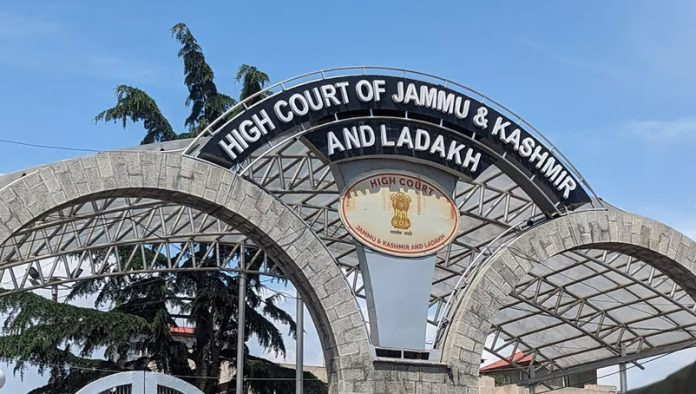
Srinagar, June 02,: Observing that constitutional courts are duty-bound to ensure that personal liberty is not sacrificed at the altar of administrative convenience, the High Court of Jammu & Kashmir and Ladakh has quashed a preventive detention order passed against a Kupwara resident under the stringent PITNDPS Act.
A single-judge bench of Justice M. A. Chowdhary ruled that the entire foundation of preventive custody rests on the executive’s urgent assessment of a threat, noting that if law enforcement agencies “sleep over the matter” and fail to execute a warrant for a long duration, the genuine necessity of the detention becomes highly questionable.
The court said that preventive detention is an exceptional measure and not a tool to circumvent standard judicial processes, particularly when a citizen has already been granted bail by a competent court under ordinary penal laws.
The ruling came on a writ petition filed by Jaffer Hussain Sheikh, a resident of Trehgam in Kupwara district, challenging the detention order passed by the Divisional Commissioner of Kashmir on December 27, 2023. The state administration had justified the preventive warrant by labeling Sheikh a hardcore drug peddler following his arrest in connection with FIR No. 32/2023, which involved the recovery of 300 grams of a charas-like substance. Court records revealed that a competent criminal court had evaluated the substantive narcotics case and formally released Sheikh on bail on May 3, 2023.
Seven months after his judicial release, the executive branch issued the parallel preventive detention order. However, local police failed to take custody of Sheikh until September 2, 2025, resulting in an institutional execution gap of more than one year and eight months.
The High Court fiercely criticized the massive execution delay, clarifying that preventive laws are strictly forward-looking and meant to avert immediate danger, not to punish past conduct.
The bench observed that an undue and unexplained delay completely breaks the necessary connection between the alleged crimes and the purpose of the detention.
“The unexplained delay in execution of the detention order assumes significance because preventive detention is based upon the subjective satisfaction of the detaining authority that immediate detention of a person concerned is necessary to prevent him from acting in a prejudicial manner,” the court said in the judgment, adding “If the respondents themselves sleep over the matter and fail to execute the detention order for such a long duration, the very basis of subjective satisfaction becomes doubtful.”
The state administration tried to defend the timeline by pointing out that Sheikh had filed an earlier petition in January 2024, securing an interim stay against his arrest. The High Court, however, dismantled this argument by saying that the prior petition was dismissed as withdrawn on April 16, 2025, precisely because the police had failed to execute the order up to that point.
Even after that interim stay was lifted, law enforcement waited an additional four and a half months before finally detaining him.
The bench noted that since ordinary criminal law was already set into motion through the initial FIR, the police were required to follow strict constitutional safeguards and show prompt execution, which was completely missing in this case.
Relying on the Supreme Court’s landmark ruling in Ramesh Yadav v. District Magistrate, Etah, the High Court reiterated that “ordinarily, a detention order should not be passed merely to pre-empt or circumvent enlargement on bail in cases which are essentially criminal in nature and can be dealt with under the ordinary law.”
To reinforce the strict constitutional limits on state power, the judgment extensively cited the apex court’s warnings in Rekha v. State of Tamil Nadu, reminding the executive branch that preventive detention is an extreme exception to Article 21.
The bench highlighted the Supreme Court’s observation that “preventive detention is, by nature, repugnant to democratic ideas and an anathema to the rule of law,” and must always be construed strictly because “the liberty of a citizen is a most important right won by our forefathers after long, historical, arduous struggles.”
Concluding that the prolonged and unjustified enforcement delay had completely vitiated the legal validity of the executive action, the High Court allowed the petition, quashed the Divisional Commissioner’s 2023 order, and directed the immediate release of the Kupwara resident from preventive custody.
