

SANJAY PANDITA
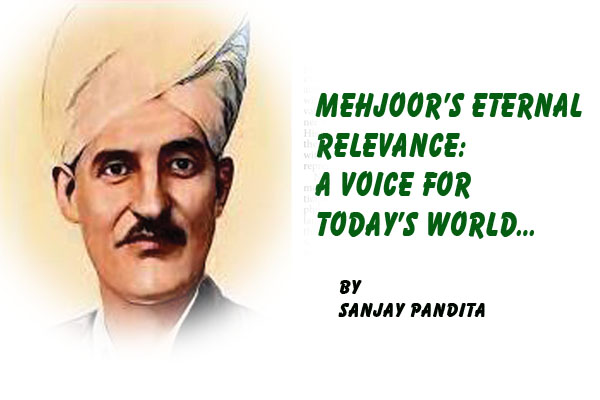
In a world grappling with the complexities of identity, alienation, conflict, and the unrelenting quest for meaning, the poetry of Peerzada Ghulam Ahmed Mehjoor emerges not as a nostalgic remnant of the past but as a beacon of relevance, speaking directly to the challenges and aspirations of contemporary times. While many literary figures remain anchored in the specific socio-political climates in which they wrote, Mehjoor transcends the boundaries of time and geography. His poetry continues to resonate because it addresses the deepest recesses of human consciousness—touching upon love, resistance, nature, and the indefatigable human spirit.

Today’s world is one of contradictions. Technological advancement runs parallel to emotional detachment. Societies claim progress while inequality and disenfranchisement persist. Amid this discord, Mehjoor’s voice rises—not merely as a symbol of Kashmiri culture but as a universal poet whose words offer solace, provoke thought, and call for action. His poetry is not shackled by tradition but is radical in its simplicity and profound in its reach. He rejected the elitism of classical Persian and Urdu poetic conventions and instead chose the everyday idiom of the Kashmiri people. In doing so, Mehjoor democratised poetry, making it accessible not only to the educated but to farmers, lovers, labourers, and dreamers. This accessibility remains profoundly relevant in today’s fractured world, where communication often becomes exclusionary.
In an age of rising nationalism and the dangerous politics of cultural erasure, Mehjoor’s linguistic and cultural reclamation of Kashmiri identity through poetry acts as a reminder of the power of indigenous voices. His embrace of Kashmiri as a medium of serious poetic thought challenged long-standing norms and restored pride to a language that had long been overshadowed. This act is mirrored in contemporary movements across the globe, where marginalised communities strive to reclaim their languages, traditions, and narratives. Mehjoor, therefore, serves as both a pioneer and a guide—a literary ancestor to modern-day cultural resistance.
More crucially, Mehjoor’s themes speak directly to the emotional landscape of the present. Love, in his poetry, is never simply romantic; it is spiritual, philosophical, and at times, revolutionary. It stands for yearning—not just for the beloved but for beauty, justice, peace, and wholeness. In a time when alienation has become an unspoken epidemic, and mental health crises are on the rise, Mehjoor’s verses offer a kind of healing. His metaphors, drawn from nature and infused with emotional clarity, remind readers of the sacred connections we share with each other and with the world around us. His verse becomes a sanctuary—where silence speaks, and pain transforms into poetry.
Take, for instance, his celebrated couplet about the narcissus amidst a garden of flowers. It is a distilled expression of existential longing—of desiring that one thing which eludes grasp, despite the abundance around. This paradox is familiar to the modern psyche, which often feels a void even amid prosperity. Mehjoor articulates this universal ache with startling clarity, offering validation to the fragmented inner worlds many navigate today. His voice becomes the voice of the unheard emotion, echoing with those who feel unseen, misrepresented, or misunderstood.
Nature, for Mehjoor, was not merely a backdrop but a participant in the emotional and philosophical journey of life. His landscapes breathe and bleed; they weep and whisper. In a time when environmental degradation threatens the planet’s future, Mehjoor’s reverence for nature takes on new significance. He reminds us of our sacred bond with the earth, of a time when humans and their surroundings coexisted in harmony. His depictions of gardens, snow-clad fields, and rivers are not nostalgic invocations—they are urgent appeals to reawaken our environmental consciousness. The pastoral in his poetry becomes prophetic, calling modern civilisation to halt its march towards ecological oblivion and return to a life of balance and reverence.
His call for awakening—both personal and collective—resounds with urgency in contemporary society. “Come, O gardeners, create a new spring,” is not merely poetic exhortation. It is a direct challenge to the complacency that often accompanies systemic oppression and social inertia. Mehjoor does not entertain passivity; his poetry demands movement, demands action. In this way, he aligns himself with poets like Faiz, Neruda, and Tagore—those who wielded poetry not just as an art form but as an instrument of revolution. In a world beset by socio-political stagnation, Mehjoor becomes the voice that reminds us of our agency. His verses are not mirrors but compasses, directing us toward a more just and humane world.
Furthermore, his emphasis on collective upliftment rather than individual glorification is particularly resonant today. Contemporary culture, often driven by hyper-individualism and self-promotion, finds in Mehjoor a different ideal—that of community, harmony, and shared dreams. His poetry is filled with appeals to the common folk, to awaken, to rise, to transform their reality. This vision offers a counter-narrative to today’s prevalent ideologies of isolation and competition. It underscores the idea that progress is not personal alone—it must be collective.
His political sensitivity, wrapped in lyrical subtlety, continues to be instructive. Mehjoor never used overt slogans; instead, his poetic diction infused even political rebellion with grace and metaphor. This ability to balance artistic integrity with political urgency is an art lost in much of today’s rhetoric, which is either too didactic or too abstract. Mehjoor shows that poetry can be soft and powerful, gentle and forceful, personal and public—all at once. His method becomes a model for modern writers and thinkers who struggle to find the balance between engagement and eloquence.
His universality is perhaps the most powerful aspect of his relevance. Mehjoor is not bound by his birth or borders. He is not confined to Kashmir, although he draws deeply from it. His metaphors speak across languages, his themes transcend histories, and his concerns mirror the collective human experience. This is why his poetry remains undiminished even in translation—a rare quality for any poet. When Mehjoor speaks of longing, he speaks not just as a Kashmiri but as a human being. When he writes of nature, he is not simply drawing from the Himalayas but from the earth itself. And when he calls for change, he speaks to all those silenced by systems, structures, and fears.

Even in the digital age, where attention spans are shortened and language is increasingly functional, Mehjoor’s poetry holds sway. It invites slowness, contemplation, and depth. It asks readers to pause and listen—to the murmur of a stream, the sigh of a lover, the cry of a people. His verse is not consumed in haste but lingers, echoes, and returns—like a song that finds new meaning each time it is heard. His work is now not only read but sung, visualised, interpreted in art and theatre—testimony to its undying vitality. In a time when art risks becoming disposable, Mehjoor’s poetry offers permanence, a rootedness in the truth of the human condition.
Contemporary readers, especially those in conflict zones, marginalised spaces, or cultural peripheries, find in Mehjoor a voice of empathy and empowerment. He does not offer escapism but a lens to reinterpret reality, to find beauty even in struggle, and to discover strength in the face of adversity. This is why he remains relevant not only to Kashmiris but to Palestinians, Tibetans, Syrians, and anyone who has lived the reality of displacement, denial, or disillusionment. He gives them not just words, but dignity. Not just rhythm, but resistance.
In an increasingly polarised world where language is weaponised and silence is forced, Mehjoor’s poetry emerges as both shield and sword. It protects the soul and fights for its freedom. It consoles and confronts. It weeps and yet refuses to surrender. His is the voice that insists on light in the darkest night, the whisper that becomes a rallying cry, the quiet that roars.
Therefore, Mehjoor’s significance in the present is not that he wrote in the past, but that his words belong to the now and the forever. He is not a chapter in history but an ongoing dialogue. His poetry continues to ask questions we still grapple with and provides answers we are yet to fully comprehend. As long as there are hearts that ache, lands that suffer, dreams that are deferred, and hopes that flicker, Mehjoor will remain a companion—his verses flowing like a river through the ever-changing landscapes of the human spirit.
The writer can be reached at sanjaypanditasp@gmail.com
