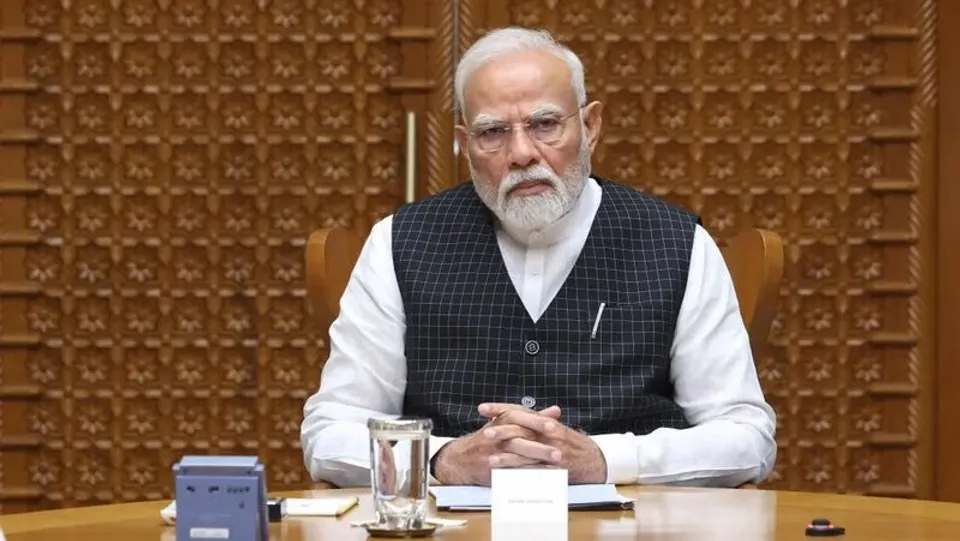
New Delhi, Oct 13: Prime Minister Narendra Modi on Tuesday said India’s economic growth was anchored in strong fundamentals and a sustained reform drive, declaring that the country sought to expand its global economic influence through shared prosperity rather than at the expense of other nations.
“We do not grow at anyone’s cost. We grow with the world. And for the world,” Modi said, pitching India as a reliable economic partner amid geopolitical tensions, trade disruptions and growing competition over critical technologies and resources.
Addressing the Bloomberg Economic Forum, he cited the country’s 7.8 per cent economic growth in the April-June quarter, foreign-exchange reserves exceeding USD 700 billion and reforms spanning taxation, insolvency and labour laws as evidence of its resilience. “In this world full of uncertainties, India inspires reliability and stability,” he said.
“This year, in the April to June quarter, India’s economic growth was 7.8 per cent. And this growth is taking place on a strong foundation,” he said citing strong macroeconomic fundamentals, including drastic reduction in India’s current account deficit from over 4 per cent 12-13 years back to about half a per cent now.
Modi argued that economic and technological strength should be measured not merely by the power a country commands, but by how effectively it creates opportunities for others. “The real question is not who has the power. The real question is, how is this power being used?” he said, summarising his approach as “power to empower”.
The prime minister highlighted India’s digital public infrastructure, expanding startup ecosystem and clean-energy capacity as examples of how domestic capabilities could support inclusive growth. He said India was sharing its experience in digital identity, payments and public infrastructure with partner countries, particularly in the Global South.
“For us, reforms are not a compulsion. Reforms are our conviction,” he said.
Modi also warned that supply chains, energy, critical minerals, payment systems and technology were increasingly becoming instruments of geopolitical pressure, making reliable partners and resilient economic systems more important.
“They are all becoming tools for coercion and for exerting pressure,” he said.
The remarks come as India seeks to attract investment, expand its role in global supply chains and deepen economic partnerships with emerging markets.
Modi pitched the country’s growth not only as a domestic economic achievement but also as a potential source of technology, talent and solutions for other economies.
He highlighted India’s digital public infrastructure, startup ecosystem, expanding clean-energy capacity and improving macroeconomic indicators to argue that the country’s rise offered a model of inclusive growth amid geopolitical tensions, supply-chain disruptions and growing competition over critical technologies and resources.
“Power is to empower,” he said, arguing that the true measure of economic and technological strength lay in how effectively it could improve lives, expand opportunities and help other countries address shared challenges.
The remarks came as India seeks to consolidate its position as a major growth engine and an alternative manufacturing and technology hub amid an increasingly fragmented global economy.
Modi said India wanted to deepen international partnerships by sharing its expertise in digital payments, digital identity and public infrastructure, particularly with countries in the Global South.
The prime minister also highlighted the expansion of India’s startup ecosystem and renewable-energy capacity, arguing that technology and innovation should benefit people across income groups and geographies. He cited India’s COVID-19 vaccine supplies to more than 100 countries as an example of using domestic capabilities to meet global needs.
Warning that supply chains, energy, critical minerals, payments and technology were increasingly becoming instruments of geopolitical pressure, Modi called for greater international cooperation on climate change, public health, artificial intelligence and economic security. ( PTI )