

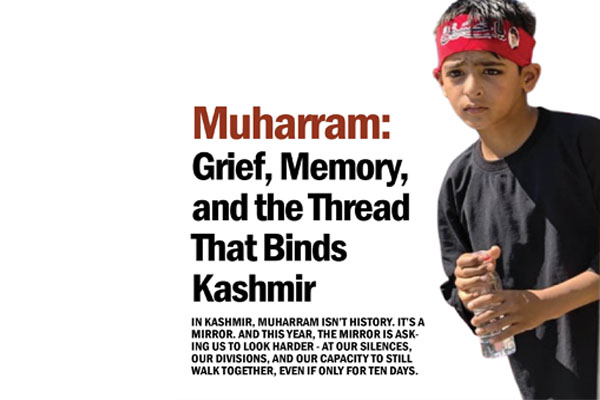
In Kashmir, Muharram isn’t history. It’s a mirror. And this year, the mirror is asking us to look harder – at our silences, our divisions, and our capacity to still walk together, even if only for ten days.
The first month of the Islamic calendar arrives in Jammu and Kashmir not with celebration, but with a collective intake of breath. Muharram. For ten days, the streets of Srinagar’s Zadibal, Hassanabad, and Budgam turn black. Walls drape in banners. The air fills with the rhythmic cadence of nohas and the scent of tehri from sabeels . This is not just mourning. This is Kashmir remembering Karbala, 680 AD, and asking what it means today.
What happened at Karbala
Imam Hussain, grandson of Prophet Muhammad, stood against Yazid’s rule in Iraq. He refused allegiance to a ruler he saw as unjust. With 72 companions, including family, he was surrounded at Karbala. Denied water for days, they were killed on the 10th of Muharram, Ashura. Hussain’s stance became the template: choose principle over survival. For Shia Muslims, it is the central tragedy. For many Sunnis and others, it remains a universal lesson on standing up to tyranny.
Kashmir’s Muharram: Older than curfews
Muharram processions in Kashmir predate modern politics. Documents note large alam processions in Srinagar in the 1800s under Dogra rule. The tradition survived political upheaval because it was never only about religion. It became community.
Today, Zadibal’s Ashura procession draws lakhs. Men, women, children walk barefoot. Zuljanah , the riderless horse, moves through the crowd. Its empty saddle symbolizes loss. People touch it, seeking mannat . Blood donors line up at medical camps – a modern response to Karbala’s thirst. In 2023, over 8,000 pints were collected in Srinagar alone during Muharram.
The ban years and the return
From 1989 to 2022, the main Ashura procession on the Srinagar routes was banned due to security. For 33 years, mourners walked bylanes or faced restrictions. Elders recall reciting nohas in courtyards, children asking why the alam couldn’t go to Imambara. In 2023, the traditional route was allowed again. A 70-year-old from Rainawari said, “I thought I’d die before seeing alam on M.A. Road again.” The lifting of the ban wasn’t just administrative. It was emotional repair.
Sunni-Shia: The shared vocabulary
Kashmir’s Muharram blurs sect lines. Many Sunni families cook tehri and distribute it. Sufi shrines hold majlis . The phrase “Hussain sabka hai” is common. At Budgam’s Imambaras, you’ll find Sunni volunteers managing water stalls. The story of Karbala functions like a shared moral grammar: resist injustice, protect the weak, stay truthful. In a place used to division, Muharram becomes a 10-day truce of shared ethics.
Women of Muharram
Often invisible in public telling, women anchor Muharram. They run majlis at home. They teach children the names of the martyrs of Karbala. In Hassanabad, the zenana majlis draws hundreds. A college student, Insha, says: “Zainab’s khutba after Karbala taught me how to speak when power wants silence. That’s not 7th century. That’s today.” The mourning is also a school of resilience.
The poetry of grief: Kashmir’s Marsiya
Kashmir gave Karbala its own tongue. The marsiya tradition here is centuries old. Poets like Mirza Akmal, Fazil Kashmiri, and Munshi Ghulam Hassan wrote in Persian and Kashmiri, turning grief into literature. Even today, zakirs in Budgam recite marsiyas that describe Karbala’s heat, the children’s thirst, and Zainab’s courage in words that make grown men weep.
Unlike elsewhere, Kashmiri marsiya uses local imagery. The Euphrates becomes the Jhelum. The desert becomes karewa . This isn’t appropriation. It’s translation – making a distant tragedy intimate. Young poets now post marsiyas on YouTube. A 22-year-old from Magam, Faizan, blends noha beats with rabab . “If Karbala happened today, Hussain would be on Instagram Live,” he says. “So we adapt.”
The economics of mourning
Muharram also moves money. In the 10 days, Srinagar’s black cloth sales cross Rs 4 crore. Alam makers in Hassanabad work year-round. Calligraphers who write “Ya Hussain” banners are booked months ahead. Sabeel stalls – offering water, tea, tehri – are funded by local mohallas. Each stall costs Rs 15,000-50,000, paid by donations. No government funding, no corporate sponsors. It’s community economics.
The blood donation camps have become a parallel economy of goodwill. SKIMS and SMHS hospitals report that Muharram donations cover 30% of their annual emergency needs. A matam leader, Shabir, puts it plainly: “We beat our chests for Hussain. We give blood for the living. Both are ibadat .”
Muharram in exile: The diaspora thread
From Dubai to Toronto, Kashmiri Shias carry Muharram with them. In London, the Anjuman-e-Hussaini Kashmir holds majlis in Kashmiri. In Delhi’s Shia College, Kashmiri students host noha nights. The rituals travel, but they also change. A student in Bengaluru says, “Here we can’t take out alam . So we do zanjeer in the basement parking. The pain is same. The setting is different.”
Social media becomes the new Imambara. Live streams of Zadibal’s Ashura get 2 lakh views. WhatsApp groups share majlis timings. Grief, once local, is now networked. Yet elders worry. “Phone pe majlis sunna is not the same as sitting on tatt wath ,” says 65-year-old Ghulam Rasool of Bemina. “The matam needs a body next to you.”
What Muharram asks in 2026
Karbala was about power, water, and dignity. Kashmir in 2026 understands all three. Youth face job scarcity. Climate change hits water sources. Public expression remains negotiated. So when a noha says “ pyaas ”, it lands differently here. When it says “ zulm ”, people map their own meanings. Muharram doesn’t give answers. It gives a question: What would you stand for, if it cost you everything?
The sham-e-ghariban ends. Candles blow out. But the question stays. In Kashmir, Muharram isn’t history. It’s a mirror. And this year, the mirror is asking us to look harder – at our silences, our divisions, and our capacity to still walk together, even if only for ten days.

