

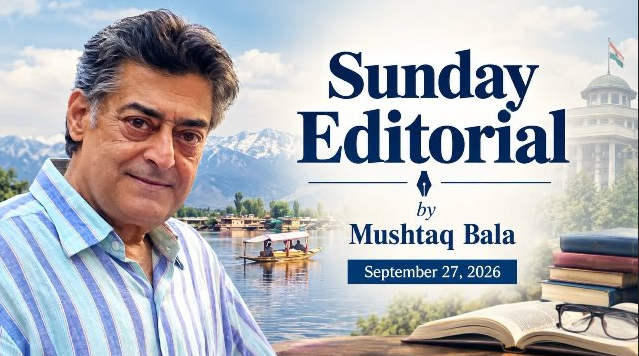
Sunday Editorial by Mushtaq Bala
The past week in Jammu and Kashmir has once again demonstrated how quickly public discourse can become consumed by political confrontation, while several equally important questions concerning education, employment, business and institutional accountability remain waiting for answers.
The proceedings of the Legislative Assembly reflected the continuing sensitivity of history and political memory in J&K. The controversy over holidays associated with Maharaja Hari Singh, Sheikh Mohammad Abdullah and July 13 led to heated exchanges and a walkout by BJP legislators. The debate is legitimate because history matters, but the manner in which historical questions are handled also matters.
Our history cannot be reduced to competing slogans.
Jammu and Kashmir carries layers of history, memory and political experience. Different communities and regions have different relationships with that history. A mature democratic society must have the space to remember, debate and even disagree without allowing historical personalities to become permanent instruments of political confrontation.
The Assembly should ultimately be a place where disagreements are converted into debate, scrutiny and legislation—not merely another arena for political theatre.
Perhaps more concerning is what emerged from the education sector this week.
The government informed the Assembly that 4,249 books had been withdrawn from circulation after scrutiny, with 3,996 of them from Kashmir. It has stated that objective criteria were adopted to identify material considered objectionable and that scrutiny is continuing.
The question that follows is simple and deserves a clear answer: Which books were withdrawn, and on what specific grounds?
If a book violates the law, the government should say so. If particular passages are considered objectionable, those reasons should be placed in the public domain. If expert scrutiny is still under way, that too should be transparently explained.
Libraries and educational institutions are not merely repositories of approved opinions. They are spaces where students encounter history, competing ideas, literature and uncomfortable questions. Academic freedom does not mean that every book is beyond scrutiny; it means that scrutiny itself must be transparent, reasoned and accountable.
The demand for transparency in this matter should therefore not be viewed through a political lens alone. It is fundamentally an educational and institutional question.
The same principle applies to the continuing protest by vocational trainers in Srinagar. Trainers have been seeking changes in the outsourcing system, improved service conditions and a formal policy providing greater stability. They say recommendations have already been made by the Directors of School Education.
Whatever the merits of the competing positions, prolonged uncertainty affecting hundreds of workers and their families is not desirable. Government cannot resolve every employment dispute immediately, but it can ensure that legitimate representations are heard, examined and answered within a reasonable time.
A functioning administration must be accessible not only to powerful institutions but also to ordinary employees whose livelihoods depend upon government decisions.
The business community, too, has been asking for predictability and institutional support.
At the 92nd Annual General Meeting of the Kashmir Chamber of Commerce and Industry, concerns were raised about financial stress, handicrafts, horticulture, crop insurance, tourism and commercial leases. The Chamber sought a special One-Time Settlement mechanism, while the government indicated that the issue could be considered and also spoke of a new Industrial Policy.
These are not merely demands of businessmen. They are questions about employment, investment and household incomes.
J&K’s economy cannot depend indefinitely on seasonal activity or government expenditure. Small businesses, artisans, farmers, tourism operators and young entrepreneurs require an environment in which policy is predictable, procedures are reasonably fast and genuine difficulties receive institutional attention.
The conversation about development therefore has to move beyond announcements. It must be measured by whether a young entrepreneur can establish an enterprise without unnecessary delay, whether an artisan can earn a sustainable livelihood, whether a farmer has meaningful protection against losses, and whether a struggling borrower has access to a fair mechanism for resolving financial distress.
There is another lesson in this week’s events.
Whether it is a book in a library, a worker outside a government office, a business seeking relief, or an elected representative raising an issue in the Assembly, institutions earn public confidence through transparency and response.
Jammu and Kashmir has witnessed enough periods in which public debate was dominated by suspicion and confrontation. The democratic transition demands something different: stronger institutions, clearer procedures and greater willingness to listen.
Political parties will naturally disagree. That is the essence of democracy. But governance should not become hostage to disagreement.
The government has a responsibility to explain its decisions. The opposition has a responsibility to scrutinise them seriously. Legislators have a responsibility to use the Assembly as a forum for public issues. Civil society and the media have a responsibility to ask questions without turning every issue into a political battle.
And citizens have a right to expect answers.
The coming weeks should therefore be an opportunity to shift the conversation—from personalities to institutions, from slogans to substance, and from confrontation to accountability.
Jammu and Kashmir does not lack public debate.
What it needs is better public dialogue—and institutions capable of turning that dialogue into credible action.
— Mushtaq Bala

