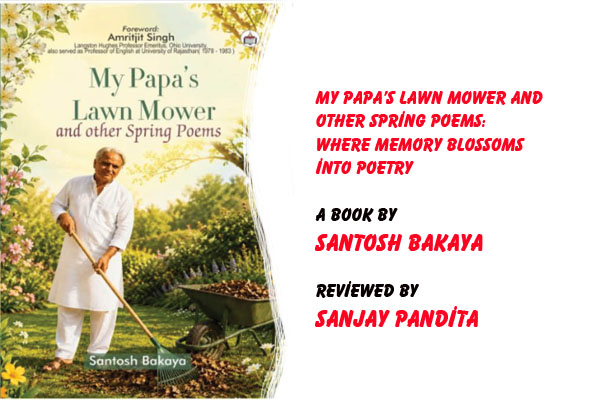
A father’s presence does not always disappear with his departure from the world. Sometimes it survives in the objects he touched, the garden he nurtured, the books he read, the songs he hummed, and the laughter that once filled the house. It lingers in familiar fragrances, seasonal changes, childhood anecdotes, and seemingly insignificant moments that acquire extraordinary meaning with the passage of time. Santosh Bakaya’s My Papa’s Lawn Mower and Other Spring Poems explores this enduring relationship between memory and affection through a collection that celebrates fatherhood, childhood, nature, family, and the emotional geography of a remembered homeland. It is, in essence, a daughter’s attempt to retrieve a world that time has altered but memory refuses to surrender.
At the centre of this collection stands Dr. Kashinath Bakaya, the poet’s father, a professor of English, accomplished scholar, and a man whose personality extended far beyond his academic achievements. Through her poems, Santosh presents a multifaceted individual who could discuss literature with scholarly authority, appreciate music, recognise birds, nurture a garden, and enthusiastically participate in the everyday lives of his children. His affection was expressed not through grand declarations but through companionship, humour, involvement, and an instinctive understanding of his children’s needs. What makes this portrait particularly appealing is that the poet does not present him as an inaccessible ideal. Instead, she brings him alive through intimate conversations, domestic incidents, playful exchanges, and recollections that reveal the warmth of his personality.
The title itself offers an interesting entry point into the collection. A lawn mower, ordinarily associated with routine gardening, becomes a symbol of a cherished domestic world. It evokes the garden, the rockery, the flowers, and the trees that formed part of the father’s everyday life. These are not merely physical spaces but emotional landscapes in which family memories have taken root. The lawn mower, like several other familiar objects in the collection, acquires significance beyond its immediate utility. An old pin-striped suit, a watermelon, a dinner gong, a letter, or even the sound of a bird can suddenly open the doors to an entire world that one thought had been lost.
The insightful foreword by Dr. Amritjit Singh provides an important perspective on Bakaya’s poetic sensibility. His observations on personal poetry, longing, and the movement between yearning and ecstasy illuminate the intimate relationship between the poet and her father. He also draws attention to the connection between childhood experience and mature reflection, preparing readers to approach the collection not merely as a daughter’s tribute but as an exploration of lived experience.
The opening poem, ‘The Time Machine Moves’, establishes the emotional framework of the book. Sitting on her balcony, the poet notices a purple sunbird feeding its young ones. The sight awakens memories of her own childhood and sets the time machine of recollection in motion. Her father emerges as a scholar equally comfortable with household responsibilities, while her mother appears as an intelligent and resourceful woman. The anecdote about her father’s determination to master Hindi is particularly engaging. His playful response to a student’s surprise at his command of the language, ‘Parishram sey sab sambhav hai’, reveals his humour, confidence, and belief in perseverance. Equally touching is the recollection of his participation in everyday domestic responsibilities, from ironing school uniforms to preparing children for school. The poem challenges the conventional image of an emotionally distant father and celebrates a relationship founded on companionship and affection.
‘What! Another Daughter!’ reveals another dimension of his personality. Recalling an insensitive neighbourhood woman’s disappointment at the birth of another girl child, the poet describes her father’s immediate response to the prejudice. His assertion that sin has no colour and his first loving kiss become powerful expressions of acceptance and protection. Through this personal incident, Bakaya addresses the larger social problem of gender discrimination. The poem’s strength lies in its ability to communicate a meaningful social message through an intimate family memory.
‘Watermelon Time’ is a delightful example of how ordinary domestic experiences become memorable poetic episodes. Set against the scorching heat of Jaipur, the poem describes the excitement created by the arrival of a watermelon. The father’s announcement brings the children rushing out, while their grandmother eagerly awaits her share. His sudden distraction upon hearing a Black-crested Bulbul reveals his fascination with birds. The contrast between his enthusiasm for nature and the grandmother’s concern about protecting her share of the fruit adds a delightful touch of humour. Such incidents give the collection its warmth and spontaneity.
In ‘His Vibrant Laughter’, a rain-washed garden, a parakeet feeding on a mango, sparkling leaves, and wild pansies gradually lead the poet towards memories of her father. The flowers returning every spring remind her of the invisible blessings of nature, while her father’s laughter becomes comparable to the arrival of spring after a desolate winter. Here, nature and memory merge beautifully, making his laughter an enduring emotional presence.
‘Dads Will Be Dads’ explores the playful dimensions of the father-daughter relationship through childhood mischief, literary references, and affectionate exchanges. Recollections of stealing guavas and sharing jokes create a lively picture of family life. Yet the tone gradually changes when the father’s powerful baritone falls silent. The transition from laughter to loss is handled with restraint, suggesting that memory can occasionally restore the presence of those who are no longer physically with us.
‘Dad’s Rockery’ further develops the association between nature and remembrance. Birds, rabbits, sparrows, parakeets, and a peacock populate a garden associated with the father’s labour and affection. The neem tree planted by him becomes a silent reminder of his contribution to that familiar world. The rockery thus emerges as more than a garden feature; it becomes a living archive of family life, rootedness, and the passage of time.
Kashmir introduces another significant emotional dimension to the collection. It is not merely a scenic backdrop but a remembered homeland and an integral part of the poet’s identity. In ‘Some Good Cheer’, she revisits her ancestral house through memories of bustling streets, tongas, hand-cart vendors, and familiar calls of sellers. Her father running out to buy strawberries, apples, cherries, paneer, and roasted chestnuts recreates the atmosphere of an earlier Kashmir. These ordinary experiences become treasured fragments of a world preserved through memory.
‘On That December Morn’ is particularly evocative. The familiar sound of icicles melting from the eaves of the old Kashmiri house transports the poet across decades. The appearance of a wounded Blue Whistling Thrush adds tenderness to the recollection, bringing together the vulnerability of nature and the persistence of childhood memories.
In ‘Spring in My Gait’, the poet celebrates Sonth, the Kashmiri spring, through saffron fields, blooming flowers, majestic chinars, the Zabarwan Hills, and almond trees dressed in delicate blossoms. The childhood memory of a snowman and a playful incident near the River Lidder lend a personal touch to the landscape. Her invocation of Wordsworth’s daffodils creates an interesting connection between English Romantic poetry and Kashmir’s natural beauty. The concluding thought, ‘There was spring at my gate. There was spring in my gait’, beautifully captures the transformation of an external season into an inward feeling of happiness.
The geographical movement between Kashmir and Jaipur is also noteworthy. Jaipur provides the setting for several domestic recollections, while Kashmir represents childhood, ancestral belonging, and seasonal wonder. These places coexist in the poet’s consciousness, connected by affection and memory. Physical distance, therefore, cannot diminish the intimacy of remembered landscapes.
‘Come with Me into the Woods’ reveals Bakaya’s literary sensibility through conversations involving Mary Oliver and Robert Frost. Her father’s fascination with nature and his ability to recall poetry establish him as a companion in both intellectual and emotional exploration. Similarly, ‘Papa’s Pin-Striped Suit’ transforms an ordinary household ritual into an affectionate recollection. The suit becomes a treasured relic, preserving something of the dignity and personality of the man who once wore it.
One of the collection’s most poignant moments arrives with ‘My Papa’s Last Letter to Me’. The unfinished correspondence becomes a final thread connecting father and daughter. His hopes of recovering, returning to work, publishing his research on Robert Browning, and continuing his conversations with her make his departure particularly painful. His unfinished thesis, incomplete novel, and untold stories become symbols of interrupted possibilities. The words ‘He left soon after’ acquire increasing emotional weight, conveying the helplessness of a daughter who still has so much to ask and share. The letter becomes more than a document; it is a treasured remnant of a relationship that death could interrupt but never erase.
Beyond its themes, the collection deserves appreciation for its distinctive poetic style. Bakaya predominantly employs free verse, allowing memories and reflections to unfold without the restrictions of a fixed metrical pattern or regular rhyme scheme. Her poems frequently adopt a narrative approach, with identifiable settings, characters, dialogues, and incidents. Yet they are not merely anecdotes divided into poetic lines. Carefully chosen images, shifts in tone, and emotional conclusions give them an individual poetic identity.
Conversational lyricism is another defining feature of her writing. The dialogues between father and daughter, the grandmother’s humorous remarks, and spontaneous family exchanges create intimacy and immediacy. Her father does not remain a distant subject of description; he speaks, laughs, jokes, teaches, and responds. Through this technique, the reader experiences the relationship rather than merely reading about it.
Imagery is among the poet’s strongest resources. Birds, flowers, trees, rain, sunlight, changing seasons, and Kashmir’s natural landscape provide a rich visual vocabulary. Nature is never merely decorative. A bird feeding its young recalls parental devotion; flowers returning every spring evoke the renewal of memory; a garden becomes a record of family life; and sunlight suggests the unexpected return of a loved one’s presence. Personification and metaphor further enrich this imaginative world. Spring signifies renewal and warmth, while winter often suggests separation and the silence of absence. The recurring time-machine metaphor effectively captures memory’s ability to transcend chronological boundaries.
Bakaya also displays a keen ear for sound and verbal play. Alliteration, repetition, rhythmic phrasing, and playful expressions such as ‘flashes, dashes, gashes’ and ‘pitter-patter’ lend musicality to her free verse. Humour, meanwhile, prevents the collection from becoming overwhelmingly sentimental. Her literary allusions to Shakespeare, Robert Browning, Robert Frost, Mary Oliver, Sylvia Plath, William Wordsworth, and Vincent van Gogh reflect an imagination nourished by literature and art. These references are woven naturally into personal recollections rather than serving as mere displays of scholarship.
Her language remains accessible, expressive, and unpretentious. She prefers the familiarity of lived experience to deliberate obscurity. At certain points, however, descriptive passages become expansive, and a little compression might have allowed some images and emotions to achieve greater intensity. The poems are most effective when a simple observation or restrained expression is allowed to communicate its full emotional significance.
The collection also moves beyond nostalgia. ‘The Stinging Refrain’ introduces the harsh realities of conflict and violence. Against the apparent beauty of spring, the poet sees a troubled world where innocent lives remain threatened. The contrast between the green landscape and the bruised human heart lends contemporary relevance to the collection, reminding readers that nature’s beauty cannot entirely silence the suffering of humanity.
The forty-four poems, followed by an epilogue, an afterword, and an interview with the poet published in Poets IN in 2018, offer considerable thematic variety. Although the father-daughter relationship remains the emotional centre, the poems extend into childhood, family, nature, literature, homeland, and the wider human condition.
The collection’s greatest achievement lies in its emotional honesty. Bakaya neither conceals the pain of bereavement nor allows grief to overshadow the vitality of cherished memories. Her father survives in his laughter, literary interests, gardening, humour, and everyday habits. He is present in flowers, birds, familiar objects, and the changing seasons. This is why the collection will resonate particularly with readers who have experienced the loss of a parent. It reminds us that grief is not always expressed through tears; sometimes it emerges through an old possession, a familiar sound, or a sudden recollection that brings the past startlingly close.
My Papa’s Lawn Mower and Other Spring Poems is ultimately a celebration of a relationship that transcends time. It reminds us that the inheritance parents leave behind is not limited to material possessions but includes values, intellectual curiosity, tenderness, and the ability to discover beauty in ordinary life. Santosh Bakaya has transformed personal memories into poetry that speaks to universal emotions. The lawn mower may belong to an earlier world, the garden may have changed, and the familiar voice may have fallen silent, but the emotional landscape remains alive. Every returning spring brings with it a fragment of the father’s laughter.
This is not merely a daughter’s tribute to her father; it is a celebration of fatherhood, family, memory, and the enduring human need to remain connected with those we love. Sensitive in observation, engaging in narration, and sincere in emotional expression, the collection deserves the attention of readers who value poetry emerging from lived experience and speaking directly to the human heart.
ABOUT THE REVIEWER
Sanjay Pandita is a poet, columnist & critical analyst , can be reached at sanjaypanditasp@gmail.com