

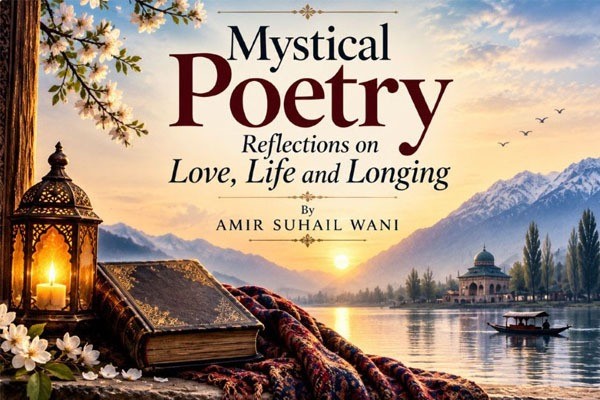
Amir Suhail Wani
Srinagar 10 Aug : Scholars of mysticism divide mystics into two broad categories based on their response to the phenomenon of spiritual enlightenment – Mystics of Sobriety (Sahw) and Mystics of Ecstasy (Sukur). Mystics of ecstasy are overwhelmed and intoxicated by spiritual experiences to the point where their intellect is subdued by their “accidents of the heart” (Wardaat-i-Qalb), and this rapture causes a rupture in the normativity of their existence, which takes such diverse forms as Whirling (Raqs), words of ecstasy (Shatahat) and, above all, poetry. Mystical poetry is that uniform and universal response to the “overflow of Being”, when a mystic is unable to contain his spiritual experiences and, in an attempt to ease the spiritual pressure building within, vents it through the ecstatic and rapturous medium of poetry. Here, the mystic is simultaneously situated, or rather torn, between two realms: the realm of transcendence from which his experiences originate and the realm of immanence in which the mystic finds himself situated by virtue of possessing a physical existence, something Heidegger called Thrownness, or Geworfenheit.
The mystic also finds himself mediating between the realm of spirit, which is limitless meaning, presence and light, and the realm of matter, which is the territory of limited forms, distance from the Divine and translucence by virtue of its separation from the source. The mystic further finds himself in a state of compromise between the infinite domain of message and meaning and the finite domain of medium and language. Mystical experiences are too vast to be compressed into the net of language, for these experiences constitute the primary revelation of Being, and language, at its ultimate limits, breaks down and ruptures when it comes to accommodating the description of Being/Existence. Here we have a typical example of compressing an ocean within a pot, and the pot cannot but break into a hundred thousand pieces under the impulse of meaning which it is inadequately equipped to contain. If mystics know this limitation of language, why then do they dare to undertake such a perilous experiment? The answer is that mystics have no control over the course of grace of which they are vehicles, and which finds its way into the world of the mundane, of which language is but the most effective means, notwithstanding its limitations. This is quite analogous to the instance of revelation which, instead of containing an infinity of meanings, is obliged to manifest in the realm of words, allowing only a limited number of possibilities to flourish. This also explains the apparent dichotomies as they exist in revelation and mystical poetry alike. What is happening is that a higher-dimensional reality is being approached through lower-dimensional representation. This is where, Schuon says, language, as if unable to hold the infinity of revelation, breaks down. Yet it is precisely this breakdown of language that helps the seeker to bask in the spiritual light which arrives across the linguistic crevices. The ultimate purpose of revelation, and for that matter of mystical poetry, is not to make factual claims which are empirically verifiable, but to draw our attention towards realms and realities which escape all language and representation, and to which only silence and bewilderment constitute the apt human response.
If mystics come into contact with the deepest layers of Being and meaning in their odysseys of spiritual flight, it becomes valuable, mystically as well as otherwise, to analyse the import of mystical poetry. What does mystical poetry say about Man, God, Universe, Life, Death, Body, Matter and other matters of importance to humankind? We begin with the assertion that traditions of mystical poetry, as they exist in different religious and socio-cultural contexts, bear striking similarities to one another. This is despite the fact that mystical poets come from backgrounds as diverse as the deserts of Arabia, the gardens of Iran, the suburbs and forests of India, or the modern cities of Europe and America. A dominant leitmotif of mystical poetry is the communion between the subject and the object, the knower and the known, the within and the without. This is to say that the epistemological gap, as it exists in all science, philosophy and religion between “I and Thou”, is overcome in the mystical state of experience through a leap of intuition. This intuition comes very close to what Henri Bergson proposed in the earlier decades of the 20th century, in which the “knower becomes the known”. Iqbal, inspired by Bergson and the early Muslim mystics, advocated a similar epistemological detour, which he heuristically called “Ishq”. As against the generic understanding of Ishq as an activity of passion, Iqbal transformed it into an epistemological apparatus of utmost significance. However, Bergson and Iqbal came as close to mystical epistemology as much as they differed from it. This is because, in mysticism, one is able to “close” the epistemological gap on the basis of closing the ontological gap. That is to say, the knower and the known, the subject and the object, the noumena and the phenomena do not merely participate in epistemological unity, but this unity is itself precluded and guaranteed by ontological unity, the existential oneness – called Wahdat-ul-Wujood or Unity of Existence. This is the primary and principal arch of all mystical poetry. Utterances like “Aham Brahmasmi” or “Anal Haq” are its expressions vis-à-vis the relationship between the human subject and the transcendental object; however, the philosophy itself goes much beyond this, celebrating the oneness and unity of all existence – binding the earth and heavens in a nuptial bond of mystical joy. Let’s take a look at few cross-cultural expression :-
Ma zi-bālāyīm-o bālā mī-rawīm
Ma zi-daryāyīm-o daryā mī-rawīm
“We are from above, and towards the Above we journey;
We are of the ocean, and towards the Ocean we return.”
Ranjha Ranjha kardi ni main aape Ranjha hoi
Saddo ni mainu Dheedo Ranjha, Heer na aakho koi.
“Calling out ‘Ranjha, Ranjha’, I myself have become Ranjha;
Call me Ranjha, not Heer.”
Man tu shudam, tu man shudi
Man tan shudam, tu jaan shudi
Ta kas na goyad ba’d az in
Man digaram, tu digari
“I became you, and you became me;
I became the body, and you became the soul;
So that no one may say thereafter:
I am one, and you are another.”
In close alignment with the doctrine of Unity of Existence stands the fiery passion of returning to one’s spiritual Origin—which is therefore also the origin of the Universe and of all the good and beauty that abound therein. Islamic mysticism employs the evocative expression Vasl ila’l-Asl—communion with the Origin—for this journey of retraction from the world of dross and multiplicity towards the realms of subtle light and, beyond them, towards the Divine Source itself. The same intuition, expressed through different metaphysical vocabularies, recurs across the great religious traditions. Hinduism maintains that man’s primordial identity with the Divine—the unity of Atman and Brahman—is obscured by Maya and Avidya, the twin veils of ontological appearance and epistemological forgetfulness. The Upanishadic declaration, “Tat Tvam Asi”—“That art Thou”—is perhaps one of the most concise formulations of this primordial identity, while the Chandogya Upanishad repeatedly returns to the intuition that the deepest reality of the self is inseparable from the ultimate Reality. In the Christian tradition, the loss of primordial communion is articulated through the imagery of Eden, the Fall and humanity’s estrangement from God; the path of restoration is understood through Christ, whose life, death and resurrection become, in Christian mystical theology, the means of reconciliation and return to God. Thus, although the metaphysical premises and theological formulations differ profoundly, a recurrent intuition appears beneath these diverse languages: man experiences himself as exiled from an original plenitude and consequently spends his earthly existence yearning, consciously or otherwise, for a lost communion. This longing manifests itself under a hundred thousand guises—as philosophy, religion, love, beauty, art, asceticism and even, in distorted forms, hedonism—each representing, at different levels, an attempt to recover what the soul dimly remembers as its primordial home.
Rumi, whose Mathnavi has often been described as the “Qur’an in Persian” because of its immense spiritual and didactic significance within the Persianate world, opens his masterpiece with precisely this analogy of separation and return. The Neyistan or “Song of the Reed” begins with the lament of the reed flute, severed from the reed-bed from which it originated:
Bishnav az ney chun hikāyat mīkunad,
Vaz judāyīhā shikāyat mīkunad.
“Listen to the reed, how it tells its tale,
How it complains of separations.”
Rumi immediately transforms the reed into an image of the human soul, whose entire song is a complaint against separation. The reed’s music is born precisely from its severance from the reed-bed; similarly, the mystic’s longing is born from the soul’s awareness, however dim, of its separation from its Origin. Rumi later makes the principle explicit:
Har kasi ko dūr mānad az asl-e khvīsh,
Bāz jūyad rūzgār-e vasl-e khvīsh.
“Everyone who is separated from his Origin
seeks again the time of his union.”
Here the entire drama of mystical existence is compressed into two movements: furqat—separation—and vasl—union; exile and return; dispersion and recollection; multiplicity and unity. The mystic’s journey is therefore not merely a movement towards something previously unknown, but a return towards something primordial, something that the deepest recesses of the soul already know.
The Upanishads articulate a remarkably powerful parallel intuition through the language of Atman and Brahman. The celebrated Mahavakya, “Aham Brahmasmi”—“I am Brahman”—does not merely constitute an assertion about the individual ego; in the Advaitic reading, it signifies the discovery that the deepest Self is not ultimately separate from the Absolute. Likewise, “Tat Tvam Asi”—“That art Thou”—collapses the apparent distance between the seeker and the sought, between the individual self and ultimate Reality. The problem, therefore, is not the creation of unity but the removal of the ignorance that conceals an already existing unity. Avidya is forgetfulness, while spiritual realization is fundamentally a process of remembrance.
Islamic spirituality too speaks repeatedly in the language of return. The Qur’anic declaration, “Indeed, to Allah we belong and to Him is our return” (Qur’an 2:156), places the entire human drama between two poles of belonging and return. The verse is uttered in the context of suffering and loss, but its metaphysical resonance extends far beyond the immediate circumstance: the human being belongs to God at the beginning and returns to God at the end. The Qur’an elsewhere says, “O mankind, you are ever striving toward your Lord, and you will meet Him” (Qur’an 84:6). The journey is therefore not an accidental movement through an indifferent universe; existence itself becomes a movement of the creature towards its ultimate Source.
The great mystical traditions thus appear to converge upon a profound intuition: beneath the phenomenal drama of birth and death, separation and union, multiplicity and identity, there persists an archetypal human memory of Origin. The mystic is the one in whom this memory becomes sufficiently intense to transform itself into longing, and longing into a journey. The entire universe then becomes, in mystical perception, a vast theatre of return—where every form bears some trace of its Origin, every beauty becomes a reminder of the Beautiful, and every authentic act of love becomes an unconscious movement towards the One from whom all things emerge and to whom, ultimately, all things return.
What, then, is the path and means by which this return to the Origin is secured? The mystics, across traditions and centuries, seem to answer almost in unison: it is Love—Ishq, Bhakti, Prema, Eros, Agape, and a dozen other words employed by different philosophical and spiritual traditions to describe that mysterious force which draws the soul beyond itself towards its ultimate Beloved. Love, in the mystical vocabulary, is not merely an emotion but a form of spiritual inflammation, a divine madness, a fever of the soul. Plato, in the Phaedrus, speaks of this condition as a form of divine madness (mania), insisting that the greatest blessings may arise from such inspired states; Rumi, deeply familiar with the Platonic inheritance through the Islamic philosophical tradition, repeatedly describes love as a fire that consumes the limitations of the self. He famously declares: “Love is the astrolabe of God’s mysteries.” For Rumi, love is not simply one experience among others; it is the very principle through which the hidden dimensions of existence become intelligible. Galen, in the ancient medical tradition, also understood love as a form of disturbance or illness of the body and spirit, and it is this language of “divine illness” that later mystical traditions transform from pathology into pedagogy: the wound itself becomes the medicine.
Iqbal takes this intuition even further when he describes Ishq in almost metaphysical terms. In his poetic universe, love is not merely an attribute of God or an emotion experienced by man; it is a creative and transformative principle woven into the very structure of existence. In Javid Nama, he famously calls love “the word of God” (Ishq farman-e Khuda ast), and elsewhere repeatedly contrasts the restless dynamism of Ishq with the cold immobility of reason divorced from spiritual vision. For Iqbal, the intellect can analyse the world, but it is love that gives the self the courage to transcend its limitations and participate creatively in existence. Thus Ishq becomes an epistemological as well as an ontological force: it does not merely tell us something about Reality; it transforms the knower so that Reality may disclose itself to him.
Ishq is, in this sense, a perpetual aching of the soul, a primordial nostalgia that reminds us of our remoteness from our spiritual Source—God, Allah, Brahman, the One. The paradox is that the Beloved is simultaneously infinitely distant and intimately near. The Qur’an expresses this paradox with extraordinary beauty: “We are closer to him than his jugular vein” (Qur’an 50:16), while elsewhere it declares, “To Allah we belong and to Him is our return” (Qur’an 2:156). The mystic therefore does not travel towards a God who is absent in space; rather, he travels through the veils of his own ignorance and forgetfulness towards a Reality that was never truly absent. In the language of Islamic mysticism, the problem is not the absence of the Beloved but the incapacity of the lover to perceive His presence. Ibn ʿArabi’s vast metaphysical edifice rests upon this paradox of Presence and concealment: God is manifest in all things and yet remains veiled by the very forms through which He manifests Himself.
This is what makes love profoundly dichotomous. Love is both the source of our aching and the remedy for that ache; it is the siren that sings of our separation and, simultaneously, our most trusted guide on the journey towards the Origin. The wound and the medicine are one. The fire that burns the lover is also the light by which the lover finds his way home. The great mystical traditions repeatedly return to this symbolism of fire. In the Qur’anic account of Moses, when he journeys through the wilderness and perceives a fire from afar, he says to his family, “Stay here; indeed, I have perceived a fire.” What initially appears to Moses as a physical flame becomes the site of a far greater encounter: “Blessed is whoever is within the fire and whoever is around it” (Qur’an 27:8). The fire sought for warmth becomes the fire of revelation. The traveller searching for an ordinary flame encounters the Divine Light. Mystical literature could hardly have found a more powerful image for the paradox of spiritual longing: the very sign that attracts the traveller onward becomes the threshold of transformation.
From the deserts of Arabia to the gardens of Persia, from the forests of India to the plains of Punjab and the valleys of Kashmir, mystics have spoken of this fire which love lights within the heart and spirit. Rabi’a al-‘Adawiyya, the great eighth-century woman mystic of Basra, transformed the language of Sufi devotion by insisting that God should be loved neither merely out of fear of Hell nor desire for Paradise, but for God Himself. Her famous prayer asks: “O Lord, if I worship You from fear of Hell, burn me in Hell; and if I worship You in hope of Paradise, exclude me from Paradise; but if I worship You for Your own sake, then withhold not from me Your Eternal Beauty.” Whether preserved in slightly different versions in later hagiographical literature, the prayer captures the revolutionary core of her mystical vision: love becomes purified when it ceases to bargain with God.
The same movement appears in Persian poetry. Hafiz sings of a love that tears down the boundaries erected by conventional piety, while Rumi makes love the fundamental force behind the soul’s movement from multiplicity towards unity. His famous assertion, “Love is the astrolabe of God’s mysteries,” suggests that love is an instrument of spiritual knowledge. The lover does not merely feel differently; he begins to see differently. The object of love becomes a mirror in which the hidden dimensions of Reality disclose themselves. This is why Rumi’s famous account of the reed in the opening of the Mathnavi is ultimately an allegory of love: “Listen to the reed, how it tells its tale, / How it complains of separations.” The reed’s song is born from separation, but its music is simultaneously the expression of its longing to return to its source.
In India, this same mystical grammar assumes the language of Bhakti and Prema. The Bhagavata Purana describes the devotion of the Gopis towards Krishna not simply as religious observance but as an all-consuming love in which the entire self is oriented towards the Beloved. Centuries later, Mirabai would transform this devotional paradigm into poetry, addressing Krishna as her true Lord and Beloved. Kabir similarly refuses to maintain a rigid boundary between the lover and the Beloved, declaring:
Mo ko kahan dhoondhe re bande,
Main to tere paas mein.
“Where do you seek Me, O seeker?
I am right here beside you.”
The lover calls the name of the Beloved until the distinction between the caller and the called begins to disappear. The human name is consumed in the Divine Name; the lover is gradually transformed into the object of his love. What Plato described philosophically as the ascent of Eros towards Beauty, what the Bhakti traditions experience as Prema, and what the Sufis call Ishq, converge here in the experience of transformation through love.
It has therefore been said, in innumerable mystical formulations, that love devours everything except itself. It consumes the ego, distinctions, possessiveness and the illusion of self-sufficiency, while sublimating the lover into a higher mode of existence. Yet love remains the most cherished of all spiritual and mundane experiences by mystics and laity alike. Why is this so? Perhaps because love possesses an origin that is deeper than the individual who experiences it. In the Islamic tradition, God is described as al-Wadud—the Loving, or the One who loves—and the Qur’an declares that God “will bring forth a people He loves and who love Him” (Qur’an 5:54). In the Christian tradition, the First Epistle of John offers the astonishing formulation, “God is love” (1 John 4:8). The Hindu traditions, meanwhile, speak of Prema as the highest flowering of devotion, in which the devotee’s consciousness becomes wholly oriented towards the Divine. The languages differ, but each attempts to express the intuition that love is not merely something human beings happen to possess; rather, human beings participate in a reality of love that precedes them.
This intuition acquires another dimension in the Christian doctrine of imago Dei—the idea that humanity is created “in the image of God” (Genesis 1:27). If the human being bears, however imperfectly, the imprint of the Divine, then the capacity for love may itself be understood as one of the deepest traces of that Divine origin within the human constitution. Islamic mysticism offers a striking parallel through the famous prophetic tradition, “I was a hidden treasure and I loved to be known,” although this saying is regarded by hadith scholars as weak in formal transmission and is better treated as a celebrated mystical aphorism than as an authenticated prophetic hadith. Its enormous influence upon Sufi metaphysics nevertheless reveals an important intuition: manifestation itself is associated with Divine Love and the desire for disclosure.
What makes love so palpable and accessible to everyone, though in infinitely different degrees and types, is precisely its dynamic character. Love cannot remain stationary. It generates restlessness, movement, longing and the irresistible desire to approach the beloved. The beloved may be God, a human being, beauty, knowledge, nature, homeland, art or even an object of worldly desire; but the structure remains recognisably similar: the lover experiences a deficiency within himself, identifies its fulfilment in the beloved, and begins a movement towards that beloved. This is why mundane love can become a ladder towards Divine Love, while Divine Love can descend into the mundane and seek expression through human relationships, poetry, music, service and sacrifice. The story of mystical love is therefore not the rejection of human love but its transfiguration. The beloved becomes a mirror, the longing becomes a path, the wound becomes a window, and love itself becomes the mysterious force through which the separated soul remembers its Origin and begins its journey home.

