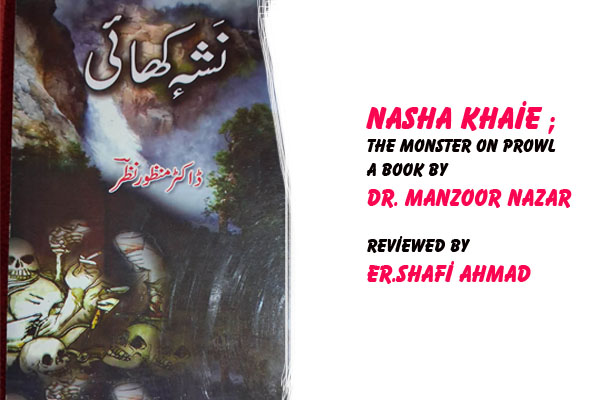
Put your ear to the whispers, your eyes to what is happening around you, and your fingers to the scratches left behind by a troubled society. You will discover one disturbing reality that has begun to rob life of its peace: the growing menace of drug addiction. The Drug monster is on prowl and its victims are all. It has silently entered our homes, streets, institutions, and, most painfully, the lives of our young.
Between the green meadows, snow-capped mountain peaks, bustling lanes, and crowded marketplaces, another reality is unfolding—one that is far removed from the romantic image of Kashmir as a paradise on earth. The serenity of the land is increasingly being threatened by substance abuse and the proliferation of dangerous drugs, with consequences that can be devastating for society at large and for the younger generation in particular. Although drug abuse has gradually begun to occupy space alongside political and social headlines, the response, despite numerous efforts, remains far from reassuring.
According to the Parliamentary Standing Committee on Social Justice and Empowerment, more than 13.5 lakh people in Jammu & Kashmir are addicted to drugs. Even more alarming is the fact that approximately 1.68 lakh of them are minors between the ages of 10 and 17.
Behind these numbers a human story is craving for a happy ending as it has put a family in distress and is threatening the life of a may be old , young or child.
Drug addiction, therefore, cannot be viewed merely as a social problem. It is a public-health emergency, a family tragedy, and, in many ways, a collective moral crisis.
Children in Kashmir are already growing up amid conflict, unemployment, uncertainty, and psychological trauma. To this burden has now been added the dark shadow of substance abuse. The vulnerability of children makes the situation particularly disturbing.
Of the estimated 1.68 lakh minors affected:
• Around 95,000 are reported to be addicted to opioids, including heroin and synthetic painkillers.
• Approximately 46,000 inhale industrial solvents such as glue, paint thinners, and nail-polish removers.
• The remaining numbers include children dependent on sedatives, cannabis, stimulants, and even veterinary medications such as Avilin.
Nasha Khaie: A Literary and Social Intervention
It is against this disturbing backdrop that Nasha Khaie, a comprehensive work by the noted writer and acclaimed clinical psychologist Dr. Manzoor Nazar, assumes particular significance.
At a time when society is fighting this menace on several fronts—through the administration, police, social reformers, religious scholars and leaders, health professionals, and writers—Dr. Manzoor Nazar has chosen another powerful instrument: the written word. His book is not merely an academic discussion of addiction; it is an attempt to understand the problem, explain its dimensions, and offer practical awareness to ordinary people.
Dr. Manzoor is presently associated with a reputed drug-addiction centre, and his professional experience lends authenticity and authority to his treatment of the subject. What makes the effort even more significant is the fact that he has written the book in Kashmiri, the mother tongue of the local population. This choice of language is important. A social problem that affects ordinary families must also be explained in a language that ordinary families can understand. By bringing the subject into Kashmiri, the author has attempted to take the discussion beyond specialists and institutions and into homes and communities.
The book has been introduced by experts in the field, including Dr. Muneeb Haroon, a practising expert in the USA, and Dr. Nazir Mushtaq, a former counsellor at the Drug De-Addiction Centre, Shehristan, Iran. Spread over 364 pages and divided into 38 sections, the book seeks to cover a wide range of issues associated with addiction. It examines the causes of drug dependence, different forms of substance abuse, their effects, treatment, prevention, and the social consequences of addiction. In this respect, the book has the potential to serve not merely as a reference work but also as a useful household guide for creating awareness.
In his foreword, Dr. Muneeb Haroon underlines the gravity of the situation, observing: “This problem has taken the shape of a pandemic, is now intricate and life-threatening, and we cannot ignore it or push it under the carpet.”
The observation captures the urgency of the subject. Addiction cannot be wished away, hidden from public discussion, or treated merely as a matter of personal failure. Dr. Haroon further emphasises that drug addiction is a disease like other ailments of the human body. The victim, therefore, requires understanding, treatment, and support rather than condemnation. Scolding, punishing, or socially isolating an addict may only deepen the problem. Compassion, professional intervention, and sustained family support are essential to recovery.
Medical Consultant Dr. Nazir Mushtaq, in his “First Impression”, reinforces the usefulness of the book. As he observes, being a student of psychiatric ailments himself, he can vouch for the book’s value as a guide for victims, their associates, relatives, acquaintances, and doctors. His suggestion that the book should find a place in every household is particularly significant. Awareness is perhaps the first line of defence against addiction, and such awareness must reach elders, young people, and children alike.
Understanding Addiction
The book begins with a fundamental question: “What is addiction?” The question may appear simple, but it opens the door to a complex subject involving history, culture, psychology, medicine, and human behaviour.
While explaining the historical dimension of substance use, the author observes that certain tribes and religious groups, at different points in history, encouraged or accepted the use of intoxicating substances. He refers to the traditional use of Bhang, Charas, wine, and other substances in different cultural settings. His purpose appears to be to demonstrate that the use of intoxicating substances is not a phenomenon of the modern age alone, although the scale, availability, and nature of the problem have changed dramatically in contemporary society.
The author then moves towards a discussion of different categories of drugs, including tobacco, opium, and Charas, explaining their harmful effects on the human body. He also discusses substances associated with sleep disorders and other psychological and physiological disturbances. Amphetamines and caffeine, among other substances, find a place in this discussion.
One of the strengths of the book appears to be its attempt to explain a complicated subject in relatively simple language. The author discusses the process of overcoming addiction and stresses the importance of caution during withdrawal. Abrupt or improperly managed withdrawal can produce severe symptoms, making professional supervision and appropriate treatment essential.
Hallucinogens and the Distortion of Perception
Another section deals with hallucinogenic substances—drugs capable of altering perception, thought processes, and a person’s sense of reality. The author discusses substances such as LSD, PCP, magic mushrooms, and ketamine.
He also traces the history of LSD and refers to its development in 1938 in the United States, including the use of the morning-glory plant in its extraction. The discussion illustrates how substances that may initially appear to have limited or specialised uses can eventually acquire a dangerous presence in society.
The author also addresses the treatment and rehabilitation of those affected by such substances. The emphasis appears to be on bringing the victim back towards a stable and healthy life rather than treating addiction merely as a moral failure.
The Hidden Danger of Prescription Drugs
Perhaps one of the more important aspects of the book is its discussion of prescription medicines.
We often assume that a substance prescribed by a doctor must necessarily be harmless. This assumption, however, can be misleading. Certain prescription medicines can themselves lead to dependence when used improperly, excessively, or for prolonged periods.
The author provides information about such medicines, including those used to induce sleep and relieve pain. He discusses their possible effects on the brain and body and points towards the dangers associated with prolonged or inappropriate use. Problems such as impaired mental processing, changes in blood pressure, visual disturbances, nausea, and other adverse effects may occur in certain circumstances. The discussion also points towards the more serious psychological consequences that substance dependence can sometimes produce.
This part of the book is particularly relevant in an age when medicines are increasingly accessible and self-medication has become common. What begins as legitimate medical treatment can, in some circumstances, gradually develop into dependence if proper precautions are not followed.
Kashmir: Paradise Under Threat
The author also turns his attention to Kashmir itself, its magnificent landscape, cultural inheritance, and valuable heritage. Yet beneath this beauty lies a disturbing social reality. The Valley, known across the world for its natural splendour, is confronting a crisis that threatens to undermine the well-being of its people.
The central purpose of the book, however, is not merely to describe the problem. It is to explore ways and means of confronting it. The author discusses various initiatives and possible interventions at different levels and emphasises the need for a coordinated response. Government institutions, medical professionals, families, educational institutions, religious leaders, social organisations, and the wider community all have roles to play.
Drug abuse cannot be defeated by one institution alone. It requires a collective response in which prevention, treatment, rehabilitation, awareness, and social support work together.
The Human Stories Behind the Statistics
One of the most poignant sections of the book is devoted to the personal stories of victims. These accounts transform statistics into human experiences. They are tragic, painful, and deeply moving. Out of a dozen stories one is reproduced here. This dates back to 2013 .In our rehabilitation centre a middle aged man who looked poor from his face . He was an auto driver by profession and girl in twenties accompanied him. The girl was drug user but wanted to leave the practice. The girl was admitted after lot of persuasion from the meagre women staff available. The girl narrated her story as under,” We were a group of five and in class 7th we got addicted to smoking. I used to bring the various material in the lunch box and distributed among all. One day I brought something new and attractive ;some powder and aluminium foil .As days passed we got addicted to the new substance but one day the supplier , a boy, declined to provide the stuff. The boy demanded around three thousand each or be prepared to roam about with wealthy men ……………………………..”
These narratives, therefore, serve an important literary and social purpose. They awaken empathy where condemnation might otherwise prevail. They remind the reader that the addict is not merely a statistic or a social nuisance but a human being caught in a complex web of circumstances, choices, vulnerability, and dependence.
A Note of Hope
Despite the darkness surrounding its subject, Nasha Khaie does not end in despair. The author concludes with a chapter on ways and means of recovery for the victims. One such attempt is what is locally called as Hal Shree or self help. He records a localized story of two people having lost way in the woods and in the process meet each other . they subsequently decide one direction to follow . Luckily their decision proves right and with sun light just beaming up they are able to come out. The learned doctor places the story as self help and is needed for patients on relapse mode.
Nasha Khaie is therefore more than a book about drugs. It is a warning, an appeal, and an attempt to awaken collective consciousness. Its greatest strength lies in bringing a complex and frightening subject into the language of the people who are most directly affected by it.
The battle against addiction will not be won through condemnation alone. Nor can it be won by the police or administration acting in isolation. It requires the combined strength of families, educators, doctors, counsellors, religious and community leaders, social workers, writers, and, above all, a society willing to recognise addiction as a human and public-health crisis.
Note: The number of drug users vary from source to source ,as such, an average has been used in the write up.
ABOUT THE REVIEWER
The writer is President Fiction Writers’ Guild and can be reached at wanishafi999@gmail.com